
Bydureon vs Victoza: Which GLP-1 Injection Fits Your Routine?

Written by Sarah Whitfield, Health Content Writer | Medically Reviewed by Dr. Melissa Grant, PharmD
Last Updated: August 2026
Bydureon and Victoza are both GLP-1 receptor agonists prescribed for adults managing type 2 diabetes, but they differ in how often they are taken, how quickly they act, and how consistently they lower blood sugar over time. Victoza is a daily injection that tends to produce steadier results and slightly more weight reduction, while Bydureon offers the convenience of a single weekly dose with a slower, more gradual onset. The right choice usually depends on whether someone values simplicity of routine or wants the option that has historically shown stronger glucose control.
Key Takeaways
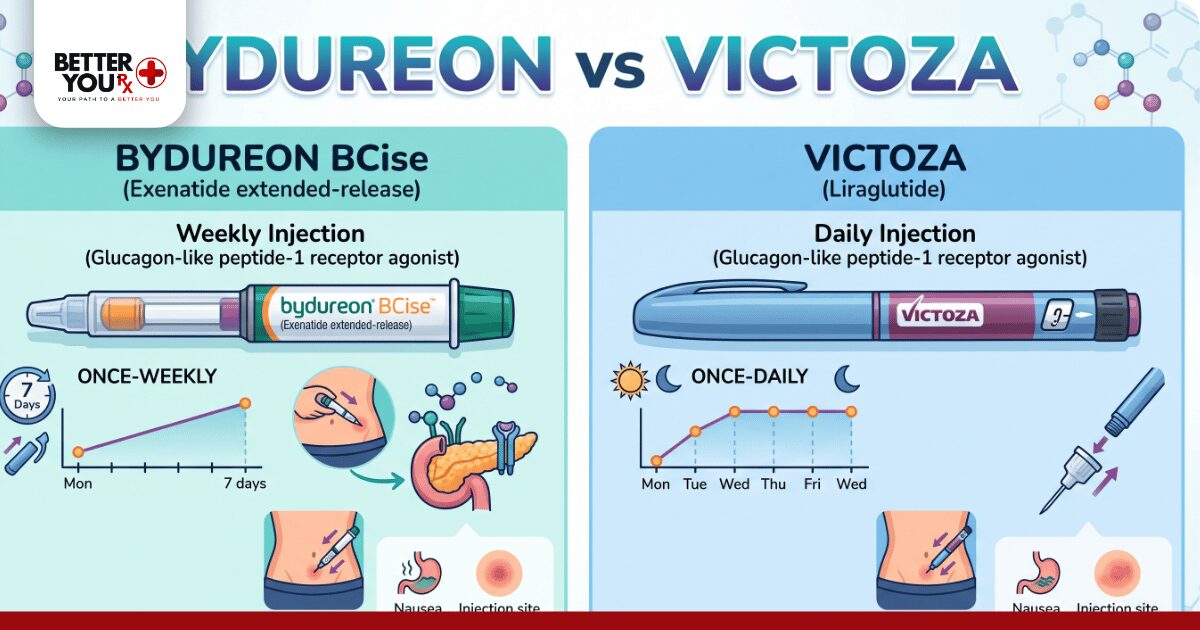
- Bydureon (Exenatide extended-release) is a once-weekly injection, while Victoza (Liraglutide) is a once-daily injection, making dosing frequency the biggest practical difference between the two
- Both medications belong to the GLP-1 receptor agonist class and are approved to help manage blood sugar in adults with type 2 diabetes
- In head-to-head comparisons, Victoza has generally shown a stronger effect on blood sugar reduction and modest weight loss compared to Bydureon
- Nausea and other digestive side effects tend to appear early with Victoza and taper off, while Bydureon’s side effects can persist longer due to its extended-release design
- Choosing between the two often comes down to how someone prioritizes dosing convenience against symptom tolerance and glucose control goals
What Bydureon and Victoza Actually Are
Bydureon and Victoza sit in the same drug class, GLP-1 receptor agonists, but they are built on different molecules. Bydureon’s active ingredient is Exenatide, formulated as an extended-release suspension. Victoza’s active ingredient is Liraglutide, a compound that also forms the basis of the weight management medication Saxenda.
Both drugs mimic a natural gut hormone called glucagon-like peptide-1, which helps the pancreas release insulin when blood sugar rises, slows how quickly food leaves the stomach, and reduces appetite. The overlap in mechanism is part of why so many patients ask about Bydureon vs Victoza when a provider first suggests a GLP-1 medication, since the class-level effects sound similar even though the day-to-day experience of using each drug can feel quite different.
Bydureon vs Victoza: How the Dosing Schedules Compare
The most immediate difference patients notice in the Bydureon vs Victoza comparison is how often each medication is used. Victoza requires a daily injection, typically at a similar time each day, while Bydureon is designed to be injected once a week. This scheduling gap changes how each drug behaves in the bloodstream and how quickly a person feels its effects.
Because Victoza is dosed daily, blood levels of the medication stay more consistent from day to day. Bydureon’s extended-release formulation means the medication is released gradually over several days, so it can take a number of weeks before it reaches a steady effect in the body.
| Feature | Bydureon (Exenatide ER) | Victoza (Liraglutide) |
|---|---|---|
| Dosing frequency | Once weekly | Once daily |
| Time to steady effect | Several weeks | About one to two weeks |
| Typical A1C reduction | Moderate | Moderate to strong |
| Average weight change | Modest | Modest to moderate |
| Common early side effect | Nausea, injection site reaction | Nausea, decreased appetite |
Things To Know
- Neither Bydureon nor Victoza is approved as a first-line treatment for type 1 diabetes or for managing diabetic ketoacidosis
- Both medications are typically added to a treatment plan that already includes lifestyle changes such as diet and activity adjustments
- Switching between a weekly and a daily GLP-1 medication should only be done under a licensed provider’s guidance, since the transition can affect blood sugar stability
- People who struggle with remembering daily routines sometimes prefer the once-weekly option, while others like the flexibility of adjusting a daily dose based on how they feel
How Bydureon and Victoza Work in the Body
Even though Bydureon and Victoza both activate GLP-1 receptors, the way each drug is metabolized shapes the overall experience. Exenatide, the compound in Bydureon, is cleared from the body relatively quickly on its own, which is why the extended-release version relies on a special delivery system to stretch its effect across a full week. Liraglutide, the compound in Victoza, has a longer natural half-life, which is part of why a single daily dose can maintain fairly steady blood levels.
This difference matters clinically. A provider weighing Bydureon vs Victoza for a specific patient often considers how quickly blood sugar needs to come down against how much day-to-day fluctuation the person can tolerate. Some patients say the steadier daily rhythm of Victoza helps them notice appetite and glucose patterns more predictably, while others prefer how the once-weekly Bydureon dose fits into a busy schedule.
Healthcare providers who prescribe either medication generally follow established clinical protocols for titration and monitoring, adjusting the plan based on lab results and tolerance over the first several weeks.
According to the Cleveland Clinic, GLP-1 receptor agonists as a class are primarily used to improve blood sugar control in type 2 diabetes and, in certain formulations, to support weight management.

Weight Loss and Blood Sugar Results: What to Expect
Weight change is often a secondary benefit rather than the primary goal for people using Bydureon or Victoza, since both were developed mainly for glucose management. That said, appetite suppression from GLP-1 activation frequently leads to some degree of weight reduction.
In practical terms, patients using Victoza generally report slightly more consistent weight loss than those using Bydureon, though results vary based on diet, activity level, and how long someone stays on the medication. Neither drug produces the more pronounced weight loss associated with newer options like Zepbound or Wegovy, which work through different or dual-hormone mechanisms.
| Category | Bydureon | Victoza |
|---|---|---|
| Primary use | Type 2 diabetes management | Type 2 diabetes management |
| Weight loss potential | Modest | Modest to moderate |
| Injection frequency | Weekly | Daily |
| Onset of noticeable effect | Gradual, several weeks | Faster, within days to two weeks |
| Related medication in same family | Trulicity (Dulaglutide) | Saxenda (Liraglutide, higher dose) |
For people specifically comparing GLP-1 options for weight-focused goals rather than diabetes management, it may help to look at how Saxenda compares to Zepbound in this Saxenda vs Zepbound breakdown, or how Wegovy stacks up against Saxenda in this Wegovy vs Saxenda for weight loss comparison, since those pages focus more directly on weight outcomes than Bydureon or Victoza do.
Side Effects and Tolerability Differences
Digestive side effects are the most common complaint with both medications, and this is one of the more practical points people weigh when comparing Bydureon and Victoza. Nausea, mild stomach discomfort, and occasional vomiting tend to show up early with both drugs and typically settle down as the body adjusts.
Victoza’s daily dosing means side effects, when they occur, tend to appear and fade within a shorter window since the drug is cleared and reintroduced every day. Bydureon’s weekly, extended-release nature means side effects can linger longer, simply because the medication keeps releasing into the bloodstream over several days. Injection site reactions, including small lumps or redness, are also reported somewhat more often with Bydureon.
Providers typically start patients at a lower dose and increase it gradually, a standard approach with most GLP-1 medications that helps the digestive system adjust over time rather than all at once.
Things To Know
- Report persistent vomiting, severe abdominal pain, or signs of an allergic reaction to a healthcare provider right away
- People with a personal or family history of certain thyroid conditions are typically screened before starting either medication
- Mild injection site bumps with Bydureon usually resolve on their own within a few weeks
- Staying hydrated and eating smaller, more frequent meals can help ease nausea during the first few weeks on either drug
Which One Might Be the Better Fit
The honest answer to the Bydureon versus Victoza question depends on what a person values most in a treatment plan. Victoza tends to be the better fit for someone who wants steadier day-to-day control, is comfortable with a daily routine, and is looking for a medication with a somewhat stronger track record on both blood sugar and modest weight loss. Bydureon tends to suit someone who prioritizes convenience above all else, particularly those who travel frequently, have a demanding schedule, or simply find a once-weekly commitment easier to sustain than a daily one.
Why one option outperforms the other for a given patient usually comes down to individual metabolism, how consistently they manage a daily versus weekly routine, and how their body responds during the first month of use. A provider typically weighs recent lab work, current medications, and any history of digestive sensitivity before recommending one over the other, since the right medication is ultimately a shared decision between patient and provider rather than a one-size-fits-all answer.
Patients who have used both medications describe a familiar pattern: the daily habit of Victoza becomes routine within a few weeks, while the weekly Bydureon dose often needs a reminder, like a phone alarm, to avoid missing a week. Neither pattern is inherently better, but recognizing which one fits a personal routine tends to predict long-term consistency more than the clinical profile alone.
For people who are also managing insulin alongside a GLP-1 medication, understanding how the two drug classes interact is worth discussing with a provider, since options like Humalog or Humulin N are sometimes used in combination with GLP-1 therapy depending on individual blood sugar targets. Some patients on a GLP-1 already managing cholesterol or blood pressure alongside diabetes also ask their provider about Crestor as part of a broader treatment plan.
Buy Wegovy from Canada
Original price was: $609.99.$596.99Current price is: $596.99.


Better You Rx works as a prescription referral service connected to a licensed contracted dispensing department, helping patients in the United States access a valid prescription pathway for medications like Bydureon and Victoza once a licensed provider has determined the medication is appropriate. The overall cost of either medication can vary depending on dosage strength and quantity prescribed, which is one of the practical factors patients often discuss with their provider before starting treatment.
People newly diagnosed with type 2 diabetes sometimes also compare GLP-1 options against other diabetes medications entirely. For a broader look at how these drug classes differ, the is Trulicity a GLP-1 breakdown walks through how Dulaglutide fits into the same family as Bydureon and Victoza, while the Mounjaro vs Trulicity comparison covers how a dual-mechanism option stacks up against a traditional single-hormone GLP-1 drug.
The Bottom Line on Bydureon and Victoza
Bydureon vs Victoza ultimately isn’t a question of one drug being universally superior. It’s a question of which weekly or daily rhythm fits a patient’s life, how their body tolerates early digestive side effects, and what their blood sugar goals look like over the following months. Victoza generally edges ahead on consistency and modest weight loss, while Bydureon wins on simplicity and reduced injection frequency.
Anyone weighing these two options should bring specific questions about dosing, side effects, and long-term goals to a licensed healthcare provider, since only a provider can evaluate personal health history and determine which medication, if either, is the appropriate next step.
Frequently Asked Questions
Do most people lose weight on Victoza?
Many people experience modest weight loss on Victoza, though it was primarily developed for blood sugar management rather than weight loss. Results vary based on dosage, diet, and activity level.
What is the difference between Victoza and insulin?
Victoza and insulin work through completely different mechanisms. Victoza stimulates the body’s own insulin release when blood sugar is elevated, while insulin directly replaces or supplements the hormone itself.
Which is more effective, GLP-1 or Semaglutide?
Semaglutide is itself a type of GLP-1 medication, so this isn’t an either-or comparison. Semaglutide-based options like Ozempic and Rybelsus are considered among the stronger performers in the GLP-1 class.
Are they discontinuing Liraglutide?
Liraglutide-based products like Victoza remain available through standard prescription channels as of this writing. Availability can shift as newer GLP-1 options enter the market, so confirm current status with a provider.
What is the cheapest GLP-1 drug I can buy without coverage?
Costs vary widely by medication, dosage, and where a prescription is filled, so there is no single cheapest option. Older GLP-1 medications like Bydureon sometimes cost less out of pocket than newer branded options.
Sources
- Cleveland Clinic: Overview of GLP-1 receptor agonists, how they work, and their approved uses in diabetes and weight management.
- Mayo Clinic: Patient education resource on type 2 diabetes treatment options, including injectable GLP-1 therapies.
- American Diabetes Association: Standards of care guidance on pharmacologic treatment approaches for type 2 diabetes.
- Journal of Clinical Endocrinology and Metabolism: Comparative research on GLP-1 receptor agonist efficacy and tolerability profiles.
- Diabetes Care: Published research on weight and glycemic outcomes associated with once-weekly versus once-daily GLP-1 therapy.
This article is for informational purposes only and is not a substitute for professional medical advice, diagnosis, or treatment. Always consult a licensed healthcare provider before starting, stopping, or changing any medication or treatment plan.