

Written by Maria Santos, BSc Health Communications | Medically Reviewed by Dr. Aleksandar Petrov, MD | Updated: July 2026
Last Updated: July 13, 2026
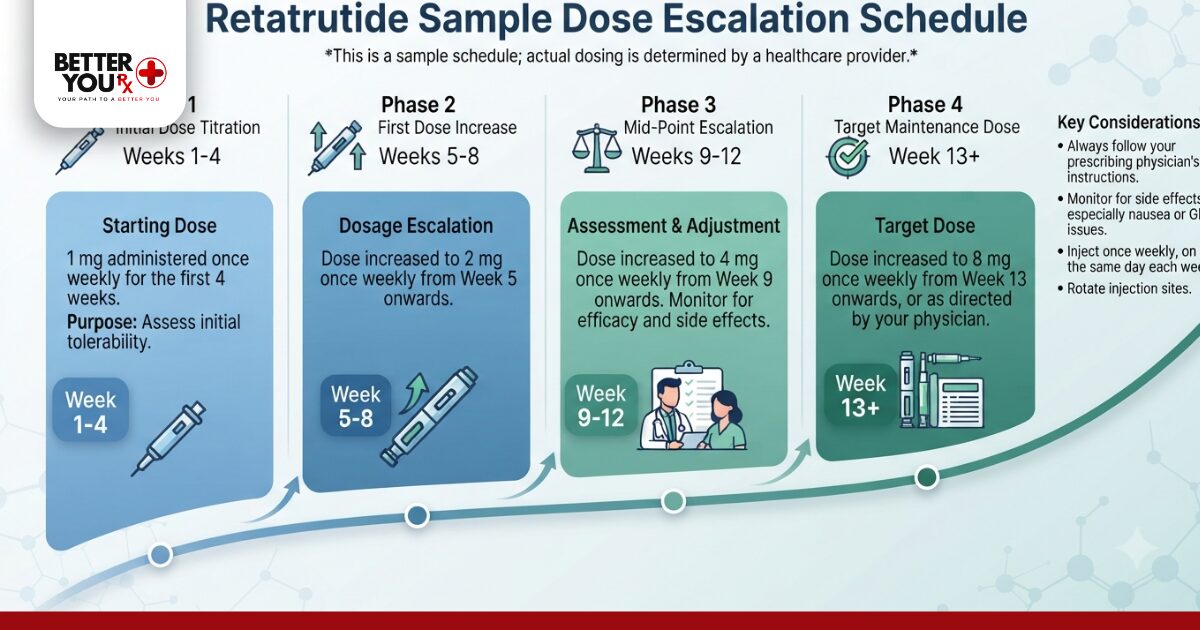
A Retatrutide dose escalation schedule describes the general process a provider uses to move a patient through treatment stages gradually, rather than starting at a full amount immediately. Because Retatrutide is still an investigational compound, the specific pacing of any Retatrutide dose escalation schedule is set individually by a licensed provider, not by a standardized chart circulating online.
Patients researching this topic are often trying to understand what the process looks like before they ever speak with a provider, and that curiosity is reasonable. What is worth knowing upfront is that the actual pacing depends heavily on how an individual patient responds during the earliest stages, which is something no generic schedule can predict in advance.
Key Takeaways
- A Retatrutide dose escalation schedule is a provider-directed process, not a fixed calendar that applies the same way to every patient.
- Retatrutide remains an investigational compound, so any Retatrutide dose escalation schedule found online should be treated as general background reading rather than a prescribing instruction.
- Escalation generally moves in stages, with a provider confirming tolerance before considering the next step.
- Moving too quickly through a Retatrutide dose escalation schedule is discouraged, since gradual pacing is part of how side effects are managed.
- Anyone considering treatment should speak with a licensed healthcare provider before making assumptions based on a schedule found outside a clinical relationship.
What Does Dose Escalation Actually Mean?
Dose escalation refers to the gradual, stepwise process of increasing a treatment amount over time rather than beginning at a target level immediately. This approach is common across many metabolic and weight-related treatments, since it allows the body time to adjust and gives a provider the chance to observe tolerance before moving forward.
A Retatrutide dose escalation schedule, in this context, is not a countdown toward a single end point. It is closer to an ongoing conversation between patient and provider, where each stage informs the next. Because Retatrutide has not completed the full regulatory review process required for standard prescribing pathways in the United States, formal escalation protocols are still being refined through structured research settings rather than finalized as a public standard.
Why a Retatrutide Dose Escalation Schedule Is Set by a Provider
The appeal of a printable schedule is understandable, since it feels predictable. However, a responsible Retatrutide dose escalation schedule is shaped around the person receiving treatment, not the other way around.
Providers typically consider several things before approving the next stage of escalation, including whether side effects appeared during the prior stage, current body weight, kidney and liver function, and any other medications a patient is taking. Two patients starting at the same time can end up on noticeably different paces, even though both are technically following a Retatrutide dose escalation schedule guided by their own care team.
It is common, for example, for a patient reporting nausea or digestive discomfort early on to remain at that stage longer before any further increase is considered. Providers see this kind of adjustment regularly across metabolic treatment plans, and it reflects routine clinical judgment rather than a rigid rule.
Things To Know
- A Retatrutide dose escalation schedule is individualized and should not be assumed to apply uniformly to every patient.
- Escalation is generally slow and stepwise, prioritizing tolerance over speed.
- Any schedule found outside a clinical relationship should be treated as general education only.
- Side effects and patient feedback directly influence how a provider paces each stage.
- Most healthcare providers follow established clinical protocols and safety monitoring practices when overseeing escalation, adjusting only after reviewing how the prior stage was tolerated.
General Framework Behind a Retatrutide Dose Escalation Schedule
While the specific pacing is set by a provider, the general structure of a Retatrutide dose escalation schedule tends to follow a recognizable pattern seen across many phased metabolic treatments. The table below outlines this framework in general terms, without prescribing specific amounts.
| Stage | General Purpose | Typical Focus |
| Starting Stage | Allow initial adjustment | Monitoring for early side effects |
| Review Stage | Confirm tolerance of the prior stage | Evaluating symptoms and patient feedback |
| Escalation Stage | Gradual movement toward a treatment goal | Provider-guided pacing based on response |
| Stabilization Stage | Maintain a steady, provider-confirmed level | Continued monitoring and periodic check-ins |
This structure shows why a Retatrutide dose escalation schedule is better understood as an evolving process rather than a fixed set of numbers applied the same way to everyone. The pacing between stages is the variable that changes most from patient to patient.
-
-
Buy Wegovy from Canada
Original price was: $609.99.$596.99Current price is: $596.99.



What Influences the Pace of Escalation
Several factors shape how quickly a provider moves a patient forward through a Retatrutide dose escalation schedule. Recognizing these factors explains why identical starting points often lead to different outcomes over time.
| Factor | Why It Matters |
| Tolerance during prior stage | Side effects often mean a provider extends the current stage |
| Health history | Kidney, liver, or digestive conditions can change the pace of escalation |
| Concurrent medications | Interactions must be reviewed before advancing |
| Treatment goals | Providers may pace escalation differently depending on the overall goal |
| Ongoing patient feedback | Symptom reporting directly shapes the next step |
Patients often describe the earliest stages as the period that matters most, since this is when a provider gathers the information needed to shape the rest of the plan. This pattern holds true across many phased treatment types, not only this one compound, and reflects how gradual dose adjustment is generally approached in clinical practice.
What Happens If Escalation Moves Too Quickly?
Moving through a Retatrutide dose escalation schedule faster than recommended is generally discouraged, since the gradual pacing exists specifically to reduce the likelihood of side effects. Patients who attempt to skip stages or increase amounts independently may experience more pronounced digestive discomfort or other reactions than those who follow a provider-guided pace.
This is one of the more consistent observations providers report across phased metabolic treatments: patience during the earlier stages tends to produce a smoother overall experience. Any perceived shortcut through a Retatrutide dose escalation schedule is not something supported by standard clinical practice.
For patients weighing their options, comparing established treatments such as Mounjaro or Zepbound can offer useful context, since both follow a similar philosophy of gradual, provider-guided pacing rather than an immediate jump to a target level.
Why Gradual Escalation Matters for Safety
The rationale behind any phased approach to treatment comes down to how the body adapts over time. Introducing a new compound gradually gives a provider the opportunity to watch for early warning signs before they become more significant, and it gives the patient’s system time to adjust without being overwhelmed all at once.
This is a pattern seen consistently across many metabolic and weight-related treatments, not just compounds still in the investigational stage. Gastrointestinal symptoms such as nausea, bloating, or changes in appetite tend to be the most commonly reported effects during early stages of gradual treatment adjustment, and providers generally expect some of this during the initial phase. What matters clinically is whether those symptoms are mild and manageable or significant enough to warrant slowing the pace further.
Patients sometimes describe feeling eager to reach a target level quickly, particularly if they have researched the topic extensively and feel confident about the process. Providers routinely explain that this instinct, while understandable, works against the purpose of a gradual approach. The stages exist specifically to reduce risk, not to delay results unnecessarily, and rushing through them removes the safety margin the process is designed to provide.
 How Patients Can Prepare for a Conversation About Escalation
 How Patients Can Prepare for a Conversation About Escalation
Patients who want to make the most of an appointment focused on treatment planning often benefit from tracking a few details beforehand. Keeping a simple log of any symptoms, energy levels, appetite changes, or concerns during the early weeks gives a provider concrete information to work with, rather than a general impression formed after the fact.
Bringing a current list of medications and any recent lab work to a consultation also helps a provider assess how a phased plan might interact with a patient’s broader health picture. This kind of preparation does not replace clinical judgment, but it does make the conversation more productive and can help a provider determine pacing more efficiently.
It is also worth asking directly what signs would prompt a pause or adjustment, since this varies by individual circumstance. A provider who understands a patient’s full history is in the best position to explain what to expect and what would count as a reason to slow down or reassess.
Final Thoughts
A Retatrutide dose escalation schedule is best understood as a flexible, provider-guided process rather than a fixed timeline anyone can follow independently. The pacing, the stages, and the decision to move forward all depend on an individualized clinical assessment that accounts for tolerance, health history, and ongoing feedback. Patients who approach the topic this way tend to have more realistic expectations heading into a conversation with their provider.
Anyone comparing options while Retatrutide continues through further research can review established treatments through resources like Wegovy or Ozempic, and explore broader context through guides such as Retatrutide side effects or Retatrutide vs tirzepatide. A Retatrutide dose escalation schedule works best as a starting point for that conversation, not a replacement for it.
Frequently Asked Questions
What is a Retatrutide dose escalation schedule?
A gradual, provider-guided process. A Retatrutide dose escalation schedule refers to the stepwise way a provider increases treatment over time, rather than a single fixed timeline that applies to every patient.
How is a dose escalation schedule different from a fixed dosing chart?
It adjusts based on response. Unlike a fixed chart, a Retatrutide dose escalation schedule changes pace depending on tolerance, side effects, and provider review at each stage.
What happens if someone escalates too quickly?
Side effects become more likely. Moving faster than recommended can increase digestive discomfort and other reactions, which is why gradual pacing is standard practice.
Who decides when to move to the next stage?
The licensed provider, not the patient. Advancing to the next stage of a Retatrutide dose escalation schedule depends on a provider’s review of tolerance and safety, not a fixed calendar date.
Can a dose escalation schedule change mid-treatment?
Yes, based on ongoing response. A Retatrutide dose escalation schedule can be adjusted at any point if a provider identifies side effects, health changes, or other factors that warrant a different pace.
Sources
- National Institutes of Health, National Library of Medicine, ClinicalTrials.gov – Registry entries and study protocols for triple agonist metabolic compounds under investigation.
- The New England Journal of Medicine – Peer reviewed clinical trial data on multi-receptor agonist compounds and metabolic outcomes.
- Mayo Clinic – General patient education on phased dosing approaches for metabolic and weight management treatments.
- Cleveland Clinic – Overview of how healthcare providers assess and monitor gradual treatment adjustments.
- American Diabetes Association – Clinical guidance on metabolic treatment monitoring and patient safety considerations.
Medical Disclaimer
This content is provided for general informational and educational purposes only and does not constitute medical advice. It is not a substitute for professional consultation, diagnosis, or treatment from a licensed healthcare provider. Retatrutide referenced in this article is discussed in its current investigational context. Readers should consult a licensed healthcare provider before starting, stopping, or adjusting any treatment plan.