
Written by Sarah Mitchell, Health and Wellness Writer | Medically Reviewed by Dr. Amanda Reyes, MD | Last Updated: August 2026 | Updated: September 2026
Last Updated: September 28, 2026
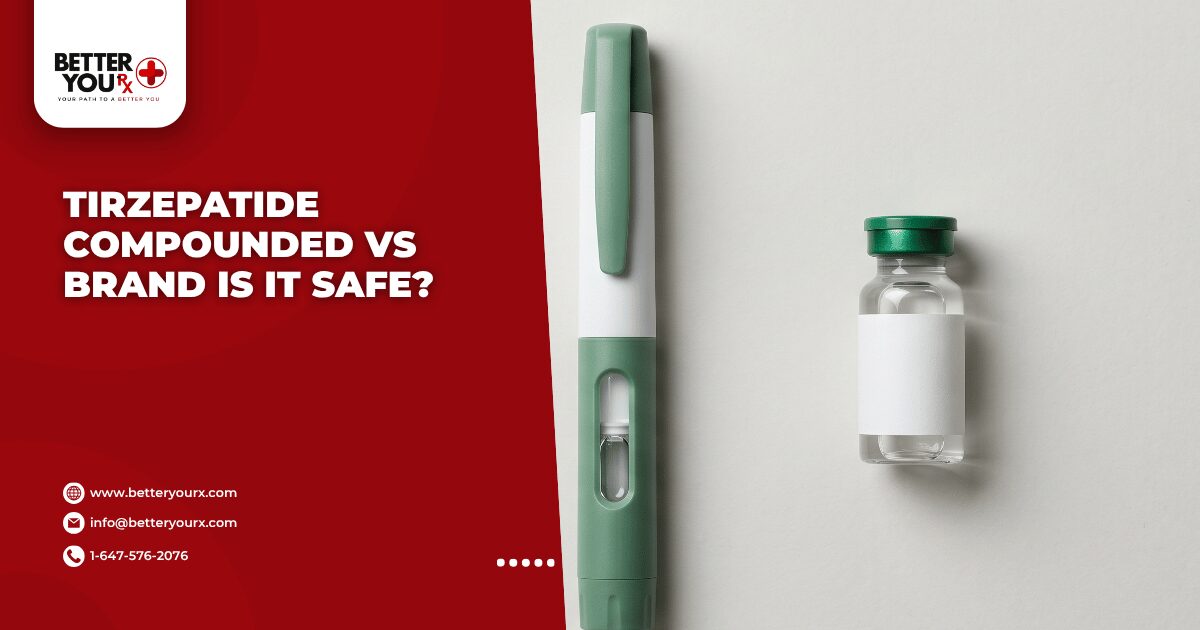
Brand-name Tirzepatide is the safer and more predictable option for most adults, while compounded Tirzepatide carries added uncertainty around strength, purity, and labeling that depends entirely on who prepares it. Zepbound and Mounjaro come from standardized manufacturing with fixed doses, whereas compounded products are custom preparations that can differ from one batch and one provider to the next.
Tirzepatide compounded vs brand is it safe is one of the most common questions patients ask once they notice the price gap between the two. Safety is not only about the molecule. It is about the finished product in your hands, the doctor supervising you, and how the medication is stored and shipped. For most patients, brand-name Tirzepatide paired with regular follow-up is the best-supported route, and compounded options deserve extra questions before a first dose.
Key Takeaways
- Brand-name Tirzepatide (Zepbound and Mounjaro) offers fixed doses, batch testing, and a long safety record, which makes it the better-supported choice for most adults.
- Compounded Tirzepatide is a custom preparation, so strength, purity, and labeling depend on the facility that makes it.
- The biggest compounded risks are dose errors, inconsistent ingredient forms, and limited safety data on the exact formulation.
- Compounded versions may make sense only in narrow cases, such as a documented reaction to an inactive ingredient, and only under a physician’s oversight.
- Either option requires a valid English prescription from a US-licensed doctor when ordered through a prescription referral service.
Tirzepatide Compounded vs Brand Is It Safe? What Really Separates Them
The active ingredient sounds identical on paper, which is why the comparison confuses so many people. Tirzepatide is a once-weekly medication that activates both GIP and GLP-1 receptors to regulate appetite and blood sugar. Zepbound is the brand used for weight management, and Mounjaro is the brand used for type 2 diabetes.
The difference lies in everything that happens after the ingredient is chosen. A brand product is a finished, standardized medication with the same strength in every pen. A compounded product is a preparation built to a prescriber’s order, and no two facilities work in exactly the same way. The answer therefore depends less on the molecule and more on the manufacturing chain behind it.
How Brand-Name Tirzepatide Is Made and Tested
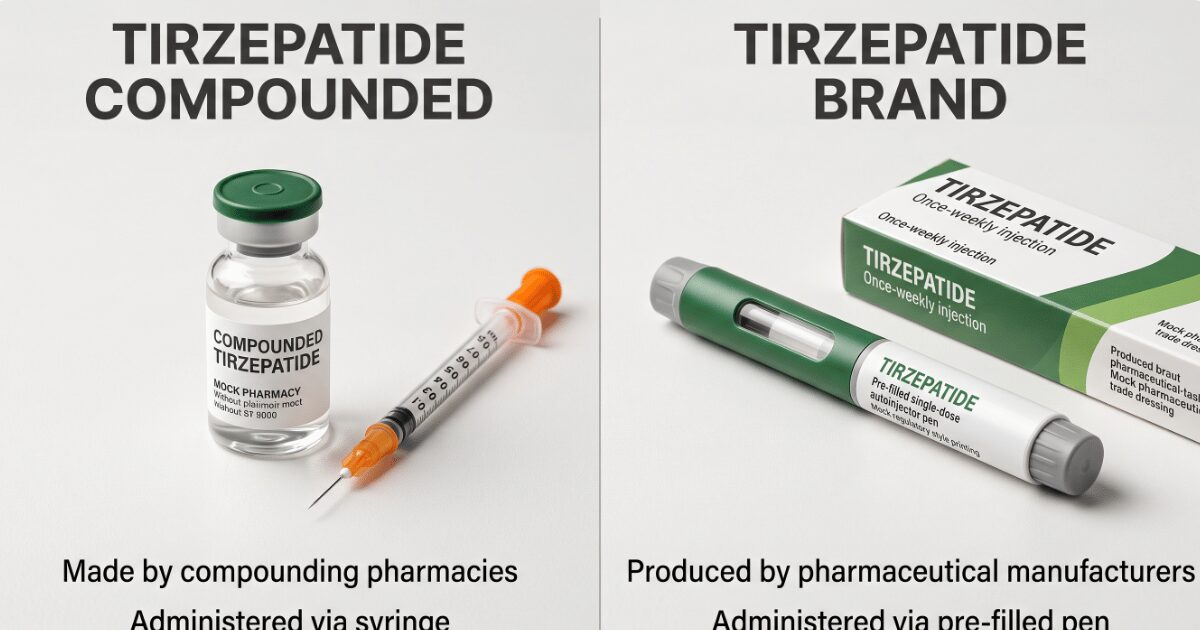
Brand-name Tirzepatide arrives as a pre-filled pen in fixed strengths. Treatment usually begins at 2.5 mg weekly and rises in steps of 2.5 mg toward a maintenance dose, with a ceiling of 15 mg. Because every pen holds the same concentration, a patient and doctor can predict what each step means.
Each batch goes through potency, purity, and sterility testing before release, and the packaging carries lot tracking. Years of clinical use also mean prescribers know what to expect at each dose, from mild nausea early on to less common concerns such as gallbladder problems. Cleveland Clinic’s medication overview for Tirzepatide is a readable outside reference on who should speak with a doctor first and which warning signs matter.
Why does this matter? Predictability. When a weekly dose is off by even a small margin, the result can be a rough week of vomiting or a stalled plateau. Fixed pens remove that guesswork.
What Compounded Tirzepatide Actually Means
Compounding is the practice of preparing a medication to a specific prescriber’s order. It exists for good reasons, such as removing an ingredient a patient reacts to. Compounded Tirzepatide, however, is usually supplied as a vial of liquid rather than a pen, and the formula can differ from the brand in meaningful ways.
Some preparations use a salt form of the ingredient instead of the exact molecule found in the brand. Others add extras such as vitamin B12 or glycine. Concentrations also vary from one facility to another, so a labeled amount on one vial may not mean the same volume as on another. None of this makes every compounded product unsafe. It means each one must be judged on its own, because the finished preparation does not go through the same testing as a brand-name medication.
A licensed, well-run compounding facility follows strict quality standards and tests its products. A poorly run one, or an online seller that skips those steps, does not. That gap is the heart of the Tirzepatide compounded vs brand is it safe debate.
Compounded vs Brand at a Glance
A quick comparison makes the trade-offs easier to see.
| Factor | Brand-Name Tirzepatide | Compounded Tirzepatide |
|---|---|---|
| Product form | Pre-filled pen | Usually a multi-dose vial |
| Dose strengths | Fixed, from 2.5 mg to 15 mg | Set by the facility and can vary |
| Ingredient form | Single standardized formulation | May use salt forms or added ingredients |
| Batch testing | Potency, purity, and sterility on every batch | Depends on the facility |
| Labeling | Uniform, with full patient information | Varies by facility |
| Dose measurement | Built into the pen | Left to the patient |
| Safety data | Extensive clinical and real-world experience | Limited data on the exact formulation |
| Best fit | Most adults | Rare, physician-directed cases |
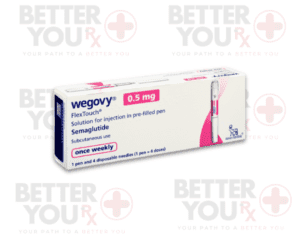
Buy Wegovy from Canada
Original price was: $609.99.$596.99Current price is: $596.99.
Where the Safety Gaps Actually Show Up
Dose accuracy is the first gap. A pen delivers the same amount every time, while a vial places measurement in the patient’s hands, and small errors compound over weeks. Providers who follow patients through dose changes often report that confusion after switching formats is the most common source of trouble, especially when a patient assumes a 5 mg pen and a 5 mg vial line up neatly.
Ingredient quality is the second gap. Without batch-level testing on the finished product, a patient cannot be sure the strength matches the label or that unwanted substances are absent. Sterility is the third. Injectable medications must be free of contamination, and storage during shipping matters as much as preparation.
The fourth gap is the seller. Online listings that offer Tirzepatide without a valid prescription, or that ship from unclear sources, carry the highest risk of counterfeit or mislabeled product. The answer to Tirzepatide compounded vs brand is it safe changes sharply with the source, and patients who report problems most often describe an unverified seller rather than a well-run facility.
Most healthcare providers follow established clinical protocols when prescribing Tirzepatide, and those protocols assume a known strength, a known formulation, and regular follow-up. Compounded products can meet that standard only when the facility, the prescriber, and the patient stay in close contact.
Things To Know
- Tirzepatide is prescribed for adults alongside diet and activity changes, not as a stand-alone shortcut.
- Brand strengths are fixed, so switching between brand and compounded products should never be done by matching numbers on your own.
- A personal or family history of certain thyroid tumors is a reason to speak with a doctor before using any Tirzepatide product.
- Common early effects include nausea, diarrhea, and reduced appetite, and they often ease as the body adjusts.
- Store the medication exactly as labeled and never share a pen or vial with another person.
- Severe stomach pain, persistent vomiting, or trouble swallowing should be reported to a doctor promptly.

Which Option Is the Best Choice?
Brand-name Tirzepatide is the best option for most patients. The reasoning is straightforward: fixed doses reduce errors, batch testing protects purity, and the safety record covers the exact product being used. Compounded Tirzepatide belongs in a narrower lane.
| Patient Situation | Better Fit | Why |
|---|---|---|
| Adult with type 2 diabetes | Mounjaro | Fixed doses and a documented track record for blood sugar control |
| Adult seeking weight management | Zepbound | Standardized step-up schedule a doctor can adjust with confidence |
| Reaction to an inactive ingredient in the brand | Compounded, physician-directed | Customization is the purpose of compounding, and the prescriber should verify the facility |
| Needs a strength the pen does not offer | Compounded, case by case | Only with clear written dosing and close monitoring |
| Currently on compounded and considering a switch | Talk to the prescriber first | Starting doses may need to be reset rather than matched |
| Personal or family history of certain thyroid tumors | Neither until reviewed | A doctor must weigh the risk before any Tirzepatide product |
Tirzepatide compounded vs brand is it safe for your situation? Ask three questions. Who prepares it? What testing is done on the finished product? Who monitors you if something feels wrong? If any answer is vague, the safer path is the brand product.
How a Prescription Referral Service Fits In
Better You Rx is a prescription referral service with a licensed contracted dispensing department. It does not replace your doctor. A prescription must be written in English by a primary care physician or licensed medical doctor practicing within the United States, and orders are for personal use only. Medication is mailed directly to the patient’s residence within the USA, never to a doctor’s office, clinic, or hospital.
Patients often find this structure reassuring, because the same steps that protect them, a real prescription, a traceable source, and delivery to their own address, also reduce the risk of counterfeit products. Anyone weighing Tirzepatide compounded vs brand is it safe should bring the prescriber into the conversation before ordering and ask which product is being prescribed by name.
Final Thoughts on Choosing Between Brand and Compounded Tirzepatide
Tirzepatide compounded vs brand is it safe? For most adults, the brand route wins on predictability, testing, and clinical experience, while compounded products call for extra scrutiny of the facility and the prescriber. The safest move is to keep your doctor involved, verify the source, and never adjust doses by guesswork. Better You Rx supports that path as a prescription referral service with a licensed contracted dispensing department.
Adults who want the brand options can look at Mounjaro KwikPen, Zepbound KwikPen, or the Semaglutide-based Wegovy for comparison. For deeper side-by-side reading, see Retatrutide vs Tirzepatide, Saxenda vs Zepbound, and Mounjaro vs Trulicity.
Frequently Asked Questions
Is compounded Tirzepatide as effective as brand-name Tirzepatide?
It may work similarly when the strength is accurate, but results cannot be guaranteed because the finished product is not standardized.
What are the main safety risks of compounded Tirzepatide?
The main risks are inconsistent strength, different ingredient forms, contamination, and dosing errors.
Can I switch from compounded to brand-name Tirzepatide?
Yes, but your prescriber should set the starting dose, because strengths do not convert one to one.
Are the side effects different between compounded and brand Tirzepatide?
The expected effects, such as nausea and reduced appetite, are similar, though compounded products add risks tied to quality and dose errors.
Do I need a prescription for either version?
Yes, both require a valid English prescription from a licensed doctor practicing in the United States.
Sources
- New England Journal of Medicine: Peer-reviewed research on once-weekly Tirzepatide for weight reduction in adults with obesity.
- The Lancet: Published studies on Tirzepatide and blood sugar control in adults with type 2 diabetes.
- Cleveland Clinic: Patient medication overview covering Tirzepatide uses, warnings, and common side effects.
- Mayo Clinic: Overview of medication-assisted weight management and questions to ask a prescriber.
- Journal of the American Medical Association (JAMA): Research on medications for obesity treatment and clinical monitoring.
Medical Disclaimer: The information on this page is for informational purposes only and is not a substitute for professional medical advice, diagnosis, or treatment. Consult a licensed healthcare provider before starting any medication or treatment.