Tirzepatide Compounded vs Brand Is It Safe?

Written by Sarah Mitchell, Health and Wellness Writer  |  Medically Reviewed by Dr. Amanda Reyes, MD  |  Last Updated: August 2026 | Updated: September 2026

Last Updated: September 28, 2026

Brand-name Tirzepatide is the safer and more predictable option for most adults, while compounded Tirzepatide carries added uncertainty around strength, purity, and labeling that depends entirely on who prepares it. Zepbound and Mounjaro come from standardized manufacturing with fixed doses, whereas compounded products are custom preparations that can differ from one batch and one provider to the next.

Tirzepatide compounded vs brand is it safe is one of the most common questions patients ask once they notice the price gap between the two. Safety is not only about the molecule. It is about the finished product in your hands, the doctor supervising you, and how the medication is stored and shipped. For most patients, brand-name Tirzepatide paired with regular follow-up is the best-supported route, and compounded options deserve extra questions before a first dose. 

Key Takeaways

  • Brand-name Tirzepatide (Zepbound and Mounjaro) offers fixed doses, batch testing, and a long safety record, which makes it the better-supported choice for most adults.
  • Compounded Tirzepatide is a custom preparation, so strength, purity, and labeling depend on the facility that makes it.
  • The biggest compounded risks are dose errors, inconsistent ingredient forms, and limited safety data on the exact formulation.
  • Compounded versions may make sense only in narrow cases, such as a documented reaction to an inactive ingredient, and only under a physician’s oversight.
  • Either option requires a valid English prescription from a US-licensed doctor when ordered through a prescription referral service.

Tirzepatide Compounded vs Brand Is It Safe? What Really Separates Them

The active ingredient sounds identical on paper, which is why the comparison confuses so many people. Tirzepatide is a once-weekly medication that activates both GIP and GLP-1 receptors to regulate appetite and blood sugar. Zepbound is the brand used for weight management, and Mounjaro is the brand used for type 2 diabetes.

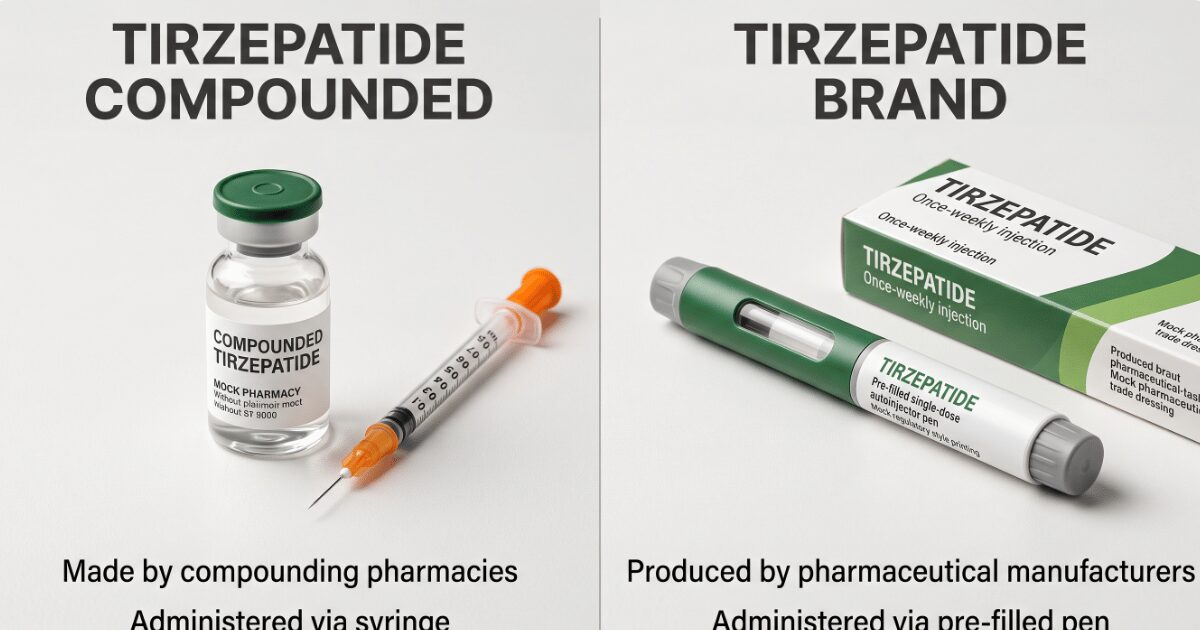
The difference lies in everything that happens after the ingredient is chosen. A brand product is a finished, standardized medication with the same strength in every pen. A compounded product is a preparation built to a prescriber’s order, and no two facilities work in exactly the same way. The answer therefore depends less on the molecule and more on the manufacturing chain behind it.

How Brand-Name Tirzepatide Is Made and Tested

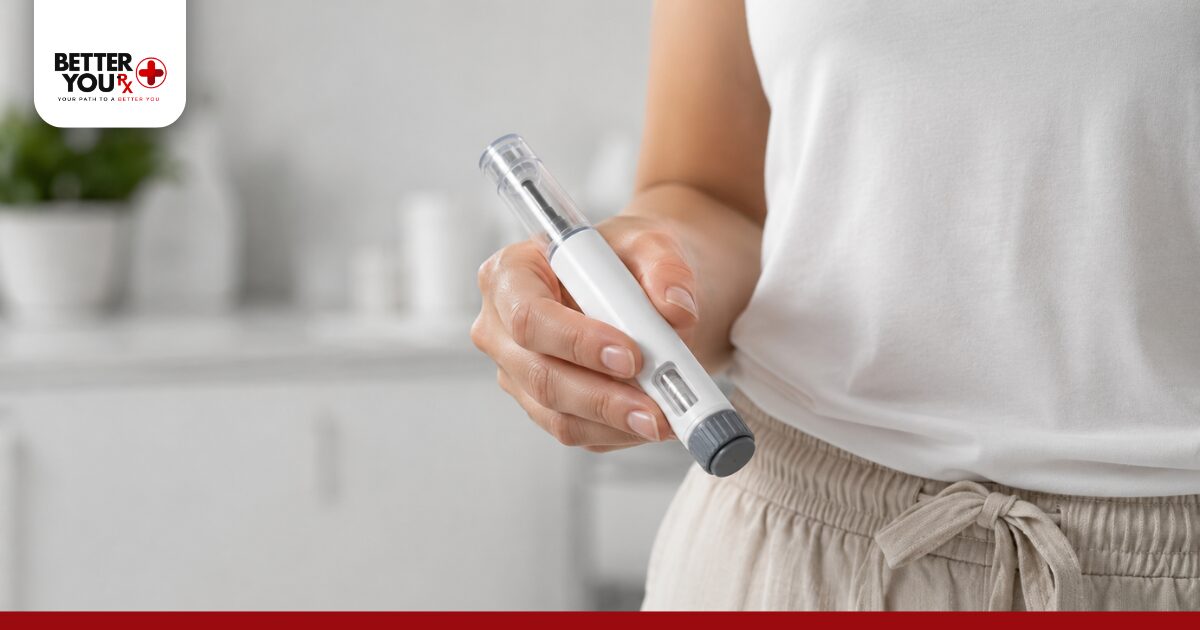
Brand-name Tirzepatide arrives as a pre-filled pen in fixed strengths. Treatment usually begins at 2.5 mg weekly and rises in steps of 2.5 mg toward a maintenance dose, with a ceiling of 15 mg. Because every pen holds the same concentration, a patient and doctor can predict what each step means.

Each batch goes through potency, purity, and sterility testing before release, and the packaging carries lot tracking. Years of clinical use also mean prescribers know what to expect at each dose, from mild nausea early on to less common concerns such as gallbladder problems. Cleveland Clinic’s medication overview for Tirzepatide is a readable outside reference on who should speak with a doctor first and which warning signs matter.

Why does this matter? Predictability. When a weekly dose is off by even a small margin, the result can be a rough week of vomiting or a stalled plateau. Fixed pens remove that guesswork.

Tirzepatide Compounded vs Brand

What Compounded Tirzepatide Actually Means

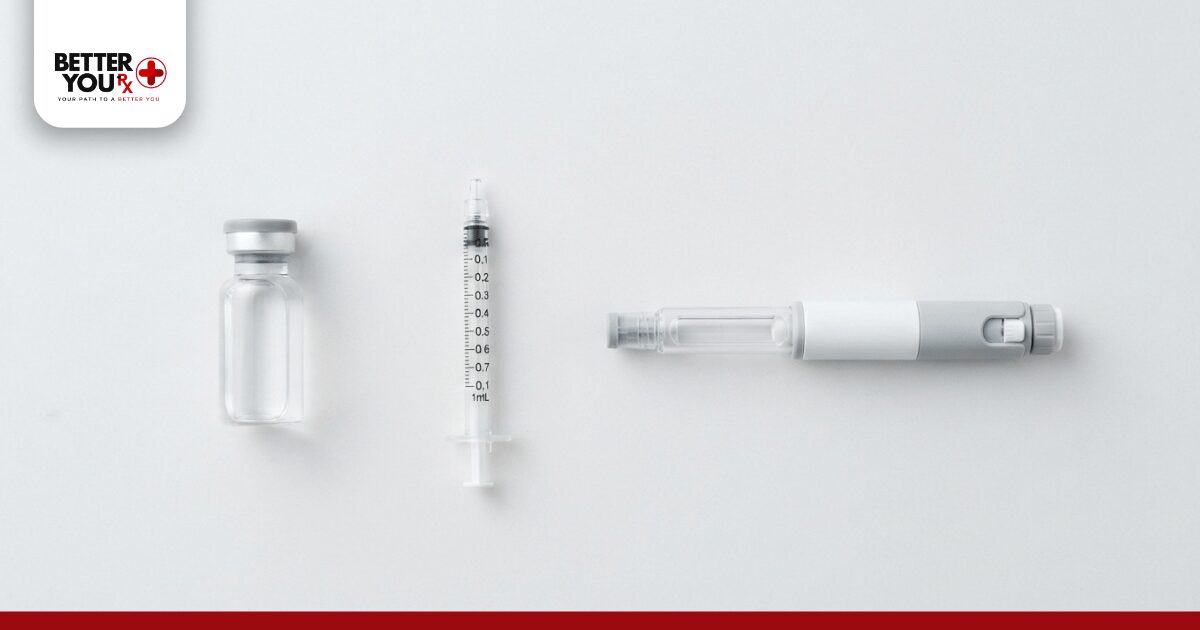
Compounding is the practice of preparing a medication to a specific prescriber’s order. It exists for good reasons, such as removing an ingredient a patient reacts to. Compounded Tirzepatide, however, is usually supplied as a vial of liquid rather than a pen, and the formula can differ from the brand in meaningful ways.

Some preparations use a salt form of the ingredient instead of the exact molecule found in the brand. Others add extras such as vitamin B12 or glycine. Concentrations also vary from one facility to another, so a labeled amount on one vial may not mean the same volume as on another. None of this makes every compounded product unsafe. It means each one must be judged on its own, because the finished preparation does not go through the same testing as a brand-name medication.

A licensed, well-run compounding facility follows strict quality standards and tests its products. A poorly run one, or an online seller that skips those steps, does not. That gap is the heart of the Tirzepatide compounded vs brand is it safe debate.

Compounded vs Brand at a Glance

A quick comparison makes the trade-offs easier to see.

Factor Brand-Name Tirzepatide Compounded Tirzepatide
Product form Pre-filled pen Usually a multi-dose vial
Dose strengths Fixed, from 2.5 mg to 15 mg Set by the facility and can vary
Ingredient form Single standardized formulation May use salt forms or added ingredients
Batch testing Potency, purity, and sterility on every batch Depends on the facility
Labeling Uniform, with full patient information Varies by facility
Dose measurement Built into the pen Left to the patient
Safety data Extensive clinical and real-world experience Limited data on the exact formulation
Best fit Most adults Rare, physician-directed cases


Where the Safety Gaps Actually Show Up

Dose accuracy is the first gap. A pen delivers the same amount every time, while a vial places measurement in the patient’s hands, and small errors compound over weeks. Providers who follow patients through dose changes often report that confusion after switching formats is the most common source of trouble, especially when a patient assumes a 5 mg pen and a 5 mg vial line up neatly.

Ingredient quality is the second gap. Without batch-level testing on the finished product, a patient cannot be sure the strength matches the label or that unwanted substances are absent. Sterility is the third. Injectable medications must be free of contamination, and storage during shipping matters as much as preparation.

The fourth gap is the seller. Online listings that offer Tirzepatide without a valid prescription, or that ship from unclear sources, carry the highest risk of counterfeit or mislabeled product. The answer to Tirzepatide compounded vs brand is it safe changes sharply with the source, and patients who report problems most often describe an unverified seller rather than a well-run facility. 

Most healthcare providers follow established clinical protocols when prescribing Tirzepatide, and those protocols assume a known strength, a known formulation, and regular follow-up. Compounded products can meet that standard only when the facility, the prescriber, and the patient stay in close contact.

Things To Know

  • Tirzepatide is prescribed for adults alongside diet and activity changes, not as a stand-alone shortcut.
  • Brand strengths are fixed, so switching between brand and compounded products should never be done by matching numbers on your own.
  • A personal or family history of certain thyroid tumors is a reason to speak with a doctor before using any Tirzepatide product.
  • Common early effects include nausea, diarrhea, and reduced appetite, and they often ease as the body adjusts.
  • Store the medication exactly as labeled and never share a pen or vial with another person.
  • Severe stomach pain, persistent vomiting, or trouble swallowing should be reported to a doctor promptly.

Tirzepatide Compounded vs Brand Is It Safe What Really Separates Them

Which Option Is the Best Choice?

Brand-name Tirzepatide is the best option for most patients. The reasoning is straightforward: fixed doses reduce errors, batch testing protects purity, and the safety record covers the exact product being used. Compounded Tirzepatide belongs in a narrower lane.

Patient Situation Better Fit Why
Adult with type 2 diabetes Mounjaro Fixed doses and a documented track record for blood sugar control
Adult seeking weight management Zepbound Standardized step-up schedule a doctor can adjust with confidence
Reaction to an inactive ingredient in the brand Compounded, physician-directed Customization is the purpose of compounding, and the prescriber should verify the facility
Needs a strength the pen does not offer Compounded, case by case Only with clear written dosing and close monitoring
Currently on compounded and considering a switch Talk to the prescriber first Starting doses may need to be reset rather than matched
Personal or family history of certain thyroid tumors Neither until reviewed A doctor must weigh the risk before any Tirzepatide product


Tirzepatide compounded vs brand is it safe for your situation? Ask three questions. Who prepares it? What testing is done on the finished product? Who monitors you if something feels wrong? If any answer is vague, the safer path is the brand product.

How a Prescription Referral Service Fits In

Better You Rx is a prescription referral service with a licensed contracted dispensing department. It does not replace your doctor. A prescription must be written in English by a primary care physician or licensed medical doctor practicing within the United States, and orders are for personal use only. Medication is mailed directly to the patient’s residence within the USA, never to a doctor’s office, clinic, or hospital.

Patients often find this structure reassuring, because the same steps that protect them, a real prescription, a traceable source, and delivery to their own address, also reduce the risk of counterfeit products. Anyone weighing Tirzepatide compounded vs brand is it safe should bring the prescriber into the conversation before ordering and ask which product is being prescribed by name.

Final Thoughts on Choosing Between Brand and Compounded Tirzepatide

Tirzepatide compounded vs brand is it safe? For most adults, the brand route wins on predictability, testing, and clinical experience, while compounded products call for extra scrutiny of the facility and the prescriber. The safest move is to keep your doctor involved, verify the source, and never adjust doses by guesswork. Better You Rx supports that path as a prescription referral service with a licensed contracted dispensing department.

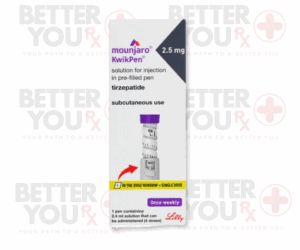
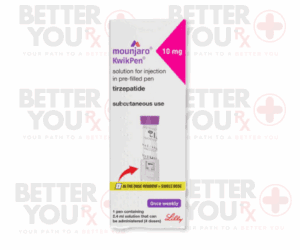
Adults who want the brand options can look at Mounjaro KwikPen, Zepbound KwikPen, or the Semaglutide-based Wegovy for comparison. For deeper side-by-side reading, see Retatrutide vs Tirzepatide, Saxenda vs Zepbound, and Mounjaro vs Trulicity.

Frequently Asked Questions

Is compounded Tirzepatide as effective as brand-name Tirzepatide?

It may work similarly when the strength is accurate, but results cannot be guaranteed because the finished product is not standardized.

What are the main safety risks of compounded Tirzepatide?

The main risks are inconsistent strength, different ingredient forms, contamination, and dosing errors. 

Can I switch from compounded to brand-name Tirzepatide?

Yes, but your prescriber should set the starting dose, because strengths do not convert one to one.

Are the side effects different between compounded and brand Tirzepatide?

The expected effects, such as nausea and reduced appetite, are similar, though compounded products add risks tied to quality and dose errors.

Do I need a prescription for either version?

Yes, both require a valid English prescription from a licensed doctor practicing in the United States.

Sources

  1. New England Journal of Medicine: Peer-reviewed research on once-weekly Tirzepatide for weight reduction in adults with obesity.
  2. The Lancet: Published studies on Tirzepatide and blood sugar control in adults with type 2 diabetes.
  3. Cleveland Clinic: Patient medication overview covering Tirzepatide uses, warnings, and common side effects.
  4. Mayo Clinic: Overview of medication-assisted weight management and questions to ask a prescriber.
  5. Journal of the American Medical Association (JAMA): Research on medications for obesity treatment and clinical monitoring.

Medical Disclaimer: The information on this page is for informational purposes only and is not a substitute for professional medical advice, diagnosis, or treatment. Consult a licensed healthcare provider before starting any medication or treatment.


Best Tirzepatide Plateau Breaker Tips For Restarting Weight Loss?

Written by the Editorial Team, Health and Wellness Content | Medically Reviewed by Dr. Emily Carter, MD | Last Updated: September 2026

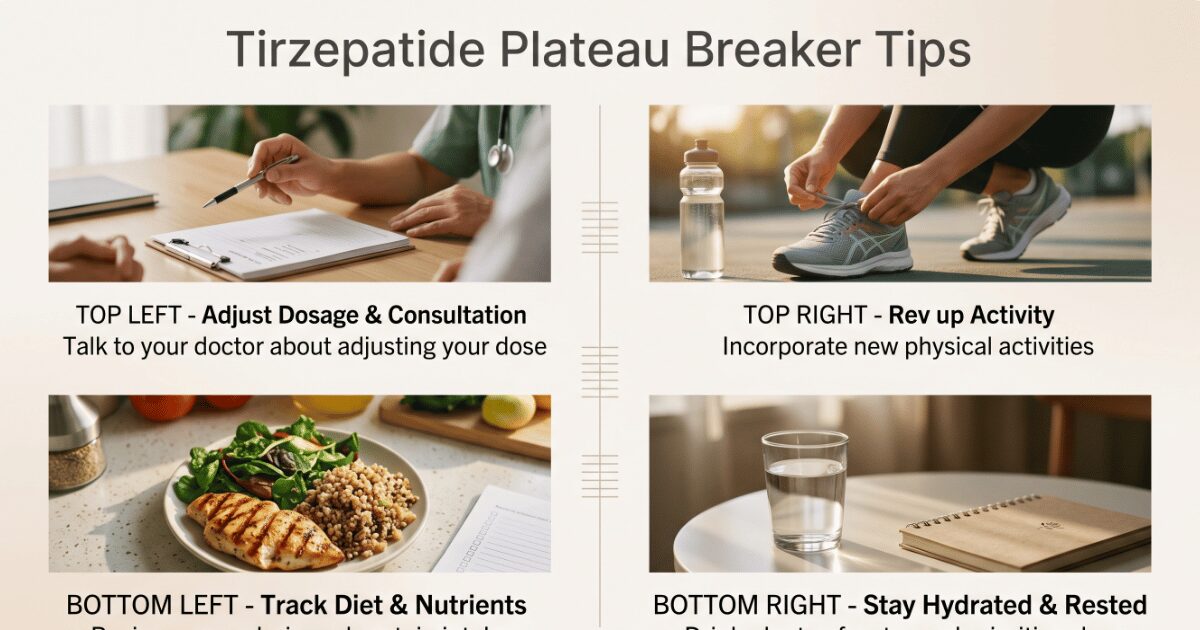
Weight loss on Tirzepatide rarely moves in a straight line, and a stall of several weeks does not mean the medication has stopped doing its job. Tirzepatide plateau breaker tips that work best combine small, sustainable changes such as protein-focused meals, better sleep, resistance training, and stress management, alongside an honest look at portion sizes and daily activity levels. Most plateaus resolve within four to six weeks once these habits are adjusted, and a prescribing doctor can help decide whether a dose change is appropriate if progress still stalls beyond that window.

Key Takeaways

  • A weight loss plateau on Tirzepatide usually reflects the body adjusting to a lower weight, not a medication that has stopped working
  • The most effective Tirzepatide plateau breaker tips focus on protein intake, resistance training, sleep, and stress control rather than dose changes alone
  • Water retention, inconsistent meal tracking, and reduced daily movement are common but often overlooked plateau triggers
  • Dose adjustments should only happen under the guidance of a prescribing doctor, never through self-directed changes
  • Plateaus are a normal, expected phase of weight loss treatment and typically resolve within a few weeks with small, consistent adjustments

What Causes A Weight Loss Plateau On Tirzepatide

A plateau happens when the body adapts to a lower weight by burning fewer calories at rest, a process often called metabolic adaptation. As total body weight drops, the energy required to maintain daily functions drops with it, which means the same calorie intake and activity level that once produced weight loss may only maintain the current weight. This is a biological response, not a sign that Tirzepatide has become less effective.

Several other factors commonly overlap with this natural slowdown. Portion sizes tend to creep up gradually as appetite suppression softens over weeks of treatment, especially around social meals or stressful weeks. Water retention from increased muscle activity, higher sodium intake, or hormonal shifts can mask fat loss on the scale for several days at a time, which is why daily weigh-ins can be misleading. Reduced non-exercise movement, sometimes called NEAT, also plays a role, since people naturally move less throughout the day as they lose weight and feel less need to fidget, pace, or take the stairs.

Common Cause Why It Happens What Usually Helps
Metabolic adaptation The body needs fewer calories to function at a lower weight Reassessing calorie needs every few weeks
Water retention Sodium, hormones, or new exercise routines hold extra fluid Tracking trends over two weeks, not daily weigh-ins
Appetite normalizing Suppression can soften slightly as the body adjusts Rebuilding structured meal planning
Reduced daily movement Less spontaneous activity happens as weight drops Adding short walks or standing breaks
Inconsistent tracking Portions and snacks go unrecorded Returning to simple food logging

Tirzepatide Plateau Breaker Tips

Things To Know

  • A plateau is generally defined as no meaningful weight change for three to four consecutive weeks, not a single stalled week
  • Scale weight and fat loss are not always the same thing, especially for people who have added resistance training
  • Many patients report that plateaus often line up with looser food tracking or a return to old snacking habits rather than a change in how well Tirzepatide is working
  • Sleep debt of even one or two hours a night can measurably raise hunger hormones and slow visible progress
  • Most healthcare providers follow established clinical protocols when evaluating a plateau before considering any change to a Tirzepatide regimen

Tirzepatide Plateau Breaker Tips That Actually Work

Breaking a stall does not usually require a dramatic overhaul. The most reliable Tirzepatide plateau breaker tips are small, repeatable adjustments that address the actual causes of a slowdown rather than chasing the number on the scale.

Prioritize protein at every meal. Aiming for 25 to 30 grams of protein per meal helps preserve lean muscle mass, which keeps resting metabolism higher during weight loss. Muscle tissue burns more calories at rest than fat tissue, so protecting it directly supports continued progress week after week.

Add resistance training two to three times a week. Strength training signals the body to hold onto muscle even in a calorie deficit, which helps prevent the metabolic slowdown that comes with losing muscle along with fat. Bodyweight exercises, resistance bands, or a light set of dumbbells are enough to get started.

Fix sleep before changing anything else. Poor sleep raises ghrelin, the hormone that drives hunger, and lowers leptin, the hormone that signals fullness. Seven to eight hours of consistent sleep is one of the simplest Tirzepatide plateau breaker tips because it addresses appetite regulation at the source rather than relying on willpower alone.

Manage stress and cortisol. Chronic stress raises cortisol, which can encourage fat storage around the midsection and increase cravings for high-calorie foods. Short daily walks, breathing exercises, or a consistent wind-down routine before bed can meaningfully lower stress load over a few weeks.

Recheck portions and hidden calories. Sauces, dressings, beverages, and mindless snacks often account for a plateau that otherwise looks unexplained. A short return to food logging for one to two weeks usually reveals the gap.

Stay consistent with hydration. Adequate water intake supports digestion and can reduce the false hunger signals that are sometimes mistaken for real appetite.

The table below breaks down how each adjustment supports progress and roughly how soon changes tend to show up.

Lifestyle Adjustment How It Helps Break The Plateau Typical Timeframe To Notice Change
Protein-focused meals Preserves muscle and supports satiety One to two weeks
Resistance training Protects resting metabolic rate Two to four weeks
Consistent sleep Regulates hunger and fullness hormones One to three weeks
Stress management Lowers cortisol-driven cravings Two to four weeks
Food logging Identifies hidden or forgotten calories Immediate to one week

When To Talk To Your Prescriber About Adjusting Your Plan

Lifestyle changes resolve most plateaus, but there are times when a conversation with a prescribing doctor makes sense. A stall lasting longer than six weeks despite consistent effort, unexplained fatigue, or a plateau that coincides with side effects worth reporting are all reasonable reasons to reach out.

A doctor may review the current treatment plan and discuss whether a dose adjustment is appropriate based on individual response, tolerance, and overall health history. This decision should always be made with a licensed medical provider rather than through self-directed changes, since dose timing and titration depend on factors specific to each person.

Better You Rx operates as a prescription referral service connected with a licensed, contracted dispensing department, helping patients access the medications their doctors have prescribed for them. This kind of support works alongside, not instead of, regular check-ins with a treating physician about progress and next steps.

Tirzepatide Plateau Breaker Tips That Actually Work

How These Tirzepatide Plateau Breaker Tips Compare To Semaglutide Plateau Strategies

Tirzepatide and Semaglutide both slow gastric emptying and reduce appetite, but Tirzepatide also activates GIP receptors alongside GLP-1 receptors, which is why many prescribers describe its effect on appetite and blood sugar regulation as more pronounced for some individuals. This dual mechanism is part of why plateaus on Tirzepatide sometimes respond a little faster to lifestyle adjustments than plateaus on Semaglutide-based treatment, though individual results vary widely from person to person.

Why plateaus happen is largely the same across both medications: metabolic adaptation, water retention, and looser tracking habits affect anyone losing weight, regardless of which GLP-1 or GIP therapy they use. How a plateau gets broken is also similar, since protein intake, resistance training, sleep, and stress management address the underlying biology rather than the specific drug involved.

Which option tends to work best during a stubborn plateau usually comes down to how a person’s body responds to the added GIP activity in Tirzepatide compared with the GLP-1-only approach of Semaglutide. Some people find the appetite control from Tirzepatide easier to sustain through a plateau, while others do equally well on either option once the same lifestyle adjustments are in place. This is a conversation worth having directly with a prescribing physician rather than deciding alone.

Frequently Asked Questions

What are the best Tirzepatide plateau breaker tips to try first?

The most effective first steps are prioritizing protein, adding resistance training, and fixing sleep before making any other changes. These three areas address the biological drivers of a plateau directly and often produce visible results within two to three weeks.

How long does a typical Tirzepatide plateau last?

Most plateaus last three to six weeks before progress resumes with consistent lifestyle adjustments. A stall lasting longer than six weeks despite these changes is a reasonable point to check in with a prescribing doctor.

Does drinking more water actually help break a plateau?

Yes, staying consistently hydrated can reduce false hunger cues and support digestion, though water alone will not resolve a plateau on its own. It works best combined with protein intake and activity changes.

Should I increase my Tirzepatide dose if I hit a plateau?

Dose changes should only be made by a prescribing doctor after reviewing individual progress and health history. Self-adjusting a dose is not recommended and does not address the lifestyle factors most plateaus involve.

Is it normal to plateau more than once during Tirzepatide treatment?

Yes, multiple plateaus throughout a weight loss journey are common and expected, not a sign that treatment has failed. Each stall typically responds to the same core adjustments of protein, sleep, movement, and stress management.

Final Thoughts On Restarting Progress

A plateau is a pause, not a stop sign. The Tirzepatide plateau breaker tips that consistently work, protein-focused meals, resistance training, better sleep, and stress management, address the actual biology behind a stall rather than chasing short-term scale changes. Patience paired with small, consistent adjustments tends to outperform any single quick fix.

For patients managing their prescribed treatment, Mounjaro and Zepbound remain among the most commonly prescribed Tirzepatide-based options, while Wegovy is a frequently discussed Semaglutide-based alternative worth comparing with a doctor. For further reading, Mounjaro compared with Trulicity, Retatrutide compared with Tirzepatide, and Saxenda compared with Zepbound offer additional context for anyone weighing treatment options.

Better You Rx supports patients as a prescription referral service working with a licensed, contracted dispensing department to help connect prescribed treatment plans with the medications patients need.

Sources

  1. Cleveland Clinic: Overview of weight loss plateaus, metabolic adaptation, and practical strategies for restarting progress.
  2. Mayo Clinic: Clinical information on GLP-1 and GIP receptor agonist medications and their role in weight management.
  3. Harvard T.H. Chan School of Public Health: Research on nutrition, protein intake, and sustained metabolic health during weight loss.
  4. The Obesity Society, Obesity Journal: Peer-reviewed research on incretin-based therapies and long-term weight management outcomes.
  5. Journal of Clinical Endocrinology and Metabolism: Clinical research on sleep, cortisol, and hormonal regulation of appetite.

This content is provided for informational purposes only and is not a substitute for professional medical advice, diagnosis, or treatment. Always consult a licensed healthcare provider before starting, stopping, or adjusting any medication or treatment plan. Individual results and responses to Tirzepatide-based treatment vary.

Best Tirzepatide Nausea Remedies That Actually Work?

Written by Sarah Nars, Health Content Writer | Medically Reviewed by Dr. Maria Santos, PharmD | Updated: September 2026

Last Updated: October 5, 2026

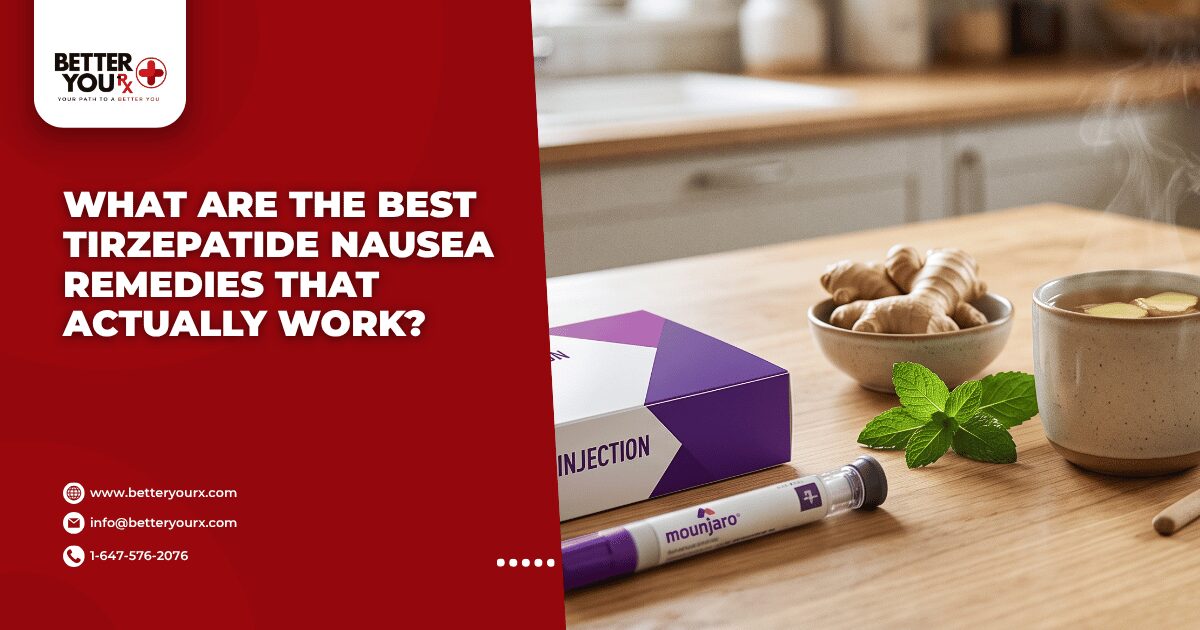
Tirzepatide nausea remedies that actually work usually combine smaller meals, steady hydration, slower dose increases, and mild natural aids like ginger rather than any single fix. Most patients notice nausea within the first two days after a dose and see it ease within about a week as the body adjusts to the medication.

Tirzepatide, sold under the brand names Mounjaro and Zepbound, slows stomach emptying as part of how it helps manage blood sugar and weight. That same mechanism is also the reason nausea is the most frequently reported side effect during the early weeks of treatment. The good news is that nausea tends to be manageable and temporary for most people, and a handful of practical adjustments can make a real difference in daily comfort.

Key Takeaways

  • Tirzepatide nausea remedies that actually work rely on meal size, pacing, and hydration rather than any single trick.
  • Nausea is most noticeable in the first two to three days after a dose or a dose increase and usually fades as the body adjusts.
  • Small, low-fat, low-fiber meals ease stomach discomfort far more reliably than skipping meals altogether.
  • Ginger, peppermint tea, and steady water sipping are low-risk options many patients find genuinely helpful.
  • Slower dose titration under medical guidance remains one of the most dependable ways to prevent severe nausea.
  • Vomiting that will not stop or an inability to keep fluids down should always prompt a call to a healthcare provider.

Why Tirzepatide Causes Nausea In The First Place

Tirzepatide belongs to a class of medications that mimic two gut hormones, GLP-1 and GIP, which regulate appetite and digestion. One of the effects of this dual action is delayed gastric emptying, meaning food stays in the stomach longer than usual. For many patients, that fullness translates into nausea, especially in the hours after an injection.

Nausea tends to follow a predictable pattern. It is usually strongest during the first two to three days after starting Tirzepatide or after a dose increase, then settles down as the digestive system adapts. Patients who begin at a low starting dose and move up gradually tend to report milder symptoms than those who increase too quickly.

Healthcare providers who prescribe Tirzepatide regularly observe that nausea severity often tracks closely with how fast a patient eats, how much fat is in a meal, and how hydrated they are throughout the day. This is exactly why most nausea remedies focus on those everyday habits rather than on stopping the medication.

What To Avoid While Managing Tirzepatide Nausea

Tirzepatide Nausea Remedies That Actually Work

Finding tirzepatide nausea remedies that actually work usually means testing a few simple adjustments rather than reaching for a single cure. Why these approaches help comes down to biology: Tirzepatide slows digestion, so anything that reduces stomach load or calms the digestive lining tends to bring relief.

Eating smaller, more frequent meals is consistently the change patients report making the biggest difference. Large meals sit in an already-slowed stomach and intensify the feeling of fullness that triggers nausea. Splitting daily food into four or five smaller portions, rather than three large ones, gives the stomach less to process at once.

How a person eats matters almost as much as what they eat. Low-fat, low-fiber foods are digested more easily, while greasy, fried, or heavily spiced dishes tend to worsen symptoms. Plain rice, toast, broth-based soups, and lean proteins are common go-to options during the first few days after a dose.

Staying hydrated is another practical piece of the puzzle. Sipping water steadily throughout the day, rather than drinking large amounts at once, helps prevent the bloated feeling that can accompany nausea. Some patients find that room-temperature water is easier to tolerate than ice-cold drinks.

Ginger has genuine research support for calming nausea of several kinds, and many patients find ginger tea, ginger chews, or ginger capsules helpful in the hours after a dose. Peppermint tea is another mild option some people use to settle their stomach.

Which option works best really depends on the individual. Some patients respond most to meal timing, others to hydration, and others to ginger or peppermint. Trying one adjustment at a time for a few days makes it easier to identify what is genuinely helping.

Remedy How It Helps Best Time To Use
Smaller, frequent meals Reduces stomach load during slowed digestion Throughout the day, especially the first 3 days after a dose
Low-fat, low-fiber foods Digests more easily and reduces bloating First 2 to 3 days after each dose
Steady water sipping Prevents dehydration and eases stomach discomfort All day, in small consistent amounts
Ginger tea or ginger chews Calms the stomach lining and reduces queasiness Morning or shortly after a dose
Peppermint tea Mild soothing effect on digestion Evening or after meals
Slower dose titration Gives the digestive system time to adjust Discussed with a prescriber before each increase

Things To Know

  • Nausea usually peaks within 48 hours of a dose and settles within a week for most patients.
  • Fatty, fried, or very sugary foods are the most common trigger for a nausea flare-up.
  • Eating too quickly, even a small meal, can bring on symptoms just as easily as eating too much.
  • A prescriber can slow the dose titration schedule if nausea becomes difficult to manage.
  • Better You Rx works as a prescription referral service connecting patients with a licensed contracted dispensing department, and pairing that access with a prescriber’s guidance on dose pacing is often the most effective combination for easing symptoms.
  • Nausea that comes with severe abdominal pain is not typical and warrants prompt medical attention.

How Timing And Dosing Affect Nausea Relief

Dose titration schedules exist largely because of nausea. Starting at a low dose and increasing gradually over several weeks gives the digestive system time to adapt to the medication’s effect on gastric emptying. Jumping to a higher dose too soon is one of the most common reasons patients experience more intense nausea than expected.

Timing meals around an injection also plays a role. Many patients find that eating a light meal a few hours before a scheduled dose, rather than a heavy one right beforehand, keeps the stomach more comfortable. Avoiding alcohol and very rich foods on dosing days is a simple habit that several patients report helps noticeably.

How long nausea typically lasts depends on where a patient is in the titration schedule. Symptoms are usually strongest in the first few days of a new dose level and taper off before the next increase, following a pattern most prescribers are familiar with.

Dose Stage Common Nausea Timing Typical Duration
Starting dose First 1 to 2 days after the first dose Usually mild, resolves within a few days
First dose increase Days 1 to 3 after the increase Moderate, often eases within a week
Later dose increases Days 1 to 2 after each increase Milder than earlier stages for most patients
Maintenance dose Rare, occasional mild nausea Usually brief if it occurs at all

What To Avoid While Managing Tirzepatide Nausea

Certain habits tend to make nausea worse rather than better. Lying down right after eating slows digestion further and can intensify discomfort, so staying upright for at least thirty minutes after a meal is a simple habit worth keeping. Carbonated drinks can also add to the bloated feeling many patients already experience.

Skipping meals entirely to avoid nausea often backfires, since an empty stomach combined with Tirzepatide can produce its own wave of queasiness. Overeating in an attempt to get it over with has the same effect in reverse, overwhelming a stomach that is already digesting more slowly than usual.

Self-adjusting a dose without medical guidance is not recommended. A prescriber is best positioned to decide whether to slow the titration schedule, and any concerns about severe or persistent nausea should go through that conversation rather than trial and error at home. According to the Cleveland Clinic, gradual dose escalation and dietary adjustments are commonly recommended first-line strategies for managing GLP-1-related gastrointestinal side effects.

Tirzepatide Nausea Remedies

Final Thoughts

Managing nausea while starting Tirzepatide comes down to a handful of consistent habits rather than any single trick. Smaller meals, steady hydration, mindful dose pacing, and simple aids like ginger cover most of what patients need to get through the adjustment period comfortably. For most people, symptoms fade within days rather than weeks, and the tirzepatide nausea remedies that actually work are the ones practiced consistently, not occasionally.

Patients exploring GLP-1 treatment options can review related medications like Mounjaro Kwikpen or Zepbound Kwikpen, and Pantoprazole is sometimes discussed with a prescriber for patients managing broader digestive discomfort. Better You Rx operates as a prescription referral service with a licensed contracted dispensing department supporting patients throughout their treatment.

For additional reading, the following resources cover related topics: Mounjaro Vs Trulicity, Side Effects Of Trulicity, and Foods To Avoid With Trulicity.

Frequently Asked Questions

What are the best tirzepatide nausea remedies that actually work?

Small, low-fat meals, steady hydration, ginger, and slower dose titration are the tirzepatide nausea remedies that actually work best for most patients.

How long does tirzepatide nausea usually last?

Tirzepatide nausea typically peaks within the first 48 hours after a dose and fades within three to five days.

Does eating smaller meals help with tirzepatide nausea?

Yes, eating smaller, low-fat meals reduces stomach load and is one of the most effective remedies for tirzepatide-related nausea.

Can ginger tea reduce tirzepatide nausea?

Ginger tea can calm mild tirzepatide nausea by soothing the stomach lining and easing digestive discomfort.

When should I contact a doctor about tirzepatide nausea?

Contact a doctor if nausea lasts beyond a week, causes vomiting, or prevents you from keeping fluids down.

Sources

  1. Cleveland Clinic – Overview of GLP-1 and GIP receptor agonist medications and common gastrointestinal side effects.
  2. Mayo Clinic – Patient guidance on managing nausea and digestive side effects during weight management treatment.
  3. Journal of Clinical Endocrinology and Metabolism – Clinical data on dose titration schedules and gastrointestinal tolerability of incretin-based therapies.
  4. Obesity Society – Clinical perspectives on GLP-1 and GIP dual agonist therapy and patient-reported side effects.
  5. American Diabetes Association – Educational resources on incretin-based medications and dietary strategies for symptom management.

This content is for informational purposes only and is not a substitute for professional medical advice, diagnosis, or treatment. Always consult a licensed healthcare provider before starting, stopping, or changing any medication or treatment plan.


Tirzepatide Gallbladder Symptoms: What Are the Warning Signs to Watch For?

Written by Ana Mitchell, Health Content Writer | Medically Reviewed by Dr. Angela Cruz, MD | Last Updated: September 2026

Key Takeaways

  • Tirzepatide gallbladder symptoms warning signs typically include pain under the right ribs, nausea after meals, bloating, and in some cases fever or yellowing of the skin
  • Gallbladder issues are tied more closely to rapid weight loss than to Tirzepatide itself, though the medication class shows a modestly elevated association in clinical observations
  • Mild digestive discomfort in the first weeks of treatment is common and usually different from true gallbladder pain
  • Sudden, severe upper right abdominal pain lasting more than a few hours should be treated as a reason to seek medical evaluation
  • A primary care physician can confirm whether gallbladder symptoms are related to Tirzepatide or another cause through imaging and bloodwork

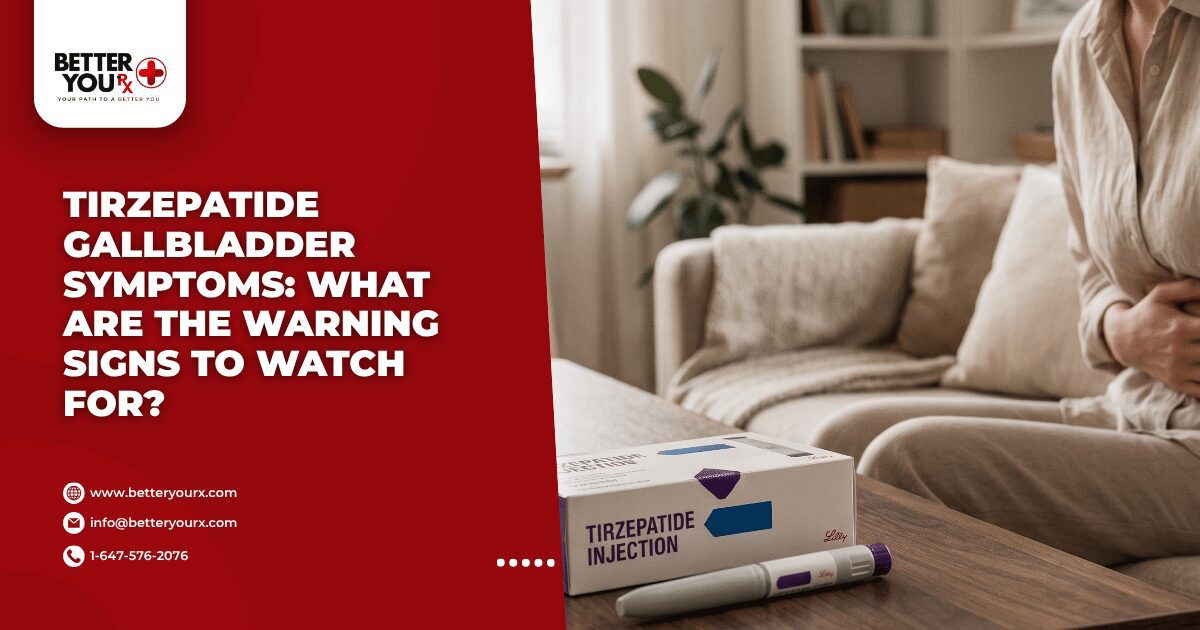
Tirzepatide gallbladder symptoms warning signs include sharp pain below the right ribs, nausea that lingers after meals, bloating, and occasionally fever or a yellow tint to the skin or eyes. These symptoms point toward gallstones or gallbladder inflammation, conditions that appear at a slightly higher rate in people using Tirzepatide and other GLP-1 or GIP based medications, largely because of how quickly the body loses weight during treatment.

Most people taking Tirzepatide for type 2 diabetes or weight management never develop gallbladder problems, and mild stomach upset in the early weeks is far more common than an actual gallbladder issue. Still, knowing the difference between routine digestive adjustment and a genuine warning sign matters, because untreated gallstones can lead to infection or a blocked bile duct.

This overview walks through how Tirzepatide connects to gallbladder health, the specific warning signs worth tracking, what current research shows about GLP-1 and GIP medications as a class, and when a symptom crosses the line from mildly annoying to something a doctor needs to see.

How Tirzepatide Affects The Gallbladder

Tirzepatide is a once-weekly injectable medication approved for type 2 diabetes management and, under a different brand name, for chronic weight management. It works by activating GLP-1 and GIP receptors, which slow stomach emptying, reduce appetite, and support significant weight loss for many patients.

The gallbladder connection is not about Tirzepatide directly damaging the organ. Instead, it comes down to how weight loss itself affects bile chemistry. When the body loses weight quickly, the liver releases more cholesterol into bile, and the gallbladder empties less frequently. Over time, this combination makes it easier for cholesterol to crystallize into gallstones.

Healthcare providers who prescribe Tirzepatide, sold under the brand names Mounjaro and Zepbound depending on the indication, are generally aware of this pattern and factor rapid weight loss into how they monitor patients. Most healthcare providers follow established clinical protocols when evaluating digestive symptoms in patients on GLP-1 or GIP based therapies, which typically includes asking about abdominal pain location, timing, and whether it follows meals.

Patients who lose weight gradually tend to have a lower likelihood of developing gallstones compared to those who lose weight very rapidly, which is one reason providers often discuss a target pace of weight loss when starting Tirzepatide. Recognizing Tirzepatide gallbladder symptoms warning signs early, rather than dismissing them as ordinary stomach upset, gives patients and their care team the best chance to address a gallbladder problem before it becomes an emergency.

What Research Shows About GLP-1 And GIP Medications And Gallbladder Risk

Tirzepatide Gallbladder Symptoms Warning Signs To Watch For

Not every stomach ache during Tirzepatide treatment points to the gallbladder. The warning signs below are the ones worth tracking closely, because they line up with what doctors typically see in gallstone or gallbladder inflammation cases.

Pain is usually the first clue. It tends to sit below the right ribs or in the center of the upper abdomen, sometimes spreading to the right shoulder blade or back. Unlike routine stomach discomfort from Tirzepatide, gallbladder pain often follows a fatty or large meal and can last anywhere from thirty minutes to several hours.

Nausea and vomiting that show up alongside the pain, rather than on their own, are another signal worth noting. Bloating and a feeling of fullness that does not match how much was eaten can also point toward the gallbladder rather than general digestive adjustment.

Fever, chills, and a yellow tint to the skin or the whites of the eyes are more urgent. These suggest the gallbladder may be inflamed or infected, or that a gallstone is blocking the bile duct. Dark urine and pale, clay-colored stools sometimes accompany jaundice and point toward the same underlying issue.

The table below separates symptoms that typically warrant a call to the doctor’s office from those that call for same-day or emergency evaluation.

Symptom Type What It Looks Like Recommended Action
Mild, watch and report Occasional bloating, mild fullness after fatty meals, brief discomfort under the right ribs Mention at next appointment or call the office within a few days
Moderate Recurring pain after meals lasting under an hour, mild nausea without vomiting Contact the prescribing provider within 24 to 48 hours
Urgent Severe pain lasting more than a few hours, fever, chills, vomiting, yellowing skin or eyes, dark urine Seek same-day or emergency medical care

Things To Know

  • Gallbladder symptoms can appear at any point during Tirzepatide treatment, not just the first few weeks, since bile chemistry changes accumulate over months of weight loss
  • A family history of gallstones, being female, or having a higher starting body weight all raise the general risk of gallbladder disease independent of any medication
  • Gallbladder pain is often mistaken for heartburn or muscle strain early on because both can cause discomfort in the same general area
  • Ultrasound imaging remains the standard first step doctors use to confirm or rule out gallstones when Tirzepatide gallbladder symptoms warning signs are reported
  • Stopping Tirzepatide on your own without medical guidance is not typically recommended, even if gallbladder symptoms are suspected, since a doctor needs to confirm the cause first

What Research Shows About GLP-1 And GIP Medications And Gallbladder Risk

Gallbladder related side effects are not unique to Tirzepatide. Research on the broader class of GLP-1 and GIP based medications, which includes Semaglutide, sold as Ozempic, Wegovy, and Rybelsus, and Liraglutide, sold as Saxenda, has observed a modestly higher rate of gallstones and gallbladder inflammation compared to people not taking these medications.

The leading explanation researchers point to is weight loss speed rather than a direct chemical effect on the gallbladder itself. Medications in this class can produce weight loss considerably faster than diet and exercise alone typically achieve, and rapid weight loss is a well established, independent risk factor for gallstone formation regardless of what caused it.

According to the Cleveland Clinic, gallstones affect a substantial portion of adults at some point in their lives, and risk factors include rapid weight loss, obesity, family history, and being female. This context helps explain why gallbladder symptoms show up across the entire GLP-1 and GIP medication class rather than being specific to one drug.

Patients often describe their experience to providers as vague stomach discomfort at first, something that only gets identified as gallbladder related once pain becomes more localized and consistent after meals. This pattern is part of why providers ask detailed follow up questions rather than assuming every stomach complaint is a medication side effect that will pass on its own.

The table below compares how gallbladder related findings have generally been reported across common GLP-1 and GIP medications.

Medication Class Common Brand Names General Gallbladder Findings
Tirzepatide (GIP/GLP-1) Mounjaro, Zepbound Modestly elevated gallstone reports, largely tied to rapid weight loss
Semaglutide (GLP-1) Ozempic, Wegovy, Rybelsus Similar pattern of elevated gallstone and gallbladder inflammation reports
Liraglutide (GLP-1) Saxenda Gallbladder related events reported at rates comparable to other GLP-1 medications

Who Is More Likely To Experience Tirzepatide Gallbladder Symptoms

Certain factors make gallbladder symptoms more likely to appear during Tirzepatide treatment, and knowing them helps patients and providers watch more closely from the start.

Losing weight quickly, generally more than three pounds a week over an extended period, raises gallstone risk regardless of what medication is driving the weight loss. People starting Tirzepatide at a higher body weight often lose weight faster in the early months, which is part of why this window deserves extra attention.

Sex and age play a role as well. Women, particularly those who have been pregnant multiple times, have a higher baseline risk of gallstones than men. Risk also increases somewhat with age, since bile composition changes gradually over the decades.

A personal or family history of gallstones is one of the strongest predictors of future gallbladder problems, independent of medication. Patients who mention this history when starting Tirzepatide give their provider useful information for monitoring going forward.

Diet during treatment matters too. Very low fat intake, which sometimes happens naturally as appetite drops on Tirzepatide, can reduce how often the gallbladder empties, which may contribute to stone formation over time. Providers sometimes suggest maintaining modest healthy fat intake for this reason, separate from any weight loss goals. Recognizing personal risk factors makes it easier to notice Tirzepatide gallbladder symptoms warning signs early rather than after a complication develops.

Tirzepatide Gallbladder Symptoms

When To Seek Care For Tirzepatide Gallbladder Symptoms Warning Signs

Most digestive discomfort during Tirzepatide treatment resolves on its own or responds to simple adjustments like eating smaller meals. Tirzepatide gallbladder symptoms warning signs that persist, worsen, or come with fever are different, and they call for medical attention rather than a wait and see approach.

Contact a primary care physician within a day or two for pain that returns after several meals in a row, especially if it consistently follows fatty or fried food. Mild nausea without vomiting, occasional bloating, or discomfort that fades within an hour generally falls into this same lower urgency category, though it is still worth reporting.

Seek same-day or emergency evaluation for severe pain that does not ease after a few hours, pain accompanied by fever or chills, persistent vomiting, yellowing of the skin or eyes, dark urine, or pale stools. These combinations suggest a blocked bile duct or an infected gallbladder, both of which need prompt treatment.

A doctor will typically start with a physical exam and bloodwork, followed by an abdominal ultrasound if gallbladder involvement seems likely. Depending on the findings, treatment can range from dietary adjustments and monitoring to gallbladder removal surgery in more serious or recurring cases. This decision is made by a licensed physician based on imaging and symptom severity, never based on the Tirzepatide prescription alone.

Patients working with Better You Rx, a prescription referral service connected to a licensed contracted dispensing department, are encouraged to keep an open line of communication with their prescribing physician about any new or worsening digestive symptoms throughout treatment.

Moving Forward With Tirzepatide And Gallbladder Health

Tirzepatide gallbladder symptoms warning signs are worth taking seriously, but they are far from inevitable for most patients. Understanding the difference between routine digestive adjustment and a genuine gallbladder problem gives patients the confidence to keep moving forward with treatment while staying alert to real warning signs.

Working closely with a prescribing physician, reporting new symptoms early, and being mindful of weight loss pace are the most practical steps available. For patients exploring Mounjaro Kwikpen or Zepbound Kwikpen as treatment options, or comparing them against alternatives like Saxenda, a conversation about individual gallbladder risk factors is a reasonable place to start.

Better You Rx operates as a prescription referral service supported by a licensed contracted dispensing department, connecting patients with the medications their physicians prescribe. For further reading, Mounjaro vs Trulicity, Saxenda vs Zepbound, and Retatrutide side effects cover related comparisons and side effect profiles worth reviewing before starting or switching GLP-1 and GIP based treatment.

Frequently Asked Questions

Is Stomach Pain From Tirzepatide Always A Gallbladder Problem?

No, most stomach pain during Tirzepatide treatment is related to slower digestion, not the gallbladder. General nausea, bloating, and mild cramping are common side effects, especially in the first few weeks. Pain that is sharp, sits under the right ribs, and follows meals is more likely to be gallbladder related and worth mentioning to a doctor.

How Soon Can Gallbladder Symptoms Appear After Starting Tirzepatide?

Gallbladder symptoms can appear at any point, though they are more often reported after several months of steady weight loss. Since gallstones form gradually as bile chemistry shifts, symptoms are not typically an immediate reaction to the first few doses.

Can Tirzepatide Related Gallbladder Symptoms Go Away Without Treatment?

Mild symptoms sometimes ease with dietary changes, but true gallstones usually need medical evaluation. Tirzepatide gallbladder symptoms warning signs that involve fever, jaundice, or severe pain do not resolve on their own and require prompt care from a doctor.

Does Weight Loss Speed Affect Gallbladder Risk On Tirzepatide?

Yes, losing weight very quickly is one of the clearest risk factors for gallstones during Tirzepatide treatment. Providers often discuss a gradual weight loss pace specifically to help lower this risk.

Should I Stop Taking Tirzepatide If I Notice Gallbladder Symptoms?

Do not stop Tirzepatide without first speaking to the prescribing physician. A doctor needs to confirm whether symptoms are gallbladder related before deciding on any change to treatment.

Sources

  1. Cleveland Clinic: Overview of gallstones, including risk factors, symptoms, and treatment options
  2. Mayo Clinic: Gallbladder disease symptoms, causes, and when to see a doctor
  3. Harvard Health Publishing: Digestive side effects associated with weight loss medications
  4. Johns Hopkins Medicine: Gallbladder anatomy, function, and common disorders
  5. American Diabetes Association: Clinical guidance on GLP-1 and GIP based diabetes therapies

The information above is provided for general educational purposes only and is not intended as medical advice. It should not replace consultation with a licensed healthcare provider. Anyone experiencing gallbladder symptoms or considering starting or stopping Tirzepatide should speak directly with a qualified physician for personalized guidance.


Tirzepatide Missed Dose: What Happens If You Miss a Dose?

Written by Avery Collins, Health Content Writer | Medically Reviewed by Dr. Lisa Moreno, PharmD | Updated: October 2026

Last Updated: October 6, 2026

Tirzepatide missed dose what happens depends almost entirely on timing. Missing a weekly dose by a day or two is common and generally manageable, while missing it by several days changes the recommended next step. This article walks through the standard timing windows, what changes the longer a dose is delayed, and how to get back on schedule without doubling up or increasing the chance of unwanted side effects.

Key Takeaways

  • A missed dose of Tirzepatide can usually be taken within 4 days (96 hours) of the scheduled time, based on standard weekly dosing guidance
  • If more than 4 days have passed, the missed dose is typically skipped, with the next dose resuming on the regular weekly schedule
  • Two doses should never be taken close together to make up for a missed dose of Tirzepatide
  • An occasional missed dose does not usually interrupt long term treatment progress when the regular schedule resumes promptly
  • A consistent weekly routine, paired with reminders, is the most reliable way to avoid a Tirzepatide missed dose from becoming a pattern

Understanding The Tirzepatide Weekly Dosing Schedule

Tirzepatide is designed to be taken once every seven days, which gives the body a steady, predictable level of the medication over time. Because of this weekly rhythm, timing matters more with Tirzepatide than it would with a medication taken daily, where one missed dose barely shifts the overall exposure.

Most patients pick a day of the week that fits naturally into their routine, such as a Sunday morning or a day that lines up with a grocery run or a weekly appointment. Having a fixed day, rather than a loose plan to take it sometime during the week, is one of the simplest ways to avoid the question of a Tirzepatide missed dose altogether.

Healthcare providers typically explain the weekly pattern during the first prescription conversation, since understanding how the medication builds up in the body over consecutive weeks helps explain why consistency matters more than any single dose on its own.

Tirzepatide Missed Dose What Happens By Timing

The guidance for a missed dose of Tirzepatide changes depending on how many days have passed since the scheduled time. This single detail is the most important factor in deciding what to do next.

Time Since Missed Dose What Typically Happens Next
Within 4 days (96 hours) The missed dose can usually be taken as soon as remembered
More than 4 days The missed dose is typically skipped, with the next dose resuming on the regular schedule
Two or more weeks missed A healthcare provider is usually consulted before resuming, since the starting dose may need to be reassessed

If the missed dose is taken within that first window, the regular weekly schedule can continue from that new day, or some patients choose to shift back to their original day the following week. Either approach is common, and a healthcare provider can confirm which makes more sense for an individual routine.

What If More Than A Week Has Passed?

When a dose is missed by more than four days but less than two weeks, the typical recommendation is to skip that dose entirely rather than take it late. The next dose is then taken on the regularly scheduled day, picking the routine back up without adjusting the dose amount itself.

This approach exists because taking a dose too close to the next scheduled one increases the amount of medication active in the body at once, which can raise the likelihood of side effects such as nausea or stomach discomfort without adding any meaningful benefit.

What If Several Weeks Have Been Missed?

When several weeks pass without a dose, the body’s exposure to Tirzepatide drops significantly, since the medication is no longer being replenished on its usual weekly basis. In this situation, restarting at the previous dose can sometimes feel more intense than expected, which is why a healthcare provider is typically consulted first. In practice, many providers choose to restart treatment at a lower dose and work back up gradually, similar to how the medication was introduced originally.

Why Timing Matters So Much With Tirzepatide

The reason timing carries more weight with Tirzepatide than with many other medications comes down to how the body processes it. Tirzepatide has a long half-life, meaning it stays active in the system for an extended period after each dose. This is part of why it only needs to be taken once a week in the first place.

That same long half-life is also why doubling up is discouraged. Because the previous dose has not fully cleared the body, adding another dose too soon effectively stacks the medication rather than simply catching up on what was missed.

Patients who have been on Tirzepatide for a while often describe this in practical terms. Missing a single dose by a day or two rarely feels different, but stretching several weeks without any dose can bring a noticeable return of appetite or blood sugar fluctuation, which is the body’s way of showing that the medication’s effect has gradually worn off. This is a common, expected pattern rather than a sign that something has gone wrong.

Tirzepatide Missed Dose

Common Reasons People Miss A Weekly Dose

Missing a weekly injection is rarely about forgetting the medication matters. It is usually about the schedule itself slipping out of view.

  • Travel or a disrupted weekly routine, especially across time zones
  • A change in work schedule that shifts the usual dosing day
  • Running out of medication before a refill arrives
  • Simply losing track of which day of the week the last dose was taken
  • Assuming a missed dose is not significant enough to address right away

Most healthcare providers follow established clinical protocols when guiding patients through a missed or delayed weekly dose, which is why reaching out with questions, rather than guessing, tends to produce the most consistent outcomes.

Things To Know About A Missed Dose Of Tirzepatide

  • A single missed dose does not usually undo weeks or months of progress, especially when the regular schedule resumes promptly
  • The weekly dosing day can be changed permanently if needed, as long as there are at least three full days between the old and new day during the transition
  • Side effects such as nausea can sometimes feel more noticeable after catching up on a missed dose, since the body had a short break from the medication
  • Proper storage conditions matter just as much as timing, since a dose that has not been stored correctly may not work as expected
  • Setting a recurring weekly alarm or calendar reminder is one of the most effective ways patients prevent a Tirzepatide missed dose from becoming a repeated pattern

Comparing Missed Dose Guidance Across Weekly Injectable Medications

Tirzepatide belongs to a broader category of weekly injectable medications, and the general missed dose principles tend to be similar across this group, though exact timing windows can vary slightly by product.

Medication Typical Missed Dose Window General Next Step
Tirzepatide Within 4 days Take as soon as remembered, then resume the regular weekly schedule
Semaglutide Within 5 days Take as soon as remembered, then resume the regular weekly schedule
Dulaglutide Within 3 days Take as soon as remembered, then resume the regular weekly schedule

These windows reflect general patterns reported across weekly medications in this category, and a healthcare provider should always confirm the specific guidance that applies to an individual prescription.

How To Get Back On Track After A Missed Dose

Getting back on a consistent schedule after a missed dose of Tirzepatide is usually straightforward once the correct next step has been identified.

  1. Check how many days have passed since the scheduled dose
  2. If it has been 4 days or less, take the dose as soon as it is remembered
  3. If it has been more than 4 days, skip the missed dose and wait for the next scheduled day
  4. Resume the regular weekly pattern from that point forward
  5. Reach out to a healthcare provider if more than two weeks have passed, or if there is any uncertainty about which day to resume on

Better You Rx supports patients working with their prescribing physicians by connecting them to a licensed contracted dispensing department once a valid prescription is in place, which helps weekly medications arrive on a predictable schedule so missed doses become less likely in the first place.

Tirzepatide Missed Dose What Happens By Timing

Which Option Is Right When A Dose Is Missed

Deciding whether to take a late dose or skip it entirely comes down to one factor more than any other, which is the number of days that have passed.

Why the 4 day window exists is tied to how long Tirzepatide remains active in the body before the next dose would normally be due. How this plays out in practice is fairly simple. Inside the window, taking the dose late keeps the weekly rhythm close to intact, while outside the window, skipping avoids the risk of two doses overlapping too closely. Which option applies best depends entirely on the individual timeline, which is why checking the calendar first, before deciding anything else, is the most reliable starting point.

For patients managing other ongoing prescriptions alongside Tirzepatide, similar logic often applies. Readers comparing their options may also find it useful to review how Tirzepatide compares to other weekly injections when thinking through long term treatment planning.

Frequently Asked Questions

Can I take Tirzepatide a day late?

Yes. Taking Tirzepatide a day late is generally considered safe. A missed dose of Tirzepatide can typically be taken as soon as it is remembered, as long as it falls within the standard 4 day window.

What happens if I miss my Tirzepatide dose by a week?

The dose is typically skipped. When a Tirzepatide missed dose stretches past 4 days, the usual guidance is to skip that dose and resume on the next regularly scheduled day rather than taking it late.

Will missing one dose of Tirzepatide undo my progress?

Usually not. A single missed dose rarely reverses meaningful progress, especially when the regular weekly schedule resumes promptly afterward.

Can I take two doses of Tirzepatide close together to catch up?

No. Taking two doses close together is not recommended, since it can increase the amount of active medication in the body and raise the chance of side effects such as nausea.

Should I contact my provider after missing several weeks of Tirzepatide?

Yes. If two or more weeks have passed, checking in with a healthcare provider is recommended, since the starting dose may need to be reassessed before resuming.

Final Thoughts On A Missed Dose Of Tirzepatide

A missed dose of Tirzepatide is rarely a cause for panic once the timing is understood. Staying within the 4 day window keeps the weekly rhythm intact, while going beyond it simply means skipping ahead to the next scheduled day rather than doubling up. The pattern that protects long term progress is consistency over time, not perfection on any single week.

Patients weighing their options can also review Mounjaro Kwikpen, Zepbound Kwikpen, and Ozempic as related weekly treatment options worth discussing with a prescribing physician. For additional reading, the breakdown of whether Trulicity is considered a GLP-1 medication and the guide on Trulicity dosage scheduling both cover related weekly dosing questions that pair well with this topic.

Better You Rx operates as a prescription referral service connecting patients with a licensed contracted dispensing department, working from a valid prescription issued by a primary care physician or licensed medical doctor practicing in the United States.

Sources

  1. Cleveland Clinic, clinical overview of GLP-1 and GIP receptor agonist medications, including general dosing principles
  2. Mayo Clinic, patient education resource on weekly injectable medications for metabolic health and type 2 diabetes
  3. American Diabetes Association, standards of care guidance on injectable therapy adherence and dosing schedules
  4. Journal of Clinical Endocrinology and Metabolism, published pharmacokinetic research on long acting GIP and GLP-1 receptor agonists
  5. Obesity Medicine Association, clinical guidance on weekly injectable therapy management for chronic weight conditions

This content is provided for informational purposes only and is not a substitute for professional medical advice, diagnosis, or treatment. Always consult a licensed healthcare provider before starting, stopping, or adjusting any medication, including Tirzepatide. Individual dosing guidance should come directly from the prescribing physician.


Tirzepatide Hair Shedding: How Long Does It Last?

Written by Maria Santos, Health Content Writer | Medically Reviewed by Dr. Angela Ruiz, MD | Updated: October 2026

Last Updated: Oct 12, 2026

Tirzepatide hair shedding typically lasts between six and twelve months from the point it first appears, with the heaviest shedding clustering around months three to five before new growth takes over. It is not caused by the medication attacking hair follicles directly, but by the body’s reaction to fast weight loss, lower calorie intake, and the metabolic stress that comes with both.

For most people, the shedding phase is temporary, follows a predictable timeline, and resolves on its own as the body adjusts to a new weight and a steadier eating pattern. Protein intake, nutrient levels, and the pace of weight loss all shape how noticeable the shedding becomes and how quickly it clears.

Key Takeaways

  • Hair shedding linked to Tirzepatide usually shows up between two and four months after starting treatment, not immediately.
  • For most people asking Tirzepatide hair shedding how long it lasts, the answer is roughly six to twelve months, with new growth replacing shed strands over time.
  • The shedding is generally tied to rapid weight loss and reduced calorie intake, a pattern called telogen effluvium, rather than a direct effect of the medication itself.
  • Protein intake, vitamin levels, and the pace of weight loss all influence how noticeable the shedding becomes and how long it sticks around.
  • Shedding that continues well past a year, or that comes with bald patches instead of diffuse thinning, deserves a conversation with a healthcare provider.

Why Tirzepatide Is Linked To Hair Shedding

Tirzepatide is a medication originally developed for type 2 diabetes management and now widely used for weight loss, sold under brand names including Mounjaro and Zepbound. It works by mimicking two gut hormones, GIP and GLP-1, which slow digestion, reduce appetite, and help the body use insulin more efficiently. None of these mechanisms target hair follicles. The hair loss that some patients report is almost always a downstream effect of rapid weight change rather than a direct pharmacological action.

Hair grows in cycles. Most strands sit in a growth phase called anagen for two to seven years, then shift into a short resting phase called telogen before shedding and being replaced. Normally, only around ten percent of scalp hair is in the resting phase at any given time. A sudden physical stressor, such as losing a large amount of weight quickly, can push a much larger share of hair follicles into that resting phase all at once. Weeks later, those follicles shed together, producing the clumps of hair people notice in the shower drain or on a hairbrush. This pattern has a name: telogen effluvium.

Because Tirzepatide can produce faster and more significant weight loss than many older treatments, it is more likely to trigger this stress response than medications with a gentler effect on appetite and calorie intake.

Things To Know

  • Telogen effluvium is diffuse, meaning hair thins evenly across the scalp rather than in a single bald spot.
  • The shedding event that shows up at month three often reflects a stressor, such as a steep drop in calories, that happened roughly two to three months earlier.
  • Not everyone who loses weight on Tirzepatide experiences noticeable shedding. Genetics, baseline nutrition, and the speed of weight loss all play a role.
  • Hair shedding from telogen effluvium is almost always reversible once the underlying trigger resolves.

Tirzepatide Hair Shedding How Long It Typically Lasts

The question Tirzepatide hair shedding how long comes up constantly in patient forums and clinic visits, and the honest answer depends on the pace of weight loss and how well nutritional needs are met along the way. That said, a general pattern does emerge across the research on telogen effluvium and the real-world reports tied to GLP-1 and dual-agonist therapies.

Timeframe After Starting Tirzepatide What Typically Happens
Weeks 1 to 8 Little to no noticeable shedding; appetite reduction and early weight loss begin
Months 2 to 4 Shedding often starts, usually tied to the steepest phase of calorie reduction
Months 3 to 5 Shedding tends to peak, with the most hair loss reported in the shower or on pillows
Months 6 to 9 Shedding gradually slows as the body stabilizes at a new weight and eating pattern
Months 9 to 12 Regrowth becomes visible for most people; overall hair density starts returning toward baseline

For most people, the full cycle from first noticeable shedding to meaningful regrowth takes somewhere between six and twelve months. This matches the general pattern seen with telogen effluvium from other causes, including surgery, illness, or extreme dieting, since hair follicles need time to cycle back through growth phases once the stressor passes.

A smaller group of people report shedding that resolves faster, closer to three or four months, particularly when weight loss happens more gradually and protein and micronutrient intake stay consistent throughout treatment. On the other end, people who lose weight very quickly or who have underlying nutritional gaps sometimes see shedding extend closer to the twelve month mark before it fully settles.

Tirzepatide Hair Shedding

What Influences How Long Tirzepatide Hair Shedding Lasts

Several factors shape both how noticeable the shedding becomes and how long it continues. Clinicians who work with patients on GLP-1 and dual-agonist therapies consistently report that the people who struggle least with hair shedding tend to be the ones who prioritize protein and steady eating habits from the start, rather than treating the medication as a reason to eat less overall.

Factor How It Affects Shedding Duration
Speed of weight loss Faster loss tends to trigger more pronounced, longer-lasting shedding
Protein intake Low protein intake during rapid weight loss is strongly linked to prolonged shedding
Iron and vitamin D levels Deficiencies can extend the resting phase of hair follicles
Overall calorie adequacy Very low calorie intake adds physical stress on top of weight loss itself
Pre-existing hair or scalp conditions Can make shedding more noticeable or slower to recover from
Age and hormonal factors Postmenopausal women and people with thyroid changes may see a longer shedding window

Things To Know

  • Spacing out weight loss goals rather than pursuing the fastest possible drop tends to reduce both the severity and the duration of shedding.
  • A diet that includes adequate protein, iron, zinc, and vitamin D supports the hair growth cycle during a period of calorie reduction.
  • Hydration and overall nutritional balance matter more than any single supplement marketed specifically for hair.
  • Shedding duration is individual, so two people on the same dose and timeline can have very different experiences.

How Tirzepatide Hair Shedding Compares To Other Weight Loss Medications

Hair shedding tied to rapid weight loss is not unique to Tirzepatide. It has been reported with other GLP-1 receptor agonists as well, including Ozempic, Wegovy, and Saxenda, since the underlying mechanism is the same physical stress response rather than something specific to any single drug class.

Medication Typical Weight Loss Pace Reported Hair Shedding Pattern
Tirzepatide (Mounjaro, Zepbound) Often faster, due to dual hormone action Moderate to noticeable, peaking around months three to five
Semaglutide (Ozempic, Wegovy) Moderate to fast Reported in a similar window, generally slightly less pronounced
Liraglutide (Saxenda) Gradual Less frequently reported, likely tied to slower weight loss pace
Non-medication rapid weight loss (surgery, extreme dieting) Variable, often very fast Can be more severe, with similar six to twelve month recovery window

This comparison matters because it reframes the question away from “does this specific drug cause baldness” and toward the more accurate picture: any approach that produces fast, significant weight loss carries some risk of temporary shedding, and the recovery timeline tends to look similar across causes.

Managing Hair Shedding While On Tirzepatide

While shedding tied to Tirzepatide usually resolves on its own, there are practical steps that can support the hair growth cycle and make the shedding phase easier to manage. A dietitian working with weight management patients will often point out that the people who weather this phase most comfortably are the ones who treat protein and micronutrients as part of the treatment plan, not an afterthought.

A few practical habits that patients commonly find helpful during this window:

  1. Prioritize protein at every meal, aiming for a consistent intake rather than skipping meals to maximize weight loss speed.
  2. Keep a close eye on iron, vitamin D, zinc, and B12 levels, particularly if dietary intake has changed significantly.
  3. Avoid tight hairstyles or harsh chemical treatments during a shedding phase, since added tension can make thinning more noticeable.
  4. Use a gentle, sulfate-free shampoo and avoid over-washing, which can make shed hair more visible without actually increasing hair loss.
  5. Track weight loss pace with a healthcare provider rather than pushing for the fastest possible results, especially in the first few months.

Patients who bring up hair shedding at a follow-up visit are often reassured to learn that it reflects their body adjusting to rapid change rather than a sign that something is wrong with the medication itself. Most healthcare providers follow established clinical protocols when evaluating hair loss reports during weight management treatment, which typically includes ruling out thyroid issues, iron deficiency, and other common causes before attributing shedding solely to weight change.

Tirzepatide Hair Shedding How Long It Typically Lasts

When To See A Healthcare Provider

For anyone still weighing Tirzepatide hair shedding how long is normal versus concerning, shedding that follows the typical telogen effluvium pattern does not usually require treatment beyond nutritional support and patience. However, a few signs suggest it is worth scheduling an evaluation:

  • Shedding continues past twelve months without any sign of slowing or regrowth.
  • Hair loss appears in distinct patches rather than evenly across the scalp.
  • Shedding is accompanied by scalp redness, itching, or pain.
  • There are other symptoms present, such as fatigue, unusual cold sensitivity, or changes in nails and skin, which can point to a thyroid or nutritional issue separate from weight loss.

A primary care provider can run basic bloodwork to check iron stores, thyroid function, and vitamin levels, which helps separate ordinary telogen effluvium from a less common underlying cause.

Frequently Asked Questions

How long does Tirzepatide hair shedding usually last before it stops?

Most cases resolve within six to twelve months of the shedding first starting. Shedding typically peaks around month three to five and gradually tapers as the body stabilizes.

Does hair grow back after Tirzepatide hair shedding?

Yes, in the vast majority of cases hair regrows fully. Telogen effluvium is a temporary disruption of the hair cycle, not permanent follicle damage, so regrowth is the expected outcome.

Is hair shedding a common side effect of Tirzepatide?

It is reported, but not universal. Hair shedding tends to affect people who lose weight quickly or who have nutritional gaps during treatment, rather than everyone taking the medication.

Can eating more protein reduce Tirzepatide hair shedding?

Yes, adequate protein intake is one of the most consistent factors linked to milder, shorter shedding episodes. Protein supports the structural needs of actively growing hair follicles.

Should I stop Tirzepatide if I notice hair shedding?

Most people do not need to stop treatment, since shedding is usually temporary and manageable with nutritional support. Any decision about adjusting treatment should be made with a healthcare provider.

Final Thoughts On Tirzepatide Hair Shedding

Anyone searching Tirzepatide hair shedding how long it takes to resolve can take some reassurance from the pattern described above: it is uncomfortable to notice but rarely permanent. It traces back to the same biological response the body shows after any period of rapid weight loss, not to a unique property of the medication itself. Paying attention to protein intake, pacing weight loss sensibly, and keeping an eye on nutritional levels throughout treatment can shorten the shedding window and make the whole experience easier to manage.

For readers comparing options or researching related GLP-1 treatments, these related resources may help: comparing Ozempic and Trulicity, Mounjaro versus Trulicity, and understanding how GLP-1 medications work.

Better You Rx is a prescription referral service connecting patients with a licensed contracted dispensing department, and patients exploring treatment options such as Zepbound or Ozempic can speak with their prescribing provider about what to expect throughout treatment, including manageable side effects like temporary hair shedding.

Sources

  1. American Academy of Dermatology Association – Clinical overview of telogen effluvium, its causes, and typical recovery timelines.
  2. Mayo Clinic – Patient-facing overview of hair loss types, including stress-related and weight loss-related shedding.
  3. Cleveland Clinic – Guidance on telogen effluvium triggers, including rapid weight loss and nutritional deficiency.
  4. Journal of the American Academy of Dermatology – Peer-reviewed research on telogen effluvium mechanisms and hair cycle disruption.
  5. Endocrine Society Clinical Practice Guidelines – Reference material on GLP-1 and dual-agonist therapy metabolic effects relevant to weight loss side effects.

This content is for informational purposes only and is not a substitute for professional medical advice, diagnosis, or treatment. Always consult a licensed healthcare provider before starting, stopping, or changing any medication or treatment plan, including for concerns about hair shedding or other side effects.


Can You Still Get Compounded Tirzepatide in 2026?

Compounded tirzepatide is no longer widely available for general use, because the national supply shortage that once permitted large-scale pharmacy compounding was resolved in late 2024. Today, a state-licensed pharmacy can only prepare it when a prescriber documents a specific clinical reason, such as an allergy to an inactive ingredient in the brand-name product or a dose strength that isn’t sold commercially. For most patients, brand-name Tirzepatide, sold as Mounjaro for type 2 diabetes and Zepbound for weight management, is now the practical, widely stocked path forward, dispensed through a licensed contracted dispensing department once a valid prescription is on file.

Key Takeaways

  • Compounded tirzepatide is no longer available for cost or convenience reasons alone; access now requires documented medical necessity through a state-licensed pharmacy.
  • Brand-name Tirzepatide, sold as Mounjaro and Zepbound, is broadly available now that the supply shortage that once allowed wide-scale compounding has been resolved.
  • A valid, English-language prescription from a primary care physician or licensed medical doctor practicing in the United States is required before either option can move forward.
  • Tirzepatide’s dual GIP/GLP-1 mechanism gives it a modest edge over single-action GLP-1 medications like Ozempic in head-to-head comparisons.
  • A starting 2.5 mg dose of Tirzepatide is meant as the first step of titration, not a standalone long-term weight-loss dose.

What Is Compounded Tirzepatide?

Tirzepatide is the active ingredient behind Mounjaro and Zepbound, two once-weekly injectable medications built to activate both the GIP and GLP-1 hormone receptors at once. A compounded version refers to that same active ingredient prepared by a pharmacy rather than manufactured and packaged by the original drug maker. During a multi-year shortage between 2022 and late 2024, state-licensed compounding pharmacies stepped in to prepare custom vials of Tirzepatide, often combined with additives like vitamin B12 or niacinamide, to fill a gap that standard manufacturing could not close fast enough.

Those vials typically arrived as multi-dose liquid, paired with insulin-style syringes, rather than the prefilled pen most patients recognize from Mounjaro or Zepbound. That distinction matters, because measuring an individual dose from a vial adds a manual step that a prefilled pen removes entirely.

Why It Became So Popular During the Shortage Years

When demand for Tirzepatide outpaced what manufacturers could produce, waitlists stretched for months and self-pay pricing for brand-name pens climbed well past what many households could absorb. A compounded version filled that gap at a noticeably lower monthly cost, and telehealth platforms built entire businesses around fast access to it.

Providers who worked through that period often describe the same pattern: patients arriving after weeks of searching for any pharmacy with brand-name product in stock, relieved to find an alternative that let them start treatment without more delay. That real-world urgency is part of why the compounding market grew as quickly as it did between 2022 and 2024.

Most healthcare providers now follow established clinical protocols when deciding whether this kind of pharmacy-prepared option is appropriate for a given patient, since the circumstances that once justified broad compounding have changed substantially.

What is Compounded Tirzepatide

The Current Landscape for Tirzepatide Access

The national supply shortage that once permitted large-scale compounding was formally resolved in late 2024, and the wind-down period for large-scale compounding operations closed through the first half of 2025. That shift changed the rules significantly. A state-licensed pharmacy can still prepare an individually customized formulation, but only when a prescriber documents a specific clinical reason, such as a verified allergy to an inactive ingredient in the brand-name product, or a dose strength that isn’t sold commercially.

Cost alone, convenience, or a general preference for a lower price point no longer qualifies as a basis for pharmacy compounding. Mounjaro and Zepbound, by contrast, are widely stocked through standard retail and specialty pharmacies, with no special exception required to fill a prescription.

Patients who were previously using a compounded protocol are generally encouraged to discuss next steps with their prescriber rather than continuing without a documented reason on file. In many cases, transitioning to brand-name Mounjaro or Zepbound through a standard prescription referral turns out to be simpler and more predictable than trying to qualify for a narrow compounding exception.

Brand-Name Tirzepatide vs. Compounded Formulas: A Side-by-Side Look

Factor Brand-Name Tirzepatide Pharmacy-Compounded Version
Current access Any patient with a valid prescription Documented medical necessity only
Delivery format Prefilled, pre-measured injection pen Typically a multi-dose vial, manually measured
Added ingredients Single active ingredient only May include additives such as B12 or niacinamide
Dose consistency Standardized in every pen Depends on individual pharmacy practices
Typical pricing Set pricing through a licensed dispensing department Historically lower, now less predictable

Quality assurance is where the two paths diverge most. Brand-name pens undergo identical testing and sterility checks in every batch that leaves the manufacturer, while a compounded vial’s quality depends on the sourcing and technique used by that specific pharmacy. Patients who followed a compounded protocol during the shortage years sometimes noticed variation in how consistently a dose felt from one vial to the next, something rarely reported with prefilled brand-name pens.

Things To Know About Tirzepatide Access Today

  • A prescription for compounded tirzepatide must include documented clinical justification; a general request for a lower-cost option does not meet that standard.
  • Measuring a dose from a compounded vial relies on the patient or caregiver drawing up the correct amount, which introduces more room for error than a prefilled pen.
  • Mounjaro is approved specifically for type 2 diabetes management, while Zepbound targets weight management, though both share the same active ingredient.
  • A prescription must come from a primary care physician or licensed medical doctor practicing in the United States and be written in English before a referral can move forward.
  • Shipping applies to a patient’s residence for personal use only; prescriptions cannot be sent to a doctor’s office, clinic, or hospital.

Compounded Tirzepatide

Choosing What’s Right for You: Why, How, and Which Option Makes Sense

Why does this distinction matter? Because the active ingredient is the same, but the oversight behind it is not. Brand-name Tirzepatide goes through standardized manufacturing and quality checks on every batch. A pharmacy-compounded version is prepared individually, so consistency depends heavily on the specific pharmacy doing the work.

How should someone decide? Start with the reason a compounded formulation would even be considered. If it is a genuine allergy to an inactive ingredient, or a dose strength that Mounjaro and Zepbound do not offer, a documented conversation with a prescriber is the appropriate next step. If the interest is purely about lowering the monthly cost, brand-name Tirzepatide accessed through a straightforward prescription referral is the more stable, currently compliant path.

Which option applies depends almost entirely on individual clinical circumstances rather than preference. For the overwhelming majority of patients today, brand-name Mounjaro or Zepbound is the practical, widely available choice, dispensed through a licensed contracted dispensing department once a valid prescription is received.

Tirzepatide Dosage Tiers at a Glance

Dose Typical Purpose Notes
2.5 mg Starting dose for the first 4 weeks Allows the body to adjust; not intended as a standalone long-term dose
5 mg First maintenance step Common early plateau for tolerability
7.5 mg Mid-range titration step Often introduced if additional effect is needed
10 mg Higher maintenance range Associated with more pronounced appetite and glucose effects
12.5 mg Upper titration step Reserved for patients tolerating lower doses well
15 mg Maximum studied dose Used when maximum effect is clinically appropriate

Doses in this range are identical across Mounjaro and Zepbound, and the titration schedule that pharmacy-compounded protocols historically followed generally mirrored this same structure, since it reflects the pharmacology of the active ingredient itself rather than the brand behind it.

Most healthcare providers space each increase about four weeks apart, giving the digestive system time to adjust before moving to the next tier. Skipping ahead in the schedule tends to increase nausea and other digestive side effects without necessarily speeding up results, which is why a gradual, provider-guided titration remains the standard approach regardless of which formulation a patient starts with.

For patients comparing GLP-1 options broadly, Mounjaro and Zepbound remain the two brand-name pathways carrying the tirzepatide molecule, while Ozempic represents the semaglutide-based alternative many patients ask about when weighing GLP-1 medications side by side.

According to Cleveland Clinic’s comparison of tirzepatide and semaglutide, the dual-hormone mechanism behind Tirzepatide has shown a modest edge over semaglutide in head-to-head weight and blood sugar outcomes, which is part of why interest in the medication, brand-name or otherwise, has stayed so high.

For readers weighing next-generation options, how Retatrutide stacks up against Tirzepatide is a useful next read, along with how Mounjaro compares to Trulicity for patients weighing older GLP-1 medications against newer dual-agonist options. Readers curious about the investigational compound behind some of the recent buzz can also review Retatrutide’s reported benefits.

Final Thoughts on Your Tirzepatide Options

Compounded tirzepatide is not gone, but it is no longer the wide-open option it was during the shortage years. What remains is a narrow, medically justified pathway sitting next to a brand-name option that is now the practical default for most patients. Anyone weighing a pharmacy-compounded version against Mounjaro or Zepbound is really weighing documentation and consistency against a standardized, readily available product, and for most people, that comparison settles quickly in favor of brand-name Tirzepatide accessed through a straightforward prescription referral.

Better You Rx connects patients with a licensed contracted dispensing department once a valid, English-language prescription from a U.S.-based primary care physician or licensed medical doctor is on file, mailed directly to a patient’s residence for personal use.

Frequently Asked Questions

Can you still get compounded tirzepatide?

Short answer: Only in narrow cases. A state-licensed pharmacy can still prepare it, but only with documented medical necessity, such as an ingredient allergy or an unavailable dose strength, not for cost or convenience.

Is compounded tirzepatide better than regular tirzepatide?

Short answer: No. The active ingredient is identical, but brand-name Tirzepatide offers standardized manufacturing and a prefilled pen, while a compounded version depends on individual pharmacy practices.

Can you lose weight on 2.5 mg of tirzepatide?

Short answer: Some early appetite changes are possible, but 2.5 mg is a starting dose meant for the first month of titration, not a long-term weight-loss dose on its own.

How much longer will compounded tirzepatide be available?

Short answer: It is expected to stay limited to documented medical-necessity cases going forward, since the supply shortage that once allowed broader access has already been resolved.

Is tirzepatide stronger than Ozempic?

Short answer: Tirzepatide activates two hormone receptors instead of one, and clinical comparisons have generally shown a modest efficacy edge over Ozempic for both weight and blood sugar outcomes.

Sources

  1. Cleveland Clinic — Comparison of tirzepatide and semaglutide mechanisms, dosing, and clinical outcomes.
  2. Mayo Clinic — Patient drug information covering tirzepatide dosing, administration, and safety considerations.
  3. American Diabetes Association — Standards of Care in Diabetes, clinical guidance on incretin-based therapies.
  4. Nature Medicine — Published SURMOUNT trial data on tirzepatide’s weight-loss outcomes.

Medical Disclaimer: This content is for informational purposes only and is not a substitute for professional medical advice, diagnosis, or treatment. Always consult a licensed healthcare provider before starting, stopping, or changing any medication.

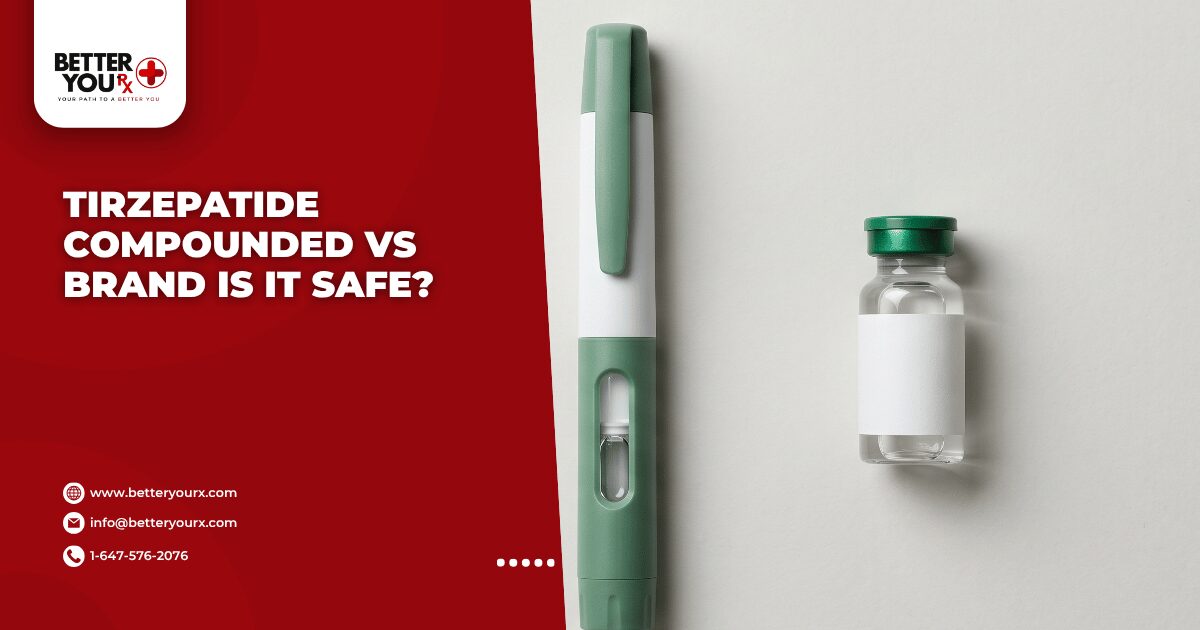
Is Better You Rx the Best Online Provider for Tirzepatide in 2026?

Written by Sarah Mitchell, Health & Wellness Writer | Medically Reviewed by Dr. James Caldwell, MD | Updated: June 2026

Tirzepatide is a dual-action GLP-1 and GIP receptor agonist available as Mounjaro and Zepbound, prescribed for type 2 diabetes management and chronic weight management respectively. Finding the best online provider for tirzepatide means looking for a service that combines legitimate prescription handling, transparent pricing, and direct home delivery. Better You Rx is a prescription referral service with a licensed contracted dispensing department that connects U.S. patients with Tirzepatide options at significantly more accessible price points than what many encounter domestically.

Patients across the country who have been prescribed Tirzepatide often encounter the same barrier: out-of-pocket costs are steep, and obtaining it without guidance can feel overwhelming. That is where identifying the best online provider for tirzepatide shifts from a convenience to a practical, well-considered health decision.

What Makes Someone the Best Online Provider for Tirzepatide

Not every service that claims to offer Tirzepatide delivers on safety, legitimacy, or transparency. When evaluating the best online provider for tirzepatide, a few non-negotiables are worth understanding before placing any order.

Your prescription must come from a licensed primary care physician or medical doctor practicing within the United States. No legitimate referral service should fill a Tirzepatide order without a valid, English-written prescription issued by a U.S.-based provider. This is a patient safety standard, and most healthcare providers follow established clinical protocols when prescribing this medication.
The service must ship directly to your residential address. Medication is intended for personal use only, and delivery goes straight to where you live, removing logistical barriers that can delay treatment.

Pricing should also be clear and published upfront. Vague cost structures or undisclosed fees are a red flag when managing a long-term medication plan.

Tirzepatide Pricing at a Glance

Pricing transparency is one of the clearest ways to identify the best online provider for tirzepatide. The tables below reflect current pricing available for both Zepbound and Mounjaro KwikPen options through this prescription referral service.


Zepbound KwikPen Pricing

Dose Quantity Price
2.5mg/0.6mL or 5mg/0.6mL 1 pen (4 doses) 96.99
7.5mg/0.6mL or 10mg/0.6mL 1 pen (4 doses) 96.99
12.5mg/0.6mL or 15mg/0.6mL 1 pen (4 doses) 96.99

Mounjaro KwikPen Pricing

Dose Quantity Price
2.5mg/0.6mL or 5mg/0.6mL 1 pen 96.99
7.5mg/0.6mL or 10mg/0.6mL 1 pen 96.99
12.5mg/0.6mL or 15mg/0.6mL 1 pen 96.99

U.S.-based insurance is not accepted, as this service operates outside of the United States. These prices reflect direct out-of-pocket costs with no hidden fees attached.

Best Online Provider for Tirzepatide

How the Prescription Process Actually Works

Many patients assume that finding the best online provider for tirzepatide involves a complicated medical intake process. In practice, it is far more straightforward than expected.

You start with a valid prescription from your U.S. physician. That prescription must be written in English and issued by a primary care doctor or licensed medical professional practicing within the United States. Once submitted, the prescription referral process is handled through a licensed contracted dispensing department.

The medication is then mailed directly to your residential address. Prescriptions from physicians practicing outside the United States are not accepted. This setup is designed specifically for U.S. patients who want a more cost-accessible pathway to Tirzepatide without compromising the integrity of the prescription process.

Patients who go through this process often describe it as far less stressful than navigating domestic networks, particularly when coverage gaps interrupt their treatment timeline.

Zepbound vs. Mounjaro: Which Option Works Best for You

Both Mounjaro and Zepbound contain Tirzepatide as the active ingredient. The primary difference lies in their approved clinical indications. Mounjaro is prescribed for blood sugar management in adults with type 2 diabetes, while Zepbound is approved for chronic weight management in adults who meet specific body weight criteria alongside a weight-related health condition.

Both are administered as subcutaneous injections once weekly. Dosing typically begins at 2.5mg and is adjusted based on patient response and tolerance. Your prescribing physician determines which formulation and dosage tier is appropriate for your situation.

If you want to explore a detailed side-by-side breakdown, the Saxenda vs Zepbound comparison offers useful context on how these weight management medications differ in approach.

For patients specifically weighing GLP-1 options for diabetes, the Mounjaro vs Trulicity breakdown is worth reviewing before your next physician consultation.

Why Tirzepatide Stands Out Among Weight Management Medications

Tirzepatide works differently from earlier GLP-1 receptor agonists because it targets two hormone receptors simultaneously. By activating both the GLP-1 and GIP pathways, it addresses appetite regulation and metabolic function through two parallel mechanisms. This dual action is what sets Tirzepatide apart from single-receptor medications like Semaglutide.

In clinical practice, healthcare providers have observed that patients starting Tirzepatide often report noticeable shifts in appetite and satiety within the first few weeks, particularly when transitioning from lower-tier GLP-1 options. These early responses are consistent with how the medication interacts with gut hormones that signal fullness.

For those who have previously tried weight management medications without lasting results, Tirzepatide represents a meaningfully different mechanism. If you have been on Saxenda or a similar option and are considering a transition, discussing Tirzepatide with your prescribing physician is a logical next step.

You can also review the Wegovy vs Saxenda for weight loss comparison to understand where Tirzepatide fits within the broader landscape of injectable weight management therapies.

Things to Know Before Starting Tirzepatide

  • Tirzepatide requires a valid prescription from a U.S.-licensed physician
  • Prescriptions must be written in English
  • Starting doses are typically low (2.5mg) and increased gradually over several weeks
  • Once-weekly injection schedule makes it manageable for most patients
  • Common early side effects include nausea, reduced appetite, and mild digestive changes
  • Mounjaro is intended for type 2 diabetes; Zepbound is intended for weight management
  • U.S.-based insurance is not accepted; the service ships only to U.S. residential addresses
  • Do not self-adjust your dosage without guidance from your physician
  • Store Tirzepatide pens refrigerated and away from direct light
  • Always inform your physician of any other medications you are taking before starting Tirzepatide

How the Prescription Process Actually Works

Accessing Tirzepatide Through a Prescription Referral Service

A prescription referral service with a licensed contracted dispensing department is not a domestic pharmacy. This distinction matters because it is precisely how the service can offer Tirzepatide at pricing that is often substantially lower than what U.S. patients encounter when filling prescriptions locally.

The process begins when a patient submits a valid prescription from their U.S. physician. From there, fulfillment is coordinated through the licensed contracted dispensing department and the medication is shipped directly to the patient’s home address. No pickup, no clinic drop-off, no third-party hand-off.

For patients looking at specific product pages, both the Zepbound KwikPen and Mounjaro KwikPen are accessible through the platform.

Choosing the best online provider for tirzepatide ultimately comes down to trust, process integrity, and price clarity. A service meeting all three criteria is what patients managing long-term Tirzepatide treatment should be looking for.

Making an Informed Decision About Tirzepatide Access

For any patient who has been prescribed Tirzepatide and is searching for the best online provider for tirzepatide, the decision should rest on a few straightforward criteria: verified prescription handling, direct residential delivery, published pricing, and a compliant referral structure.

The pricing is transparent, the process is documented, and every order is tied to a valid prescription from a U.S. physician. That combination is what makes a prescription referral service a dependable choice for patients managing long-term treatment with Tirzepatide.

If you are currently exploring the best online provider for tirzepatide and have your prescription ready, the next step is simply reviewing the available dosing options and placing your order through the appropriate product page.

Frequently Asked Questions About Tirzepatide

What is Tirzepatide used for?

Tirzepatide is used for two primary purposes: managing blood sugar levels in adults with type 2 diabetes (as Mounjaro) and chronic weight management in adults with obesity or a weight-related health condition (as Zepbound). It is a once-weekly injectable medication that works by activating both the GLP-1 and GIP receptors, which regulate appetite, insulin response, and metabolism.

How long does it take for Tirzepatide to work?

Most patients begin noticing reduced appetite and early changes in weight within the first two to four weeks of starting Tirzepatide. Meaningful and sustained results typically become more apparent over the first three to six months as the dose is gradually increased. Individual response varies based on starting dose, adherence, and lifestyle factors.

Who qualifies for Tirzepatide?

Tirzepatide is generally prescribed for adults with type 2 diabetes who need improved blood sugar control, or for adults with a body mass index meeting clinical thresholds alongside at least one weight-related health condition. Your prescribing physician determines eligibility based on your medical history and current health status.

Can I get Tirzepatide without seeing a doctor in person?

A valid prescription from a licensed U.S. physician is required to obtain Tirzepatide through any legitimate service. Whether that consultation happens in person or through a licensed telehealth provider is between you and your doctor. The prescription must already exist before a referral can be processed.

What is the difference between Mounjaro and Zepbound?

Both Mounjaro and Zepbound contain Tirzepatide as the active ingredient. Mounjaro is approved for type 2 diabetes management, while Zepbound is approved specifically for chronic weight management. Your physician will specify which is appropriate based on your diagnosis and treatment goals.

Medical Disclaimer

The content on this page is intended for informational purposes only and does not constitute medical advice. It is not a substitute for professional medical consultation, diagnosis, or treatment. Always consult a licensed healthcare provider before starting, stopping, or adjusting any medication, including Tirzepatide. Individual health circumstances vary, and only a qualified physician can determine the appropriate treatment plan for your specific situation.

Sources

  1. Journal of the American Medical Association (JAMA) – Published clinical data on dual GIP and GLP-1 receptor agonist therapy and outcomes in type 2 diabetes and obesity management.
  2. New England Journal of Medicine (NEJM) – Peer-reviewed trial results on Tirzepatide efficacy and safety across multiple dosing tiers.
  3. Mayo Clinic – Overview of obesity treatment options, GLP-1 receptor agonists, and medication-assisted weight management approaches.
  4. American Diabetes Association (ADA) – Clinical standards of care for type 2 diabetes, including guidance on injectable therapies and GLP-1-based treatment.
  5. Obesity Medicine Association – Clinical resources on weight management pharmacotherapy, including dual-receptor agonist medications.

Mounjaro Shortage 2024 Update: Understanding the Causes and Managing the Impact

Mounjaro (tirzepatide) is a key drug for type 2 diabetes. It also causes major weight loss. In 2024, major supply chain disruptions caused a shortage of this critical drug. This shortage has posed significant challenges for both patients and healthcare providers. It’s vital to know the causes of the shortage, its effects, and solutions. This ensures patients receive the care they need.

Understanding the Mounjaro Shortage

The Mounjaro shortage began in early 2024. Initial reports indicated sporadic shortages at pharmacies nationwide. By March, the situation had worsened. This led to widespread concern among patients and healthcare providers. As the shortage went on into June 2024, stakeholders held urgent talks to find and fix its causes.

Several factors have led to the continued shortage of Mounjaro:

  • Increased Demand: Mounjaro helps with diabetes and weight loss. This has boosted its popularity. As more patients seek out this medication, the supply has struggled to keep up.
  • Manufacturing Constraints: The production of Mounjaro is complex and prone to bottlenecks. Manufacturing facilities have struggled to boost production to meet high demand. This has caused delays and a limited supply.
  • Global Supply Chain Disruptions: Mounjaro’s production relies on raw materials. The global supply chain for them has faced many disruptions. These challenges have been worsened by geopolitical tensions, transport issues, and component shortages. Production capabilities are now more limited.

Impact of the Shortage on Patients

The Mounjaro shortage has deeply affected patients who need it for diabetes and weight loss.

Medication Shortage: It has made it hard for patients to get their meds. Pharmacies often run out of stock. This forces patients to visit multiple locations to find their prescriptions. This creates logistical challenges. It also causes stress and anxiety in patients who use Mounjaro for diabetes. In some cases, patients may wait weeks for a new supply. This can interrupt their treatment.

Potential Health Risks: Abruptly stopping Mounjaro can be dangerous for diabetics. The medication is vital for controlling blood sugar. Stopping it can lead to hyperglycemia, ketoacidosis, and other issues. Consistent medication is vital to prevent these outcomes. So, we must address the shortage quickly.

Limited Weight Loss Options: The shortage of Mounjaro is a setback for those using it for weight loss. Mounjaro has helped many patients lose weight. Its unavailability leaves them with few options. This disruption can stall their progress. It can harm their health. The lack of similar options makes it hard for patients to keep their weight loss. It shows the Mounjaro shortage’s wider impact beyond diabetes.

Coping with the Shortage: Communication and Alternatives

During this shortage, effective communication between patients and providers is vital. Patients should discuss their concerns and explore potential alternatives with their doctors. Several strategies can help manage the shortage and mitigate its impact on patients.

Switching to Available Dosages: One option is to switch to the available dosages of Mounjaro, such as the 2.5 mg pen. This dosage may not be ideal for long-term use. But, it can provide short-term relief. It can also extend the drug’s effects until higher doses are available again.

Exploring Alternative Incretin Drugs: Patients might consider other incretin drugs, like GLP-1 agonists.

The alternatives are:
alternative-medications-for-diabetes-management

Ozempic (semaglutide) is a weekly injection primarily used for managing type 2 diabetes. It helps regulate blood sugar levels and is also associated with significant weight loss benefits. Its long-acting formulation provides a steady release of medication over the week, making it a convenient option for those who prefer less frequent dosing.

Rybelsus (semaglutide), on the other hand, is taken as a daily oral pill. It is prescribed to help manage type 2 diabetes by enhancing blood sugar control. The oral form offers an alternative to injections, appealing to individuals who prefer a non-injection option. Although it requires daily administration, it provides similar benefits to Ozempic in terms of blood sugar control and weight management.

Victoza (liraglutide) is another medication for type 2 diabetes, administered through a daily injection. Like Ozempic, it helps with blood sugar control and weight loss, but it is a shorter-acting medication. While it is effective for managing diabetes, it is also approved for weight loss when combined with lifestyle changes.
Saxenda (liraglutide), also a daily injection, is specifically designed for weight management and obesity treatment. Although it can help with blood sugar control, its primary use is for weight loss. Saxenda contains a higher dose of liraglutide compared to Victoza, tailored specifically for weight management, and is not typically used solely for diabetes management.

Byetta (exenatide) is a medication that requires twice-daily injections and is used to manage type 2 diabetes. It helps improve blood sugar control and supports weight loss. Byetta is shorter-acting than other options and requires more frequent dosing, which might be less convenient but remains effective for diabetes management.

However, Novo Nordisk, the maker of Saxenda, has cautioned against switching to it. There may be supply issues and a high demand for weight loss drugs.

Regular Monitoring and Adjustments: Healthcare providers can help with the shortage. They can adjust treatment plans and monitor patients’ health. This proactive approach can reduce the risks of sudden medication changes. It will ensure patients get the care they need.

Duration of the Mounjaro Shortage

The Food and Drug has said that shortages of Lilly’s Mounjaro and Zepbound will last at least until June 2024. This is due to the unprecedented demand and ongoing supply chain issues. The situation includes all doses of the Type 2 Diabetes (T2D) medication, Mounjaro. It is now in limited supply in Australia and is expected to last until August 2024.

Tracking Shortages and Supplies of GLP-1s

A good way to verify medication shortages is to check the Food and Drug Shortage List. it means the Agency is aware of the supply issue and is working with drug manufacturers to resolve it.

Screenshot-of-the-Federal Health Authority-Drug-Shortage-List-1

In May 2024, the telehealth company Ro launched a free tracker. It helps people stay updated on GLP-1 availability by drug type, dose, and location. This tracker combines Ro’s supply data, U.S. user reports, and updates. Users can sign up for email alerts. They will be notified if a nearby GLP-1 medication is available or if its status on the Drug Shortage List changes. They include info on pharmacies within 100 miles of the user’s zip code. It also explains how to transfer prescriptions between them.

How to Get a 3-Month Supply of Mounjaro

To get a 3-month supply of Mounjaro, patients should first consult their doctor. They must ensure that a 3-month supply is suitable for their treatment plan. Once the dosage is confirmed, patients can request a 3-month prescription. After getting the prescription, patients can visit Better You Rx. It’s a pharmacy-affiliated website based in Canada that can fulfill the order. Patients can save money by using discount codes. They can find them on the website. They can order a 3-month supply of Mounjaro. This method makes the medication affordable and accessible. It allows patients to continue their treatment without interruption.

Availability of Mounjaro in Canada

As of 2023, Mounjaro is now in Canada. It comes in six single-use vial doses: 2.5 mg, 5 mg, 7.5 mg, 10 mg, 12.5 mg, and 15 mg. — approved Mounjaro in November 2023, after the phase 3 SURPASS program. A press release highlighted the approval. Findings tested doses of 5 mg, 10 mg, and 15 mg.

The SURPASS program showed that Mounjaro works. Participants had lower HbA1c levels. The study found that at least 5% of patients had side effects. These included nausea, constipation, vomiting, indigestion, diarrhea, and stomach pain.

Where to Buy Mounjaro

Patients can buy Mounjaro (tirzepatide) from Better You Rx, a pharmacy-affiliated website. It offers a cheap and easy way to manage their medications. After a doctor’s visit and a prescription, patients can order Mounjaro on the Better You Rx site. Better You Rx delivers medication on time and reliably. This helps patients stick to their treatment regimens. Always follow your healthcare provider’s instructions. Stay updated on any changes to your medication.
Final Thoughts

In 2024, a Mounjaro shortage poses a challenge. It affects diabetes patients and those using it for weight loss. Effective communication with healthcare providers is crucial during this period. Patients should discuss other treatments with their doctors. They should also talk about ways to manage their conditions. It’s essential to stay updated on Mounjaro’s shortage.
Patients can navigate this tough time by using resources and talking to providers. This will help them get the care they need. Proactive management, exploring other medications, and health monitoring can help. They can help with the Mounjaro shortage and keep patients on track with their treatment.

Better You Rx is committed to providing affordable, high-quality, online prescription meds from Canada. We aim to ensure patients get the best in convenience and reliability. Reach out to us today to discover more about our services and how we can support your healthcare needs.


Sign Up For Newsletter

Please enable JavaScript in your browser to complete this form.

Join 60.000+ Subscribers and get a new discount coupon on every Saturday.

Address

PO Box 29631, Mississauga RPO Central Parkway, ON L5A 4H2

Phone Number

1-647-576-2076

better you rx big letter logo

Discover convenience with Better You Rx, your trusted pharmacy-affiliated partner. We work with leading pharmacies to deliver prescriptions and over-the-counter medications right to your doorstep. Enjoy cost-effective solutions on a platform that’s easy to use. We focus on safety and efficacy in all products. Our dedicated team ensures a smooth experience. From ordering to delivery, we simplify your healthcare needs. Choose Better You Rx for reliable service and expert support. Trust us for all your medication requirements. Experience the ease of modern pharmacy care.

Categories

Operating Hours: 
10:00AM – 6:00PM CST
Monday – Friday

Our Payment Partners :

Copyright © 2026 BetteryouRX. All Rights Reserved.
Free Download

BETTER YOU RX

The Complete Peptides Guide

Guide + Manual · 2026

Everything You Need To Know About Peptides

Instant PDF Download

Exclusive Free Offer

Get The Complete Peptides Guide & Manual

Join the Better You RX community and unlock our expert-written guide — dosing, protocols, benefits, and safety — all in one PDF.

  • ✓ The Complete Peptides Guide (PDF)
  • ✓ Step-by-step dosing & usage manual
  • ✓ Subscriber-only discounts & updates

We respect your privacy. Unsubscribe anytime.

✓

Check Your Inbox!

Your Complete Peptides Guide and manual are on their way. We've sent them to the email you provided.

Join The Waitlist Be among the first to know when becomes available.
Add to cart