
Written by Maria Santos, BSc Health Communications | Medically Reviewed by Dr. Aleksandar Petrov, MD | Updated: July 2026
Last Updated: July 14, 2026
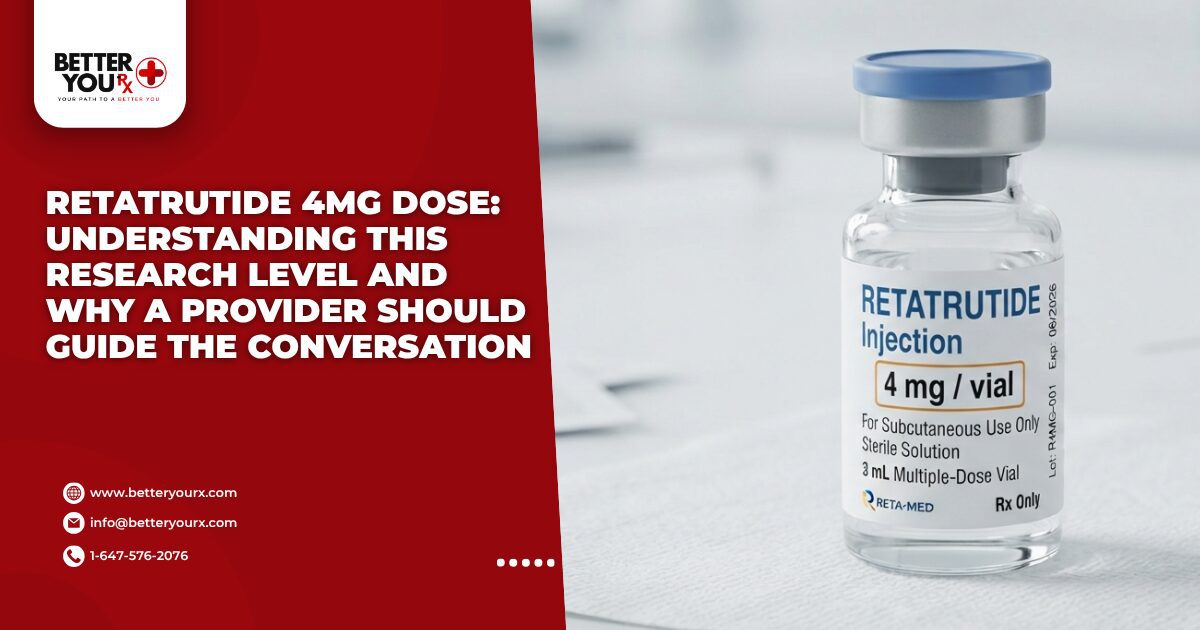
A Retatrutide 4mg dose refers to one of the higher amounts that has been examined in published research on this investigational compound, generally appearing later in a study’s range of tested levels. It is not a target number for self-directed use, and any discussion of this level should happen within a supervised relationship with a licensed provider.
Patients who come across this figure are often piecing together information from research summaries or informal online sources, trying to understand where it fits into the bigger picture. Knowing what a Retatrutide 4mg dose actually represents, and why that context does not carry over into personal use, helps make sense of a number that gets discussed frequently without much explanation.
Key Takeaways
- A Retatrutide 4mg dose is one of the higher levels that has appeared in published research on this investigational compound, not a fixed number meant for independent use.
- Because Retatrutide remains an investigational compound, any mention of a Retatrutide 4mg dose online reflects research reporting, not an approved prescribing standard.
- Whether a Retatrutide 4mg dose is ever relevant to an individual depends entirely on a provider’s ongoing review of tolerance, health history, and treatment goals.
- Moving toward a Retatrutide 4mg dose without provider oversight is not supported by standard clinical practice.
- Patients curious about a Retatrutide 4mg dose should bring the topic directly to a licensed healthcare provider rather than acting on figures found online.
-

Buy Ozempic Semaglutide from Canada
$327.99 Select options This product has multiple variants. The options may be chosen on the product page -
Sale!

Buy Wegovy from Canada
Original price was: $609.99.$596.99Current price is: $596.99. Select options This product has multiple variants. The options may be chosen on the product page

What Does a Retatrutide 4mg Dose Represent in Research?
Clinical trials examining Retatrutide have tested a range of amounts to observe how the compound performs at different levels, including its effects on appetite regulation, metabolic markers, and overall tolerability. A Retatrutide 4mg dose tends to sit toward the higher end of the levels studied in much of the published research, often reached only after earlier, lower levels were reviewed.
This distinction matters because research figures are not interchangeable with personal recommendations. A number appearing in a study reflects conditions specific to that research population, monitored under close supervision, and does not automatically apply to someone reading about it from outside that setting. Since Retatrutide has not completed the regulatory review required for standard prescribing in the United States, there is no approved consumer dosing standard tied to this figure or any other specific level at this stage.
Research teams generally report on how a compound performs across an entire tested range rather than focusing on one isolated figure, since higher levels are typically only meaningful when understood in relation to the lower levels that preceded them in the same study.
Why a Retatrutide 4mg Dose Is Not Something to Pursue Independently
A higher figure can feel like a milestone worth reaching, especially for patients who have read about it in research summaries. However, a Retatrutide 4mg dose in a clinical trial exists within a carefully monitored framework, and reaching that same figure outside of supervision removes the safety structure that made it appropriate for that research setting in the first place.
Providers who guide any phased treatment plan generally evaluate how a patient tolerated earlier stages, along with body weight, existing health conditions, and other medications, before considering whether a higher level like this would even be appropriate to discuss. Two people who start at the same point may never reach the same later stage, since the pace and ceiling of any plan depend on individual response rather than a shared target.
Patients sometimes assume that a higher number automatically means a stronger or more effective outcome, and that assumption can be misleading. Providers commonly explain that pushing toward a higher figure without confirmed tolerance at earlier stages increases the likelihood of side effects rather than improving results.
Things To Know
- This higher research figure reflects a specific study population under supervision, not a general target.
- Reaching a higher research figure typically depends on confirmed tolerance at earlier, lower levels first.
- Retatrutide remains an investigational compound without an approved consumer dosing standard.
- Assuming a higher number is automatically better can overlook the safety reasoning behind gradual, provider-guided pacing.
- Most healthcare providers rely on established clinical protocols and close monitoring when evaluating whether any higher level is appropriate for a given patient.

How a Retatrutide 4mg Dose Fits Into a Broader Research Range
Research involving Retatrutide has typically tested several levels as part of a phased design, moving from lower starting amounts toward higher figures only after earlier stages were reviewed. The table below outlines this general pattern without providing specific instructions for self-administration.
| Research Range | General Description | Clinical Relevance |
| Lower Levels | Amounts studied earliest in a trial design | Establish initial tolerance patterns |
| Mid-Range Levels | Levels reviewed after early tolerance is confirmed | Balance effect and side effect monitoring |
| Higher Levels | Amounts including a Retatrutide 4mg dose in several study designs | Reached only after lower levels were reviewed |
| Extended Observation | Levels studied over longer research periods | Ongoing monitoring within a supervised setting |
This table illustrates why this figure cannot be pulled out of its research context and applied elsewhere. It represents a later point in a structured sequence, not a starting reference for someone unfamiliar with the earlier stages.
What Determines Whether a Higher Level Is Ever Appropriate
Several factors influence whether a provider would ever consider a level this high relevant for a specific patient. None of these factors are something a patient can assess accurately without professional input.
| Factor | Why It Matters |
| Response at earlier stages | Confirms whether moving toward a higher level is reasonable |
| Body weight and overall health | Shapes how a provider interprets any studied figure |
| Kidney and liver function | Chronic conditions can change the pace or ceiling of any plan |
| Other medications | Must be reviewed for interactions before any change |
| Patient-reported symptoms | Ongoing feedback directly shapes provider decisions |
Patients often describe feeling reassured once they understand that a higher research figure is not a fixed goal to work toward, but rather a possibility that depends entirely on how the earlier parts of a plan unfolded. Providers routinely walk through this reasoning during consultations so patients understand why pacing matters more than reaching any particular number.
Why Higher Research Figures Require More, Not Less, Oversight
It is a common misconception that higher levels in a research study require less caution simply because they were tested and reported. In practice, the opposite is generally true. As a compound moves toward higher levels in any research design, monitoring tends to become more frequent, not less, since the goal is to catch any emerging safety signal as early as possible.
This is part of why a higher figure reported in a study should not be treated as evidence that it is broadly safe for unsupervised use. The reported outcome reflects what happened under continuous clinical observation, including regular lab work and structured follow-up, none of which exists for someone using the same figure independently.
Patients occasionally describe reading about a higher research level and feeling that it validates trying to reach that same point quickly on their own. Providers generally caution against this interpretation, since the research context and an individual’s unsupervised situation are simply not comparable.

Comparing a Retatrutide 4mg Dose to Other Levels in the Same Studies
Research summaries often present this level alongside lower and higher levels tested in the same trial to show how outcomes shifted across the full range. This kind of comparison is useful for understanding the general shape of the research, but it is not designed to help someone choose a level for themselves.
Patients exploring currently available, provider-prescribed options such as Mounjaro or Zepbound may recognize a similar philosophy, since these treatments are also adjusted gradually under supervision rather than started at a high level immediately. The same reasoning applies to any conversation involving this level.
Questions Worth Bringing to a Provider
Patients preparing to discuss this level, or any other researched figure, often benefit from thinking through a few specific questions beforehand. Asking what would need to be true before a provider considered a higher level appropriate, how often monitoring would occur, and what symptoms would prompt a pause gives the conversation useful structure.
It can also help to ask a provider how they evaluate research involving compounds that have not yet completed full regulatory review, since this shapes how cautiously they approach any specific figure. A provider who explains this reasoning clearly tends to leave patients with a more realistic sense of what a supervised plan actually involves.
Keeping a simple written record of any symptoms, energy changes, or concerns during earlier stages of a plan also gives a provider more useful information than a general recollection offered during an appointment. This kind of preparation supports a more productive conversation about whether any higher level, including this one, would ever be appropriate to discuss further.
Final Thoughts
A Retatrutide 4mg dose is best understood as a later point within a carefully monitored research sequence, not a target figure to reach independently. What matters most is not the number itself but the supervised process that determines whether any higher level is appropriate, including a provider’s ongoing review of tolerance, health history, and treatment goals. Patients who keep this in mind tend to have more grounded, productive conversations with their care team.
Anyone comparing options while Retatrutide continues through further research can review established treatments through resources like Wegovy or Ozempic, and explore broader context through guides such as Retatrutide side effects or Retatrutide benefits. A Retatrutide 4mg dose is a piece of research context worth raising with a provider, not a figure to pursue on one’s own.
Frequently Asked Questions
What is a Retatrutide 4mg dose used for?
A higher research reference point. A Retatrutide 4mg dose has appeared in published research as one of the higher levels studied, but it is not a figure intended for independent or self-directed use.
Is a Retatrutide 4mg dose considered a low, mid, or higher research level?
Generally a higher level. In much of the published research, this figure tends to appear later in a study’s tested range, reached only after lower levels were reviewed.
How does a Retatrutide 4mg dose compare to other studied levels?
It sits toward the upper range. Research typically tests several levels, and this figure is usually discussed as one of the higher points within that broader range.
What should someone know before considering a Retatrutide 4mg dose?
Short answer: It depends entirely on prior tolerance. A provider would need to confirm how earlier, lower levels were tolerated before any higher figure could reasonably be discussed.
Can a Retatrutide 4mg dose be self-administered without supervision?
No, this is strongly discouraged. A Retatrutide 4mg dose reported in research reflects continuous clinical monitoring, and using it independently removes that safety structure entirely.
Sources
- National Institutes of Health, National Library of Medicine, ClinicalTrials.gov – Registry entries and study protocols for triple agonist metabolic compounds under investigation.
- The New England Journal of Medicine – Peer reviewed clinical trial data on multi-receptor agonist compounds and metabolic outcomes.
- Mayo Clinic – General patient education on phased dosing approaches for metabolic and weight management treatments.
- Cleveland Clinic – Overview of how healthcare providers assess and monitor gradual treatment adjustments.
- American Diabetes Association – Clinical guidance on metabolic treatment monitoring and patient safety considerations.
Medical Disclaimer
This content is provided for general informational and educational purposes only and does not constitute medical advice. It is not a substitute for professional consultation, diagnosis, or treatment from a licensed healthcare provider. Retatrutide referenced in this article is discussed in its current investigational context. Readers should consult a licensed healthcare provider before starting, stopping, or adjusting any treatment plan.