
Written by Sarah Collins, Clinical Content Writer | Medically Reviewed by Dr. Amanda Reyes, MD | Last Updated: July 2026
The term Retatrutide maximum dose does not point to one universal number, but rather to the highest amount a specific provider determines is appropriate for an individual patient based on tolerability and response. Because Retatrutide remains investigational, this ceiling is set through ongoing clinical judgment rather than a fixed public standard. Understanding how providers approach this upper limit helps set realistic expectations for anyone exploring Retatrutide as part of a provider-directed weight management or metabolic health plan, and clarifies why the number that applies to one patient may look very different for another.
Key Takeaways
- A Retatrutide maximum dose refers to the highest tier within an individual patient’s titration schedule, determined entirely by a provider rather than a single fixed number
- Reaching the upper end of a titration schedule typically takes many months of gradual, supervised increases from a much lower starting amount
- Retatrutide remains an investigational compound, so the ceiling a provider sets depends on tolerability, response, and ongoing clinical judgment
- Not every patient needs or reaches the highest tier, since many achieve their goals at a lower or moderate amount
- Working with a provider experienced in GLP-1, GIP, and glucagon receptor compounds helps ensure any approach toward a higher dose ceiling happens safely
Is There A Fixed Retatrutide Maximum Dose?
Not exactly. Because Retatrutide is still investigational, there is no single, universally published ceiling that applies identically to every patient. Instead, each provider establishes an individualized upper limit based on how a specific patient responds throughout titration. Providers who work with Retatrutide follow a structured titration approach, starting patients at a much lower dose and increasing gradually over a period of months, adjusting the eventual ceiling as they observe tolerability at each stage.
Because Retatrutide targets three separate receptor pathways, GLP-1, GIP, and glucagon, individual responses can vary more than with single-mechanism compounds like Semaglutide. This is one of the primary reasons providers avoid treating any single number as a universal maximum and instead personalize the ceiling to each patient’s clinical picture. A patient with a highly sensitive digestive system, for example, may reach a comfortable plateau at a lower amount, while another patient with minimal gastrointestinal symptoms may be able to progress further under close supervision.
This individualized approach also reflects how investigational compounds are generally handled in clinical practice. Rather than applying a single ceiling across an entire patient population, providers treat each person’s dose ceiling as a working hypothesis that gets refined over time, adjusted upward, downward, or held steady depending on what the patient reports and what the provider observes at each visit.
How A Typical Titration Schedule Progresses
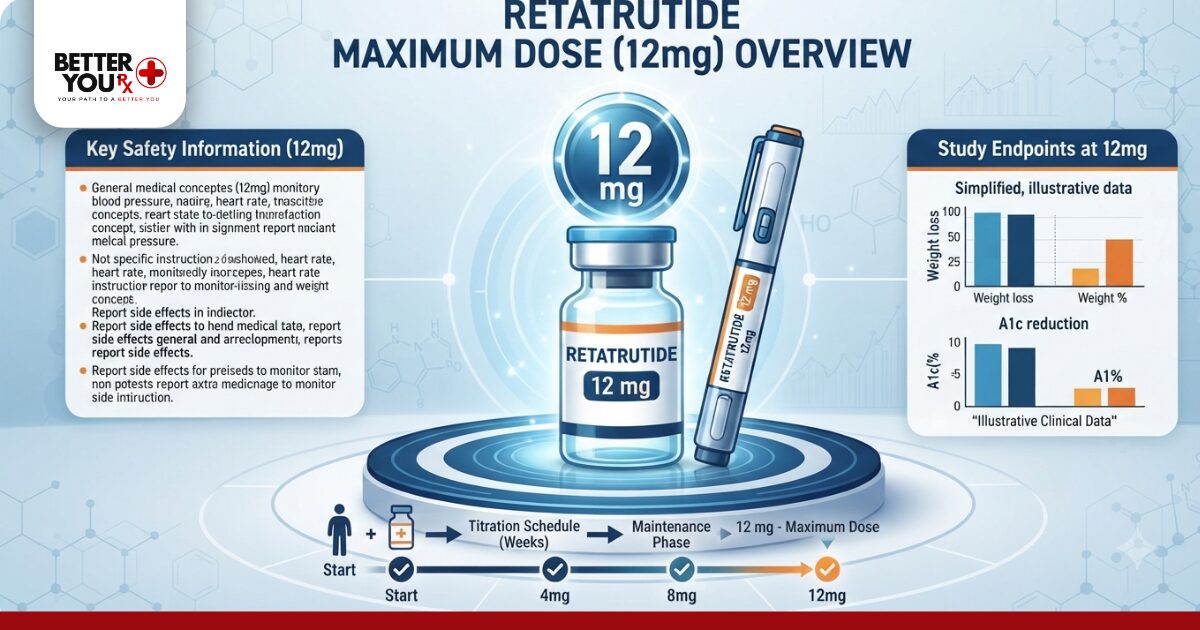
Most provider-directed titration schedules for investigational compounds like Retatrutide follow a similar general pattern, though exact timing, increments, and the eventual ceiling are always determined on an individual basis by the prescribing provider.
| Titration Stage | General Dose Range | Clinical Focus |
| Initial Phase | Lowest starting tier | Assessing baseline tolerability |
| Early Titration | Low to moderate | Monitoring gastrointestinal response |
| Mid-Range Adjustment | Moderate | Evaluating appetite and metabolic response |
| Advanced Titration | Approaching the upper range | Confirming sustained tolerability before advancing |
| Individualized Ceiling | The patient’s Retatrutide maximum dose | Set once tolerability and treatment goals are established |
This table reflects the general shape of a titration curve rather than a fixed protocol, since the final ceiling in any schedule is individualized by the provider based on how the patient responds at each stage. Some patients move through these stages relatively quickly, while others spend additional weeks or months at a given stage if side effects need more time to resolve before advancing further.

Things To Know
- A Retatrutide maximum dose is a patient-specific ceiling, not a single number that applies to everyone
- Tolerability at each lower stage is a key factor providers evaluate before approving any further increase
- Retatrutide is still considered investigational, so dosing frameworks may be refined as clinical understanding develops
- Self-directed dose increases beyond what a provider has approved are strongly discouraged
- Patients approaching the higher end of their titration schedule often report that a gradual pace made the adjustment period far more manageable than moving quickly
- Regular check-ins with a provider allow the ceiling to be reassessed if a patient’s response or goals change over time
-
-
Buy Wegovy from Canada
Original price was: $609.99.$596.99Current price is: $596.99.



Why Providers Set An Individualized Ceiling Rather Than A Universal Number
The reasoning behind an individualized approach to a Retatrutide maximum dose comes down to how differently patients respond to compounds that influence multiple metabolic pathways at once. Advancing too quickly, or aiming for the same ceiling for every patient, can increase the likelihood of nausea, fatigue, or digestive discomfort, which may lead patients to discontinue treatment altogether. A measured, personalized pace allows the digestive and metabolic systems to acclimate at each stage, which tends to support better long-term adherence and a more positive overall experience with treatment.
Providers also use each titration step as a checkpoint. If a patient experiences ongoing side effects at a lower amount, the provider may extend that stage or set a lower ceiling than they might for a patient who tolerates increases more comfortably. This individualized approach is part of why no two patients follow an identical path toward their own upper limit, even when they start treatment around the same time and share similar health profiles.
In practice, this often means a provider will hold a patient at a particular stage for several extra weeks if mild gastrointestinal symptoms are still present, rather than moving forward simply because a set amount of time has passed. Patience at this stage tends to pay off, since patients who advance only once they feel stable at a given amount generally report a smoother experience than those who progress on a fixed timeline regardless of symptoms.
How Providers Decide On A Patient’s Ceiling
Determining a Retatrutide maximum dose for a given patient is not based on a set calendar or a single external benchmark. Instead, providers typically consider a combination of factors, including how well a patient tolerated each previous stage, whether appetite and metabolic markers are trending in the expected direction, and whether any side effects reported at the current stage have resolved before approving any further increase.
In clinical practice, providers often observe that patients who progress steadily through lower stages without significant gastrointestinal symptoms tend to reach a higher personal ceiling more comfortably than those who experienced ongoing discomfort earlier in treatment. This pattern is one reason providers place such emphasis on patience during the early titration phases rather than rushing toward an upper limit. Most healthcare providers follow established clinical protocols when managing dose progression for investigational compounds, prioritizing patient safety and gradual adaptation over speed.
Beyond tolerability, providers also weigh the patient’s overall treatment goals when setting a ceiling. A patient who has already achieved the metabolic outcomes they were working toward may have little clinical reason to advance further, even if they are tolerating their current amount well. In these cases, the provider may choose to hold the dose steady rather than continue increasing simply because the patient could physically tolerate more.
Patients exploring options such as Mounjaro or Zepbound as part of a broader metabolic health conversation with their provider may find it helpful to compare how titration philosophies differ across compounds, since not every option follows the same dosing structure or reaches its ceiling at the same pace.
Which Patients Are More Likely To Approach A Higher Ceiling
Not every patient needs to approach the upper end of a titration schedule, and that is by design. Providers reserve higher ceilings for patients who have demonstrated consistent tolerability across multiple stages and who may benefit from additional metabolic effect based on their individual treatment goals. Patients who experience adequate response at a lower or moderate amount may remain there indefinitely rather than working toward a higher ceiling.
| Compound | Typical Maintenance Range | Primary Mechanism |
| Retatrutide | Individualized, with a Retatrutide maximum dose determined per patient | GLP-1, GIP, and glucagon receptor activity |
| Tirzepatide | Provider-determined maintenance range | GLP-1 and GIP receptor activity |
| Semaglutide | Provider-determined maintenance range | GLP-1 receptor activity |
This comparison illustrates why the appropriate ceiling, and whether a patient should aim toward a higher tier at all, depends heavily on which compound a provider has selected and how that patient’s body responds throughout treatment. There is no universally “best” ceiling, only the one that a provider determines fits a specific patient’s response pattern and health profile. This is also why comparing notes with another patient’s experience can be misleading, since two people on the same compound may land at very different ceilings for entirely legitimate clinical reasons.
For readers comparing options more broadly, the difference between Retatrutide and Tirzepatide is worth reviewing, along with a closer look at Retatrutide’s potential benefits and documented Retatrutide side effects, all of which can inform a more productive conversation with a provider before any dose discussion begins.
 Common Questions About Reaching A Higher Ceiling
 Common Questions About Reaching A Higher Ceiling
Patients often ask whether reaching a higher personal ceiling means treatment is “working better,” but that assumption does not always hold true. Some patients achieve strong results at moderate amounts and never need to approach a higher Retatrutide maximum dose at all. Others may need the additional tier to see the metabolic response their provider is targeting. Because Retatrutide remains investigational, providers continue to rely on individualized clinical judgment rather than a fixed formula when making these determinations.
It is also common for patients to ask what happens if they plateau below their expected ceiling. In many cases, a provider will reassess other factors, such as diet, activity levels, and any other health conditions, before deciding whether additional dose increases are the right next step or whether other adjustments make more sense first.
Better You Rx works within a prescription referral model, connecting patients with providers and a licensed contracted dispensing department, and does not set or recommend individual dosing decisions, since those determinations always rest with the prescribing provider.
Moving Toward The Right Dose For You
There is no single Retatrutide maximum dose that applies to every patient, only an individualized ceiling that a provider establishes based on tolerability, response, and clinical judgment over time. Patients considering Retatrutide as part of their metabolic health plan benefit most from open, ongoing communication with their provider about how their body is responding at each stage, rather than focusing on a specific number as the end goal.
Anyone exploring related metabolic health options can also review additional resources such as what Retatrutide does in the body or consider options like Saxenda while discussing the full range of provider-directed choices available.
Frequently Asked Questions
What Is Considered A Retatrutide Maximum Dose?
It is the highest amount a provider approves for a specific patient. There is no single fixed number, since the ceiling depends on individual tolerability and treatment goals.
How Long Does It Take To Reach The Upper Ceiling?
Typically many months of gradual titration. The exact timeline depends on how a patient tolerates each preceding stage, and providers adjust pacing individually.
Can Patients Choose Their Own Ceiling?
No, the ceiling is determined by the prescribing provider. Self-directed increases beyond an approved level are strongly discouraged.
Does Everyone Reach The Same Dose Ceiling?
No, ceilings vary significantly between patients. Providers set individualized limits based on tolerability, response, and clinical judgment.
Is Retatrutide Approved For General Use?
No, Retatrutide remains an investigational compound. All dosing decisions, including any Retatrutide maximum dose, are made by a licensed provider on a case-by-case basis.
Sources
- New England Journal of Medicine — Clinical research on triple-receptor agonist compounds and their metabolic effects.
- The Lancet Diabetes & Endocrinology — Peer-reviewed data on GLP-1, GIP, and glucagon receptor co-agonism in metabolic treatment research.
- Mayo Clinic — Overview of investigational weight management medications and general dosing principles.
- Cleveland Clinic — Patient education resources on GLP-1 and multi-receptor agonist therapies.
- Journal of Clinical Endocrinology & Metabolism — Research on titration strategies and tolerability in metabolic compound studies.
Medical Disclaimer: This content is provided for informational purposes only and is not intended as medical advice. It does not replace consultation with a licensed healthcare provider. Anyone considering Retatrutide or any other treatment should speak with a qualified medical professional to determine what is appropriate for their individual health needs before starting, adjusting, or discontinuing any medication.