
Written by Sarah Collins, Clinical Content Writer | Medically Reviewed by Dr. Amanda Reyes, MD | Last Updated: July 2026
A Retatrutide subcutaneous injection is administered into the layer of fatty tissue just under the skin, typically in the abdomen, thigh, or upper arm, using a technique guided directly by a licensed provider. This method allows the compound to absorb gradually into the body rather than entering muscle or bloodstream directly. Because Retatrutide is still investigational, every detail of the injection process, from site selection to timing, is meant to be established through provider guidance rather than general assumption.
Key Takeaways
- A Retatrutide subcutaneous injection is delivered into the fatty layer just beneath the skin, not into muscle tissue
- Common injection areas include the abdomen, thigh, and upper arm, with site rotation recommended to reduce irritation
- Providers determine timing, technique, and dose progression individually, since Retatrutide remains an investigational compound
- Reconstitution and measurement questions should always be directed to a licensed provider or dispensing team rather than self-calculated
- Consistent technique and proper site rotation are part of what makes injection routines more comfortable over time
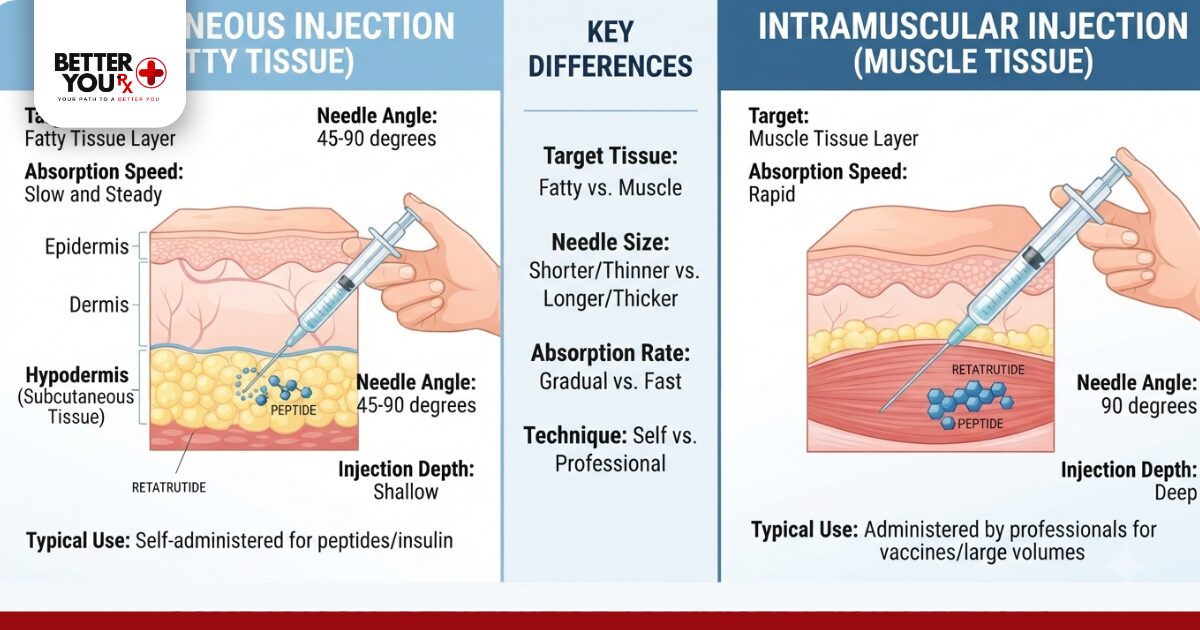
What Makes A Retatrutide Subcutaneous Injection Different From An Intramuscular One
Subcutaneous injections are delivered into the fatty tissue layer between the skin and muscle, while intramuscular injections go deeper, directly into muscle tissue. This distinction matters because absorption rates, comfort level, and appropriate needle length all differ between the two methods.
Compounds like Retatrutide are formulated for subcutaneous delivery specifically because the fatty tissue layer allows for slower, steadier absorption compared to muscle tissue. This is part of why providers are precise about instructing patients on proper depth and angle when demonstrating technique, since injecting too deeply can change how the compound is absorbed.
Common Injection Sites And What To Expect
Providers typically guide patients toward a small number of well-tolerated injection areas, each with its own general considerations.
| Injection Site | General Considerations | Rotation Tip |
| Abdomen | Common site with accessible fatty tissue, avoid the area directly around the navel | Rotate at least an inch from the previous site |
| Thigh | Front or outer thigh, generally easy for self-administration | Alternate between left and right thigh |
| Upper Arm | Often requires assistance from another person for proper angle | Best rotated with abdomen or thigh sites |
Site rotation is not a minor detail. Repeated injections into the same small area can lead to tissue irritation, lumps, or changes in how the compound absorbs, which is why providers consistently emphasize spreading sites out across a rotation pattern.
Things To Know
- A Retatrutide subcutaneous injection should never be given into the same exact spot repeatedly without rotation
- Cleaning the injection site beforehand and allowing any antiseptic to dry helps reduce discomfort
- Providers typically demonstrate proper pinch technique and needle angle during an initial in-person or guided session
- Any unusual swelling, redness, or persistent discomfort at an injection site should be reported to a provider promptly
- Patients often find that injection anxiety decreases significantly after the first few sessions, once the routine becomes familiar
How Technique Affects Comfort And Consistency
Patients frequently report that the anticipation of injecting themselves is more uncomfortable than the injection itself, particularly once they have a consistent routine in place. Providers commonly observe that patients who follow a structured rotation schedule and maintain steady technique tend to experience less site irritation over time compared to those who inject inconsistently or reuse the same location repeatedly.
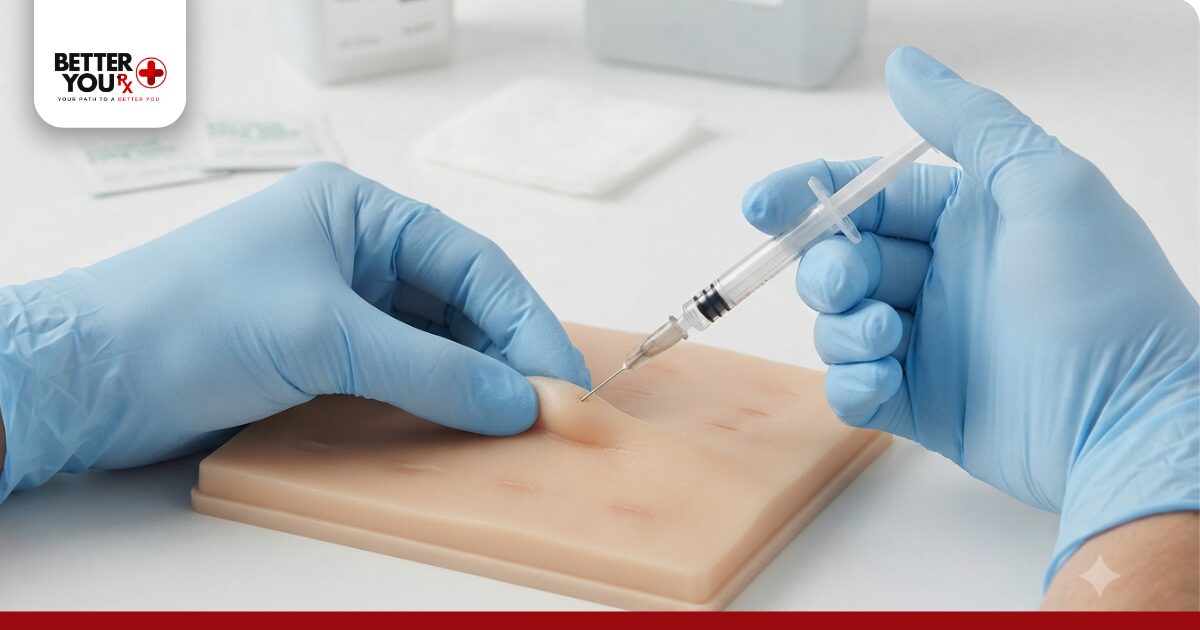
Most healthcare providers follow established clinical protocols when teaching subcutaneous injection technique, walking patients through pinch-and-inject methods, appropriate needle angles, and how to recognize when a site needs a longer rest before reuse. This structured approach is designed to make the process feel routine rather than stressful.
For patients comparing delivery methods across compounds, reviewing how Trulicity dosage is structured or exploring the difference between Retatrutide and Tirzepatide can provide helpful context on how various GLP-1 and multi-receptor compounds are typically administered.
When Timing And Site Selection Matter Most
Consistency in timing is generally more important than the exact hour a Retatrutide subcutaneous injection is given. Providers often recommend choosing a day and general time that fits naturally into a patient’s weekly routine, since this makes it easier to remember and stick with over the course of treatment. Pairing the injection with an existing habit, such as a specific morning or evening routine, is a practical tip many patients find helpful for staying consistent.
Providers may also adjust recommendations based on how a patient tolerates certain sites. Some patients find the abdomen more comfortable, while others prefer the thigh, and a provider can help determine which combination of sites and rotation pattern works best for an individual’s comfort and lifestyle.
Patients exploring related weight management options can also look into Mounjaro or Zepbound, both of which involve their own provider-guided subcutaneous administration routines.
Why Reconstitution And Measurement Questions Belong With A Provider
Questions about mixing ratios, water volume, or precise measurement calculations for Retatrutide fall outside what any general resource, including this one, can safely answer. Because Retatrutide is investigational, reconstitution and dosing calculations require exact guidance from a licensed provider or a dispensing team familiar with the specific formulation being used. Attempting to calculate these figures independently introduces meaningful risk, since even small measurement errors can affect the accuracy of a dose.
Better You Rx operates as a prescription referral service connecting patients with providers and a licensed contracted dispensing department, and any reconstitution or measurement questions should always be directed to that team or the prescribing provider directly, rather than approached through self-calculation or general online guidance.
Readers interested in learning more about how Retatrutide compares to other established options may find Retatrutide’s potential benefits and what Retatrutide does in the body useful starting points for a provider conversation, alongside documented Retatrutide side effects.
Building A Routine That Works For You
A Retatrutide subcutaneous injection becomes far less intimidating once a patient has a consistent site rotation, a comfortable technique, and a routine time that fits their schedule. None of these details need to be figured out alone. Providers walk patients through proper technique, site selection, and timing during the early stages of treatment, and ongoing questions, including anything related to reconstitution or measurement, are best directed straight to that same care team.
Patients weighing Retatrutide against other options like Saxenda can also review how administration routines compare, since understanding the day-to-day experience of a treatment is often just as important as understanding its mechanism.
Frequently Asked Questions
Should Retatrutide Be Injected Subcutaneously?
Yes, Retatrutide is formulated for subcutaneous administration. It is injected into the fatty tissue layer under the skin, not into muscle, following technique demonstrated by a provider.
Where Is The Best Place To Inject Retatrutide?
The abdomen, thigh, and upper arm are the most common sites. Providers typically recommend rotating between these areas to reduce irritation and support consistent absorption.
When Is The Best Time To Inject Retatrutide?
Consistency matters more than a specific hour. Choosing a day and time that fits naturally into a weekly routine helps patients stay on schedule, as guided by their provider.
Do You Inject Retatrutide Into Muscle?
No, Retatrutide is injected subcutaneously, not intramuscularly. It goes into the fatty tissue layer beneath the skin rather than deeper muscle tissue.
How Much BAC Water For 10Mg Retatrutide Calculator?
This calculation should come directly from a licensed provider or dispensing team. Reconstitution measurements are not something to calculate independently, since accuracy depends on the specific formulation being used.
Sources
- New England Journal of Medicine — Clinical research on administration methods for GLP-1 and multi-receptor agonist compounds.
- The Lancet Diabetes & Endocrinology — Peer-reviewed data on subcutaneous delivery and absorption in metabolic treatment research.
- Mayo Clinic — Overview of subcutaneous injection technique and general administration principles.
- Cleveland Clinic — Patient education resources on self-injection technique and site rotation for injectable medications.
- Journal of Clinical Endocrinology & Metabolism — Research on injection site variability and absorption consistency in metabolic compound studies.
Medical Disclaimer: This content is provided for informational purposes only and is not intended as medical advice. It does not replace consultation with a licensed healthcare provider. Anyone considering Retatrutide or any other treatment should speak with a qualified medical professional to determine what is appropriate for their individual health needs before starting, adjusting, or discontinuing any medication.