

Written by Danielle Marsh, RD, Health Content Writer | Medically Reviewed by Dr. Sarah Coleman, MD | Updated: August 2026
Last Updated: August 5, 2026
Retatrutide for menopause weight gain refers to the growing interest in this investigational triple-agonist medication as a possible option for women whose weight and metabolism shift once reproductive hormones decline. Clinical research on Retatrutide has shown some of the largest average weight reductions recorded among GLP-1 class medications to date, though none of that research has focused exclusively on menopausal women, and the medication remains under study rather than positioned as a menopause-specific treatment.
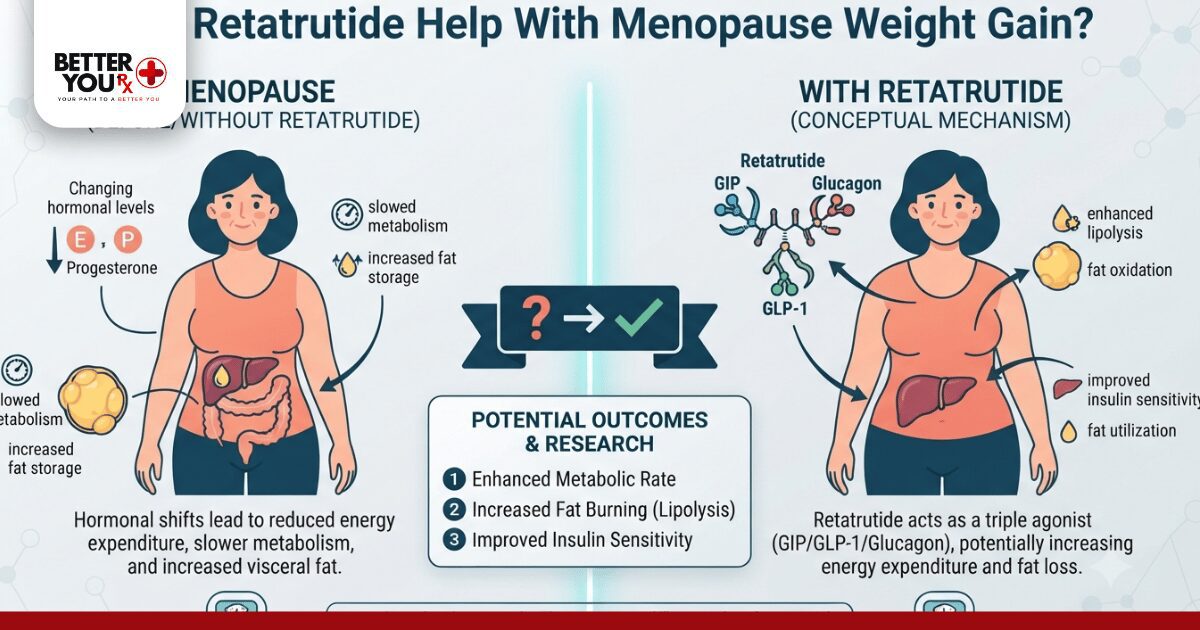
Menopause changes how the body distributes fat, often shifting it toward the abdomen, slows resting metabolic rate, and disrupts hunger and fullness signals as estrogen declines. Women exploring Retatrutide for menopause weight gain typically pair it with strength training, protein-focused nutrition, and sleep support, working with a licensed prescriber who can evaluate whether a GLP-1 or multi-agonist medication fits their individual health profile.
Key Takeaways
- Retatrutide for menopause weight gain is an emerging area of interest because this triple-agonist medication has produced some of the largest average weight reductions studied among GLP-1 class treatments so far
- Menopause changes fat distribution, slows resting metabolism, and disrupts hunger signals largely due to declining estrogen, which is why weight gain during this stage feels harder to reverse with diet and exercise alone
- Retatrutide targets GLP-1, GIP, and glucagon receptors at once, a broader mechanism than single or dual agonist medications like Semaglutide or Tirzepatide
- Retatrutide remains under clinical study and is not positioned as a menopause-specific treatment, so any use should be guided entirely by a licensed prescriber
- Strength training, adequate protein, and sleep quality remain foundational alongside any medication-based approach to menopause weight gain
Does Retatrutide Help With Menopause Weight Gain
Retatrutide has not been studied in a trial designed specifically around menopausal weight gain, but its broader mechanism and early results make it relevant to the conversation. In general population trials, participants using Retatrutide lost a substantial percentage of body weight over roughly a year and a half, outperforming many previously studied GLP-1 medications on average. Because menopause weight gain shares underlying drivers with the metabolic dysfunction Retatrutide targets, namely slowed metabolism, increased fat storage, and appetite dysregulation, researchers and prescribers view it as a reasonable candidate worth discussing on an individual basis.
That said, no medication works identically for every woman, and menopause introduces variables like fluctuating hormone levels, bone density concerns, and changes in muscle mass that a prescriber needs to weigh carefully. The honest answer is that Retatrutide may help with menopause weight gain for the right candidate, but it is not a guaranteed or universal fix, and it works best layered onto sustainable habits rather than replacing them.
What Causes Menopause Weight Gain In The First Place
Understanding why the scale shifts during menopause helps explain why medications like Retatrutide have drawn attention. Estrogen plays a direct role in regulating where the body stores fat and how efficiently it burns calories at rest. As estrogen production declines during perimenopause and menopause, many women notice weight settling around the abdomen even without major changes to diet or activity level.
Muscle mass also naturally declines with age, a process called sarcopenia, and since muscle burns more calories at rest than fat tissue, resting metabolic rate drops accordingly. Sleep disruption from night sweats and hot flashes compounds the problem, since poor sleep is consistently linked to increased hunger hormones and reduced willpower around food choices.
| Contributing Factor | What Happens During Menopause | Why It Matters |
|---|---|---|
| Declining Estrogen | Fat storage shifts from hips and thighs toward the abdomen | Abdominal fat carries higher metabolic health risk |
| Slower Metabolism | Resting calorie burn decreases as muscle mass declines | The same eating habits result in gradual weight gain |
| Sleep Disruption | Hot flashes and night sweats fragment sleep | Poor sleep raises hunger hormone levels and cravings |
| Insulin Sensitivity Changes | Cells respond less efficiently to insulin | Blood sugar swings can increase fat storage and fatigue |
A practical example many providers describe is a woman who has maintained the same diet and workout routine for years but begins gaining weight steadily through her late forties, feeling frustrated that habits which once worked no longer produce the same results. This pattern is one of the most consistent complaints reported in menopause-focused clinical practice, and it reflects real physiological change rather than a lack of discipline.
How Retatrutide For Menopause Weight Gain Actually Works
Retatrutide is classified as a triple agonist because it activates three separate hormone receptors: GLP-1, GIP, and glucagon. GLP-1 activation slows digestion and increases feelings of fullness, GIP activation supports insulin sensitivity and fat metabolism, and glucagon receptor activation is believed to increase energy expenditure, a feature that sets Retatrutide apart from GLP-1-only medications.
This combined mechanism is part of why researchers are interested in Retatrutide for menopause weight gain specifically. Since menopause involves both appetite dysregulation and a slowed metabolic rate, a medication addressing both hunger signaling and energy expenditure, rather than appetite alone, may offer a more complete approach for some women. According to the Mayo Clinic, addressing the metabolic slowdown that accompanies menopause typically requires a combination of strategies rather than a single intervention, which aligns with how prescribers currently approach Retatrutide as one component of a broader plan.
Dosing in Retatrutide research has been studied across a range of doses in controlled trial settings, and any specific figures reported in published research are reference points for scientists, not instructions for personal use. A licensed prescriber determines an appropriate starting point and any adjustments based on a woman’s full health history, current medications, and how her body responds over time.
Comparing Retatrutide To Other GLP-1 Options For Menopause Weight Management
Women researching Retatrutide for menopause weight gain often want to know how it stacks up against more established GLP-1 medications. Each option has a different receptor target, and that difference shapes both effectiveness and how a prescriber might recommend one over another.
| Medication | Receptor Targets | Typical Consideration |
|---|---|---|
| Retatrutide | GLP-1, GIP, and Glucagon | Broadest mechanism, still under clinical study |
| Tirzepatide | GLP-1 and GIP | Dual mechanism with established real-world use |
| Semaglutide | GLP-1 only | Longest track record among GLP-1 medications |
| Liraglutide | GLP-1 only | Shorter acting, requires daily dosing |
Why one option is more applicable than another usually comes down to a woman’s individual metabolic profile, tolerance for side effects, and how her body has responded to any prior treatment. Women with more pronounced insulin resistance alongside menopause weight gain may benefit from a medication that targets GIP receptors, such as Retatrutide or Tirzepatide, while women earlier in perimenopause with milder symptoms might do well starting with a GLP-1-only option their prescriber is more familiar prescribing. There is no single best answer that applies to every woman, which is exactly why individualized evaluation matters more than following a trend.
Things To Know About Retatrutide And Menopause
- Retatrutide is still being studied in clinical research and is not marketed or positioned specifically for menopause
- Weight loss results vary significantly between individuals, and no medication guarantees a specific outcome
- Strength training becomes more important during menopause since it helps preserve the muscle mass that supports metabolism
- Hydration and adequate protein intake support how the body responds to appetite-reducing medications
- Any medication decision should be made with a licensed prescriber who reviews full medical history, not based on trends or social media
- Most healthcare providers follow established clinical protocols when evaluating whether a GLP-1 or multi-agonist medication is appropriate for a patient’s individual metabolic picture

Getting Started With Retatrutide
Better You Rx operates as a prescription referral service with a licensed contracted dispensing department, connecting patients who have a valid prescription from a U.S.-based primary care physician or licensed medical doctor with contracted dispensing partners for fulfillment. Women interested in exploring Retatrutide or other metabolic health medications begin by discussing their symptoms, health history, and goals with their prescribing doctor, who determines whether a medication like Mounjaro Kwikpen, Zepbound Kwikpen, or Saxenda may be a more immediately available option while Retatrutide research continues.
Buy Wegovy from Canada
Original price was: $609.99.$596.99Current price is: $596.99.



For women comparing established options, resources like Retatrutide vs Tirzepatide and Saxenda vs Zepbound walk through how these medications differ in mechanism and typical use. Reading about Retatrutide benefits can also help set realistic expectations before a consultation.
Frequently Asked Questions About Retatrutide And Menopause Weight Changes
Is Retatrutide good for menopause weight gain?
Retatrutide may support menopause weight gain for some women, but it is not yet studied specifically for this stage of life. Its triple-agonist mechanism addresses appetite and metabolism together, which is relevant to menopause-related weight changes, though individual results depend on a full evaluation with a licensed prescriber.
Do this one thing to lose menopause belly fat?
Prioritize resistance training over cardio alone, since preserving muscle mass has the biggest impact on metabolism during menopause. Muscle tissue burns more calories at rest than fat, so strength training two to three times weekly helps offset the metabolic slowdown that drives abdominal weight gain.
Does menopause weight gain eventually stop?
Weight gain from menopause tends to plateau once hormone levels stabilize in postmenopause, though the shift in fat distribution generally remains. Continued muscle loss with age means ongoing attention to strength training and nutrition stays important even after the transition settles.
Does Retatrutide affect female hormones?
Retatrutide is not designed to directly alter reproductive hormones like estrogen or progesterone. Its receptor targets are related to appetite, digestion, and metabolis