
Written by Amanda Cole, MSN, FNP-C | Medically Reviewed by Dr. Priya Raman, MD | Updated: July 2026
Last Updated: July 30, 2026
Retatrutide for PCOS is a topic more women are searching for as interest in GLP-1 and triple agonist medications grows, but the short answer is that Retatrutide is not currently approved for PCOS or any hormonal condition. It remains investigational and studied primarily for weight and metabolic outcomes, and any connection to PCOS symptom improvement is indirect, coming from how weight loss and improved insulin sensitivity tend to affect ovulation and androgen levels. Women considering this path are better served understanding the mechanism, the current evidence, and where a licensed provider fits in, rather than searching for a way to source or dose the medication independently.
Key Takeaways
- Retatrutide for PCOS is currently a research-stage interest, not an approved treatment for Polycystic Ovary Syndrome, and any dosing information belongs to clinical trials rather than personal use
- Retatrutide targets three gut hormone receptors at once, which is why researchers are curious about its effect on the insulin resistance that drives many PCOS symptoms
- Weight reduction alone, achieved through any method, tends to improve ovulation and hormone markers in women with PCOS, which is the real reason Retatrutide keeps coming up in this conversation
- Tirzepatide and Semaglutide have far more published data in women with PCOS than Retatrutide does, since Retatrutide is still investigational
- A licensed provider who understands both PCOS and metabolic medication is the only appropriate source for a personalized recommendation
The Direct Answer: Is Retatrutide For PCOS An Established Treatment?
No. Retatrutide has not been established as a treatment for Polycystic Ovary Syndrome. It remains in clinical research for weight management and related metabolic markers, and its investigational status means dosing protocols, injection guidance, and self-administration details are appropriately left to structured trials and prescribing providers, not personal experimentation.
The interest comes from a reasonable place. PCOS is closely tied to insulin resistance in a large share of women who have it, and medications that improve insulin sensitivity and support weight reduction have a track record of easing some PCOS symptoms, including irregular cycles. Retatrutide’s mechanism overlaps with medications already studied in PCOS populations, which is why the question keeps surfacing even though research on Retatrutide itself is still early.
What PCOS Actually Involves
Polycystic Ovary Syndrome affects roughly one in ten women of reproductive age and shows up differently from person to person. Common features include irregular or absent periods, elevated androgen levels that can cause acne or excess hair growth, and small cysts on the ovaries visible on ultrasound. A large portion of women with PCOS also carry some degree of insulin resistance, meaning their cells do not respond to insulin as efficiently, which pushes the body to produce more insulin. That excess insulin is believed to stimulate the ovaries to produce more androgens, feeding back into irregular cycles and other symptoms.
This is why metabolic medications keep entering PCOS conversations. When insulin resistance improves, several downstream symptoms often improve with it, even though the medication itself was never designed specifically to treat PCOS.
How Retatrutide Works And Why It Is Different
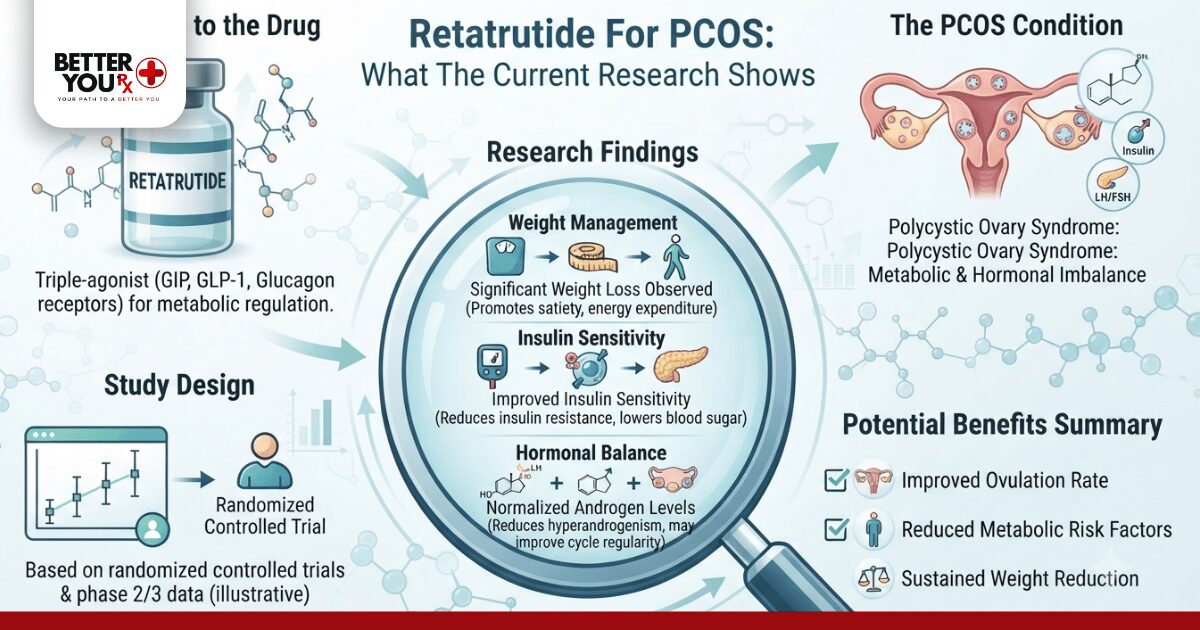
Retatrutide is a triple agonist, meaning it activates receptors for GLP-1, GIP, and glucagon simultaneously. Most currently available medications, including Semaglutide, act on GLP-1 alone, while Tirzepatide combines GLP-1 and GIP. Adding the glucagon receptor is what distinguishes Retatrutide in ongoing research, and early trial data has shown meaningful effects on weight and metabolic markers in study participants.
Because insulin resistance sits at the center of so many PCOS symptoms, a medication that produces significant improvements in insulin sensitivity and weight is naturally of interest to researchers and clinicians who treat PCOS. That said, interest and evidence are not the same thing, and Retatrutide’s PCOS-specific research base is still thin compared to more established options.
Why Retatrutide For PCOS Keeps Coming Up In Research Conversations
Three overlapping factors explain the growing interest.
First, PCOS and obesity frequently coexist, and even modest weight loss, in the range of five to ten percent of body weight, has been shown to restore ovulation in some women with PCOS. A medication associated with substantial weight reduction naturally draws attention from clinicians managing this population.
Second, insulin resistance is a shared thread between PCOS and the metabolic conditions Retatrutide is being studied for, so the underlying biology overlaps even without PCOS-specific trials.
Third, patients frequently ask their providers about newer options they encounter online, and clinicians report that questions about triple agonist medications have increased noticeably as awareness of these compounds has spread. This curiosity is common and reasonable, and it is exactly the sort of question best directed toward a provider who can weigh individual health history against the current evidence.
Retatrutide Vs Tirzepatide For PCOS: Comparing What Is Actually Known
| Factor | Retatrutide | Tirzepatide |
|---|---|---|
| Approval status | Investigational, not approved for any indication | Approved for type 2 diabetes and weight management |
| Receptor targets | GLP-1, GIP, and glucagon | GLP-1 and GIP |
| PCOS-specific trial data | Very limited | Emerging, small studies underway |
| Weight loss data available | Strong early trial results | Well established across multiple trials |
| Provider familiarity | Lower, still emerging | Higher, more prescribing experience |
Tirzepatide currently has more real-world prescribing history and a stronger safety record simply because it has been available and studied longer. That does not mean Tirzepatide is automatically the better long-term choice for every patient, but it does mean the evidence supporting its use is more mature today. Retatrutide’s ceiling may prove higher once more PCOS-specific research is published, but that conclusion is not yet supported by the data available now.
Women exploring Retatrutide vs Tirzepatide for their own situation often find that the right choice depends on prior medication history, other health conditions, and what their provider has the most experience prescribing.
Things To Know
- Retatrutide remains investigational, so self-administration guidance, reconstitution steps, and dosing schedules are not something to source outside of a clinical trial or a prescribing provider
- Weight loss itself, not the specific medication used to achieve it, is the strongest predictor of symptom improvement in PCOS
- Insulin resistance testing is a reasonable starting point before any metabolic medication conversation with a provider, including one about Retatrutide for PCOS
- PCOS symptom patterns vary widely, so what works well for one woman may not be the right fit for another
- A provider will typically want baseline labs, including hormone panels, before recommending any metabolic treatment approach
What The Research Says About Hormonal Balance
Direct evidence that Retatrutide improves hormonal imbalance in PCOS specifically is limited, since most published Retatrutide trials have focused on weight and general metabolic markers rather than reproductive hormones. What is better documented is that weight loss and improved insulin sensitivity, achieved through various methods, are associated with lower androgen levels and more regular ovulation in women with PCOS. According to MedlinePlus, lifestyle changes and medications addressing insulin resistance are commonly part of standard PCOS management.
In practice, providers who manage PCOS often describe a familiar pattern: patients who lose weight through any effective, medically supervised method frequently report their cycles becoming more predictable within a few months, even before androgen-related symptoms fully resolve. This lines up with the broader metabolic research, and it is one reason providers stay attentive to a patient’s whole metabolic picture rather than treating PCOS as a purely reproductive issue.
| PCOS Symptom | Believed Mechanism | Relevance To Metabolic Medications |
|---|---|---|
| Irregular ovulation | Elevated insulin driving excess androgen production | Improved insulin sensitivity may support more regular cycles |
| Acne and excess hair growth | Androgen excess affecting skin and hair follicles | Weight and insulin improvements may modestly reduce androgen levels |
| Weight gain resistance | Insulin resistance affecting fat storage | Medications supporting weight loss address this mechanism directly |
| Fatigue and low energy | Blood sugar swings tied to insulin resistance | More stable glucose levels may improve daily energy |
Which Option Is Actually The Best Fit
There is no single answer that applies to every woman with PCOS. For someone with more established insulin resistance, a provider may lean toward an approved option like Tirzepatide or Semaglutide simply because more prescribing experience exists. For someone earlier in their PCOS journey with milder symptoms, lifestyle changes alongside Metformin remain a well established first step many providers still recommend before considering a GLP-1 class medication at all.
Most healthcare providers follow established clinical protocols when evaluating metabolic medication options for PCOS, weighing a patient’s full history rather than reacting to a single medication name a patient has read about. The best fit is the one a licensed provider builds around an individual’s labs, symptom pattern, and treatment goals, not the newest compound in circulation.
Getting Started: What To Bring To The Conversation With Your Provider
Before discussing any metabolic medication for PCOS, it helps to arrive prepared. Bring a record of your cycle pattern over the past several months, any prior lab work including insulin and androgen levels, and a clear list of symptoms that bother you most. Providers appreciate specifics far more than a general request for “something new.”
Many women researching this topic are also exploring established options already used for weight and metabolic support, including Mounjaro Kwikpen, Zepbound Kwikpen, and Metformin, all with a longer track record in metabolic management than Retatrutide currently has.

Buy Ozempic Semaglutide from Canada
$327.99
Select options
This product has multiple variants. The options may be chosen on the product page

Buy Wegovy from Canada
Original price was: $609.99.$596.99Current price is: $596.99.
Select options
This product has multiple variants. The options may be chosen on the product page
Better You Rx operates as a prescription referral service with a licensed contracted dispensing department, connecting patients in the United States with the medications their provider prescribes once a valid prescription from a licensed physician is in place.

Retatrutide’s Investigational Status Deserves Respect
Retatrutide remains investigational, meaning it has not completed the review process required for approved medications, and trial data should not be treated as a green light for self-directed use. Reconstitution steps, injection technique, and dosing schedules for an investigational compound are not appropriate topics for general guidance, and any legitimate access happens through clinical trial enrollment or a prescribing provider working within an approved framework, should one become available.
For readers comparing options more broadly, resources covering Retatrutide benefits and Retatrutide side effects offer additional context on what current research does and does not support.
Moving Forward With Retatrutide For PCOS
Retatrutide for PCOS is a research question still being written, not a finished answer. Weight loss and improved insulin sensitivity, however achieved, tend to help many PCOS symptoms, and Retatrutide’s mechanism makes it a reasonable subject for future study, even though it is not yet an approved or established PCOS treatment. Women exploring metabolic medication for PCOS today have more established, better studied options available through a licensed provider, and that conversation is where real progress starts.
Is Retatrutide Safe For PCOS Patients?
Not established yet. Retatrutide is investigational, so its safety profile specifically in women with PCOS has not been formally studied or confirmed, and any use outside of clinical trials falls outside approved medical guidance.
Can Retatrutide Help With Hormonal Imbalance?
Indirectly, possibly. Retatrutide has not been directly studied for hormonal imbalance, but the weight loss and insulin improvements associated with it may support more balanced hormone levels, similar to patterns seen with other metabolic medications.
Is Reta Or Tirzepatide Better For PCOS?
Tirzepatide has more evidence. Tirzepatide is approved and has more real-world prescribing history, while Retatrutide remains investigational with far less PCOS-specific data available today.
Which GLP Is Best For PCOS?
It depends on the individual. Semaglutide and Tirzepatide currently have the most supporting data for PCOS-related weight and metabolic improvement, though the right choice depends on a person’s health history and provider guidance.
Can Reta Cause Infertility?
No evidence supports this. There is no established research linking Retatrutide to infertility, and in fact, weight loss achieved through metabolic medications has more often been associated with improved, not reduced, fertility markers in women with PCOS.
Sources
- Journal of Clinical Endocrinology and Metabolism, Endocrine Society: Clinical research on insulin resistance and its role in Polycystic Ovary Syndrome
- Mayo Clinic: Overview of Polycystic Ovary Syndrome causes, symptoms, and standard management approaches
- The Lancet Diabetes and Endocrinology: Published trial data on triple agonist and dual agonist metabolic medications
- American Society for Reproductive Medicine: Clinical guidance on weight management and ovulatory function in PCOS
- New England Journal of Medicine: Peer reviewed trial results on GLP-1 and multi-receptor agonist compounds
Medical Disclaimer: This content is for informational purposes only and is not intended as medical advice. It does not replace a consultation with a licensed healthcare provider. Always speak with a qualified physician before starting, stopping, or changing any medication or treatment plan, particularly regarding investigational compounds such as Retatrutide.