
Written by Amanda Reyes, BSN, RN | Medically Reviewed by Dr. Michael Torres, MD | Updated: August 2026
Last Updated: August 2026
Retatrutide for sleep apnea has not been studied directly, but the substantial weight loss associated with it in early research works through the same mechanism that makes Tirzepatide and Semaglutide effective for reducing sleep apnea severity in people carrying excess weight around the neck and airway. Because Retatrutide remains investigational, providers currently lean on medications with more established research when sleep apnea is the primary concern, while Retatrutide continues to be studied for broader metabolic outcomes. Weight loss, sleep disruption during early treatment, and which option currently has the strongest evidence behind it for sleep apnea specifically are the questions patients ask most.
Key Takeaways
- Retatrutide for sleep apnea works indirectly through significant weight loss, since weight loss is one of the most reliable ways to reduce obstructive sleep apnea severity.
- Retatrutide is still investigational, so figures referenced in research are reference points only. A licensed provider determines what is appropriate for any individual.
- Sleep disruption is commonly reported during early weight loss treatment, often tied to appetite changes or digestive adjustment.
- Tirzepatide and Semaglutide currently have more published data specific to sleep apnea than Retatrutide.
- Public figures like Shaquille O’Neal have drawn attention to sleep apnea and weight management, but individual results vary and are never a substitute for a sleep study.
Does Retatrutide Help With Sleep Apnea?
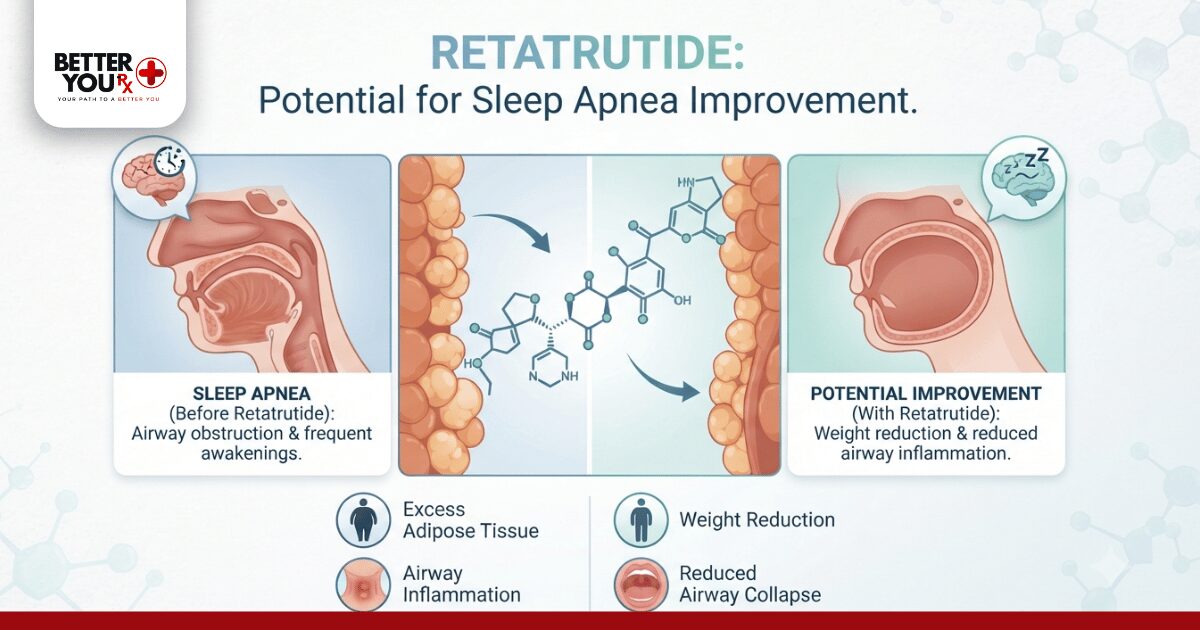
Retatrutide has not been the subject of a dedicated sleep apnea study the way some other incretin-based medications have. What it does have is strong early data showing substantial reductions in body weight, and weight is one of the most significant contributing factors to obstructive sleep apnea. When neck circumference and abdominal fat decrease, airway collapsibility during sleep tends to decrease as well, which is why weight loss medications in general are relevant to a sleep apnea conversation even without a trial designed around sleep as the primary outcome.
Sleep medicine specialists describe obstructive sleep apnea as a mechanical problem where soft tissue in the throat relaxes and narrows the airway during sleep. Excess fat around the neck and tongue base makes that narrowing more likely and more severe. Reducing that fat load through meaningful weight loss is one of the few interventions that can change the underlying anatomy rather than simply managing symptoms overnight.
What Is Retatrutide?
Retatrutide is an investigational triple agonist medication that acts on three separate gut hormone receptor pathways involved in appetite regulation and metabolism. It belongs to the same broader medication family as Tirzepatide and Semaglutide, though it targets an additional pathway that early researchers believe contributes to its notably strong weight loss results in research settings. Because Retatrutide is still investigational, dosing figures in research literature are reference points for scientific context only, never a substitute for what a licensed provider determines appropriate for an individual patient. Providers prescribing this medication class typically follow established clinical protocols, extending extra caution where long-term safety data is still limited.
Retatrutide for Sleep Apnea: What the Research Shows
The connection between Retatrutide and sleep apnea outcomes is currently indirect. Researchers have not published a trial measuring apnea-hypopnea index changes specifically for Retatrutide. What does exist is early phase research showing average body weight reductions larger, on a percentage basis, than those typically observed with older weight management medications.
Because obstructive sleep apnea severity correlates closely with body weight, especially visceral and neck fat, clinicians reasonably expect similar weight reductions from Retatrutide to produce similar downstream improvements in breathing during sleep. That expectation, however, is extrapolation from weight data, not a confirmed clinical finding. Patients considering Retatrutide for sleep apnea should understand this distinction before assuming the outcome is guaranteed.
| Medication | Sleep Apnea Specific Research | Typical Reported Weight Loss Range* |
|---|---|---|
| Tirzepatide | Dedicated sleep apnea research published | 15% to 20% |
| Semaglutide | Related cardiometabolic and weight research available | 10% to 15% |
| Retatrutide | Weight loss research only; no dedicated sleep apnea trial published | 17% to 24% |
*Figures reflect published research averages and are reference points only, not individual guarantees.
A sleep medicine provider evaluating a patient with obesity and diagnosed obstructive sleep apnea typically considers several factors before recommending any medication in this class, including current apnea-hypopnea index, cardiovascular history, and how much weight loss would realistically change airway function.
Things To Know
- Weight loss of even 10% of body weight has been linked to measurable reductions in sleep apnea severity in published research.
- Retatrutide’s third receptor pathway is believed to drive its comparatively larger average weight loss results, though this mechanism is still being studied.
- Sleep apnea severity is typically measured using the apnea-hypopnea index, which counts breathing interruptions per hour of sleep.
- A continuous positive airway pressure device remains the standard first-line treatment for moderate to severe obstructive sleep apnea regardless of weight loss progress.
- No weight loss medication, including Retatrutide, is intended to replace a diagnosed sleep apnea treatment plan.
How Weight Loss Changes Airway Function During Sleep
The throat is surrounded by soft tissue, muscle, and fat that naturally relax during sleep. In people carrying extra weight around the neck and upper body, that relaxed tissue has less room to move without partially or fully blocking airflow, which is why obstructive sleep apnea is so strongly linked to body weight.
As body weight decreases, soft tissue around the airway typically decreases too, reducing how often the airway collapses during sleep. Patients who lose a meaningful percentage of body weight often report needing lower pressure settings on their airway devices. According to the Sleep Foundation, weight management is considered one of the most effective non-device strategies for improving sleep apnea outcomes over time.
This is also why Tirzepatide, sold under the brand names Mounjaro and Zepbound, has become a frequent topic in sleep medicine circles. Its weight loss results were large enough that researchers measured whether that weight loss translated into fewer breathing interruptions during sleep, and results showed a meaningful reduction in apnea events for many participants.
Which GLP-1 Option Is Best for Sleep Apnea?
Choosing between Retatrutide, Tirzepatide, and Semaglutide for a sleep apnea related goal depends on what stage of research each medication has reached.
Why weight loss magnitude matters: Sleep apnea improvement tends to track with the amount of weight lost, so a medication associated with larger average weight reductions has a plausible advantage on paper. This is part of why Retatrutide draws interest, since its early research shows some of the largest average weight loss figures reported among this medication class.
How providers currently decide: Providers weigh how much clinical evidence exists for a medication in the specific context being treated. Tirzepatide currently has dedicated published research showing improvement in breathing events during sleep, which gives providers more confidence recommending it for that particular goal.
Which option is generally considered best: Tirzepatide currently has the most direct supporting research for sleep apnea, followed by Semaglutide, with broader cardiometabolic data supporting its safety profile. Retatrutide remains a reasonable option to discuss for weight management broadly, but not yet the option with dedicated sleep apnea research behind it. A provider reviewing a patient’s sleep study, weight history, and overall health is best positioned to determine what fits.
| Consideration | Tirzepatide | Semaglutide | Retatrutide |
|---|---|---|---|
| Sleep apnea specific data | Available | Limited | Not yet available |
| Receptor pathways targeted | Two | One | Three |
| Research maturity | Established | Established | Investigational |
Patients interested in learning more about how Retatrutide compares to Tirzepatide in broader research contexts can review how the two medications differ beyond sleep apnea specifically, since overall metabolic effects, side effect profiles, and research maturity all factor into a provider’s recommendation.

Why Sleep Problems Can Happen During Treatment
Some patients starting a GLP-1 or triple agonist medication report new sleep difficulty rather than improvement, at least in the early weeks. This is a real and commonly reported experience with a few explanations rather than one single cause.
Appetite suppression can shift when and how much a person eats in the evening, and digestive adjustment, including nausea or delayed stomach emptying, can make lying down uncomfortable at bedtime. Some patients also describe lighter sleep during the first few weeks as their body adjusts to hormonal changes affecting appetite and digestion signaling. Sleep specialists commonly observe that this early disruption tends to ease as the body adapts, though persistent sleep difficulty should always be raised with a provider rather than left to resolve on its own.
For patients taking Retatrutide, this is layered with the medication’s investigational status. Because long-term data is more limited than for Tirzepatide or Semaglutide, providers tend to monitor patients more closely for new symptoms, including sleep changes, during early treatment.
What Are the Risks of Taking a Medication Like Retatrutide?
Retatrutide shares a general side effect profile with other medications in its family, including nausea, digestive discomfort, and appetite changes most pronounced early in treatment. Because it is investigational, its long-term safety profile is less established than Tirzepatide or Semaglutide, both of which have years of broader clinical use behind them.
Patients considering Retatrutide should discuss their full medical history with a provider, including any thyroid, pancreatic, or gastrointestinal concerns. A provider is the appropriate person to determine whether current sleep apnea severity, cardiovascular health, and weight history make this class of medication reasonable at all.
Is Retatrutide for Sleep Apnea a Realistic Option Right Now?
Retatrutide for sleep apnea is a reasonable topic to raise with a provider, particularly for patients already candidates for weight management treatment who also carry a sleep apnea diagnosis. It is not currently positioned as a first-line sleep apnea treatment the way Tirzepatide has become for some patients, simply because the dedicated research has not caught up yet.
Patients exploring their weight management medication options often ask their provider to walk through established versus investigational choices, and a thorough sleep history combined with a current sleep study gives a provider the clearest picture of what fits. Reviewing how Retatrutide affects the body more broadly also helps patients understand what to expect beyond the sleep apnea question.
Getting Started
Patients exploring whether a GLP-1 or triple agonist medication fits their weight and sleep health goals typically start with their prescribing provider, followed by a referral through Better You Rx, a prescription referral service with a licensed contracted dispensing department that connects patients with appropriate options once a prescription has been issued.
Buy Ozempic Semaglutide from Canada
$327.99
Select options
This product has multiple variants. The options may be chosen on the product page
Buy Wegovy from Canada
Original price was: $609.99.$596.99Current price is: $596.99.
Select options
This product has multiple variants. The options may be chosen on the product page
Final Word on Retatrutide for Sleep Apnea
Retatrutide for sleep apnea is an emerging area of interest rather than an established treatment path today. The weight loss associated with Retatrutide in early research is meaningful, and weight loss remains one of the most reliable ways to reduce obstructive sleep apnea severity over time, but the direct research connecting Retatrutide to sleep apnea outcomes has not yet been published.
Patients with a sleep apnea diagnosis considering weight management treatment are best served by a conversation with their provider, a current sleep study, and an honest look at which medication currently has the strongest evidence behind it. For further reading, patients can review Retatrutide benefits for additional context on how this medication class is evolving, and learn more about Saxenda as another established weight management option.
Frequently Asked Questions
Does Retatrutide Help With Sleep Apnea?
Not directly, but the weight loss associated with Retatrutide can reduce sleep apnea severity in the same way weight loss from other medications does. No dedicated Retatrutide sleep apnea trial has been published, so this remains an extrapolation from weight loss data rather than a confirmed outcome.
What Are the Risks of Taking Retatrutide?
Common risks include nausea, digestive discomfort, and appetite changes, along with less established long-term safety data since Retatrutide is investigational. A provider should review personal medical history, including thyroid and pancreatic conditions, before considering this medication.
Which GLP-1 Drug Is Best for Sleep Apnea?
Tirzepatide currently has the most dedicated sleep apnea research behind it, making it the option providers most often discuss for that specific goal. Semaglutide follows with broader supporting data, while Retatrutide remains under investigation for this particular use.
Why Can’t I Sleep on Retatrutide?
Early sleep disruption is a commonly reported experience, often linked to appetite changes, digestive adjustment, or the body adapting to new hormonal signaling. This tends to ease over the first several weeks, though persistent issues should be discussed with a provider.
How Did Shaq Fix His Sleep Apnea?
Shaquille O’Neal has spoken publicly about managing his sleep apnea through a combination of weight-focused lifestyle changes and consistent use of a CPAP device as advised by his medical team. His experience reflects a broader pattern where weight management and standard sleep apnea treatment work together rather than either approach standing alone.
Sources
- New England Journal of Medicine: Clinical research on GLP-1 and triple agonist receptor medications and weight loss outcomes.
- The Lancet: Peer-reviewed research on incretin-based therapies and metabolic health.
- Mayo Clinic: Patient education on the causes and treatment of obstructive sleep apnea.
- Cleveland Clinic: Clinical overview of weight management medications and their role in metabolic health.
- Sleep Foundation: Research summaries on the relationship between weight loss and sleep apnea severity.
This content is for informational purposes only and is not a substitute for professional medical advice, diagnosis, or treatment. Always consult a licensed healthcare provider before starting, stopping, or changing any medication or treatment plan.