
Written by Zara Bennett, Health and Wellness Writer | Medically Reviewed by Dr. Melissa Grant, PharmD | Updated: July 2026
Last Updated: July 28, 2026
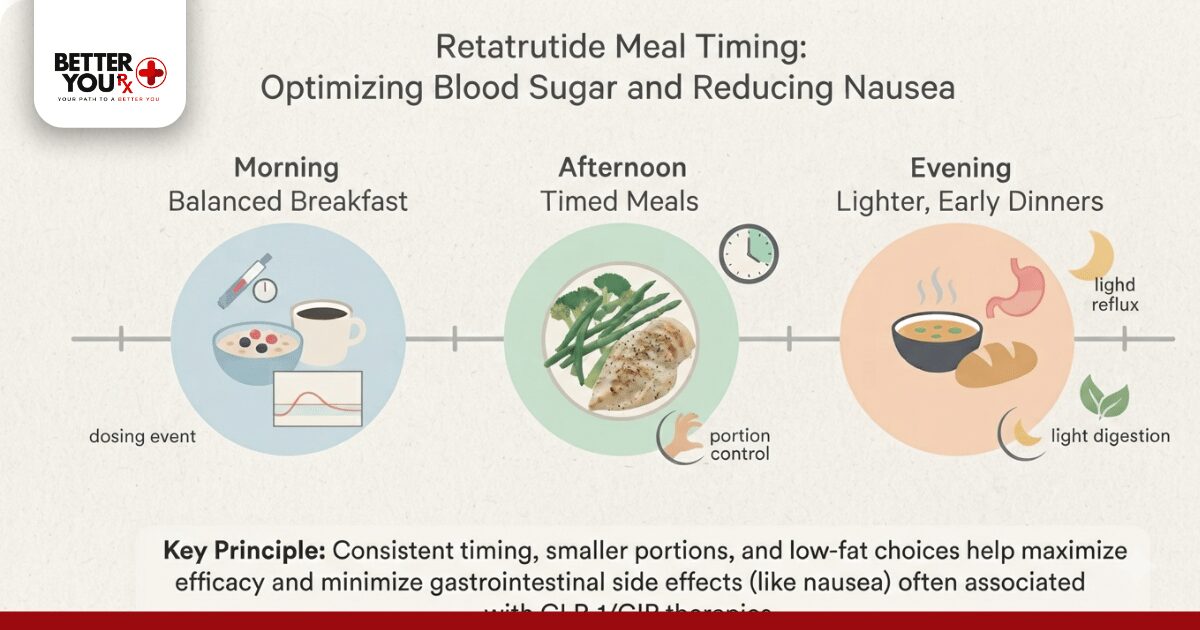
Retatrutide meal timing comes down to one central idea: what and when you eat shapes how comfortable your body feels while the compound is active, not whether it works at all. Most people report tolerating their dose best when they eat a modest, low-fat meal a couple of hours beforehand and avoid large or greasy meals in the hours that follow.
Key Takeaways
- Retatrutide meal timing changes how strong side effects like nausea and fullness feel, not whether the compound performs its studied role
- Eating a smaller, lower-fat meal a few hours before and after a dose tends to reduce stomach discomfort for most people
- Retatrutide slows how quickly food leaves the stomach, so pairing it with heavy or greasy meals often intensifies queasiness
- There is no single required hour to eat around a dose; individualized retatrutide meal timing should always be set with a healthcare provider
- Retatrutide remains an investigational compound, so every timing decision should be guided by provider oversight rather than self-directed trial and error
Why Retatrutide Meal Timing Matters
Retatrutide belongs to a research category of compounds studied for their action on appetite signaling and the speed at which the stomach empties. Because digestion slows down, food sits in the stomach longer than usual, which is precisely why meal choices around a dose have such an outsized effect on comfort.
Retatrutide is still investigational and is not an approved medication available through standard prescribing. Every detail here should be treated as a research reference point rather than a personal instruction, and anyone considering it should work through a licensed healthcare provider who can weigh individual health history before any dosing or meal pattern is set. Most healthcare providers who work with GLP-1 class compounds follow established clinical protocols for introducing new medications alongside dietary adjustments, and that same cautious, individualized approach applies here.
Skipping this step and eating on autopilot is one of the most common reasons people feel worse than they need to. A heavy, fried lunch eaten right around dosing time can turn mild queasiness into a genuinely rough afternoon, while the same meal eaten a few hours later might barely register.
Blood sugar swings are another reason meal choices deserve attention around a dose, particularly for anyone monitoring glucose as part of a broader health picture. Long gaps without food followed by a large, carbohydrate-heavy meal can produce a more noticeable rise and fall than smaller, steadier meals spread through the day. That pattern is worth flagging to a provider, especially for people already managing blood sugar alongside any research protocol.
Retatrutide Meal Timing at a Glance
| Time Relative to Dose | General Guidance | Why It Helps |
| 2 to 3 hours before | Small, low-fat meal | Reduces stomach fullness while the compound is most active |
| 30 to 60 minutes before | Light snack only, or nothing heavy | Prevents dosing on a completely empty, acid-heavy stomach |
| Immediately after dosing | Wait before eating anything substantial | Allows initial absorption without adding extra digestive load |
| 2 to 4 hours after | Balanced, moderate portion meal | Supports steady energy without overwhelming digestion |
| Evening hours | Avoid large, rich meals close to bedtime | Reduces reflux and nighttime nausea |
How Food and Retatrutide Interact
The reason meal timing gets so much attention traces back to gastric emptying. Compounds in this research class are studied for their ability to slow the rate at which the stomach releases food into the small intestine. That slower emptying is part of why appetite and fullness cues change so noticeably, but it is also the mechanism behind the nausea, bloating, and reflux that many people describe in the first weeks of exposure.
Harvard Health Publishing has written about how this class of gut hormone based compounds affects digestion and appetite regulation, noting that the slowed stomach emptying is a central part of both the intended effect and the common side effects. That slower digestion is also why fatty, fried, or very large meals tend to sit heavier and longer than they normally would, amplifying discomfort well beyond what the same meal would cause on its own.
Hydration plays a supporting role too. Sipping water steadily through the day, rather than gulping large amounts with a meal, tends to sit better on a stomach that is already digesting more slowly than usual.
Portion size matters just as much as food choice. A plate that would normally feel reasonable can feel uncomfortably large once gastric emptying slows down, which is why many people find they need to eat less at each sitting even when their overall appetite has not changed dramatically. Adjusting portions gradually, rather than cutting meals down all at once, tends to be easier to sustain.
Things To Know About Retatrutide and Meals
- Protein-forward, smaller portions are generally easier to tolerate than large, carbohydrate-heavy plates
- Alcohol can compound nausea and should be discussed with a provider rather than assumed safe
- Fiber is helpful in moderation, but very high-fiber meals eaten close to dosing can add to fullness and bloating
- Skipping meals entirely is not a shortcut; an empty stomach can make some people feel more nauseated, not less
- Every person’s tolerance is different, and what works for one week may need adjusting the next as the body adapts
Which Meal Timing Approach Works Best
Why does one approach work better than another? It comes down to matching the meal pattern to the specific side effects a person is experiencing. How this plays out in practice varies: someone with morning nausea often does better dosing later in the day, while someone who feels fine in the morning but sluggish at night may prefer the opposite.
Which option is best depends on lifestyle as much as biology. A grazing pattern of several small meals suits people with persistent fullness, while a more traditional three-meal structure with a buffer before and after dosing suits people whose main complaint is occasional queasiness rather than constant fullness. There is no universally superior schedule; the right retatrutide meal timing pattern is the one a person and their healthcare provider settle on after tracking a few weeks of response.
Comparing Meal Timing Approaches
| Approach | How It Works | Best For |
| Morning dosing with a breakfast buffer | Dose early, then eat a small meal one to two hours later | People with mild, manageable nausea who prefer routine |
| Evening dosing with an early dinner | Dose after a light early dinner, avoid late-night eating | People who notice more nausea earlier in the day |
| Grazing pattern | Several small meals spread evenly through the day | People with persistent fullness or reduced appetite |
Managing Nausea Around Your Dose
Patients commonly report that room-temperature or cold foods sit easier than hot, aromatic dishes in the first few hours around a dose, since strong smells can intensify queasiness. Ginger tea, plain crackers, and small sips of water are frequently mentioned as easy first steps when mild nausea appears. Providers who work with this compound class in practice often observe that people who eat smaller, more frequent meals report fewer digestive complaints than those who eat two or three large meals a day.
If nausea becomes severe, persistent, or is accompanied by vomiting that prevents keeping fluids down, that is a signal to contact a healthcare provider rather than to keep adjusting meals independently.
A common scenario healthcare providers describe is someone feeling fine for the first hour or two after a dose, then experiencing a wave of fullness once a meal is introduced too soon. Waiting a bit longer than feels necessary, then starting with a small portion rather than a full plate, tends to resolve this pattern for most people within the first few weeks.

Practical Tips for Retatrutide Meal Timing
- Keep a simple food and symptom log for the first month to spot personal patterns
- Favor grilled, baked, or steamed preparations over fried or heavily sauced dishes
- Space caffeine and alcohol away from dosing times rather than pairing them together
- Build meals around lean protein and vegetables before adding starches
- Adjust gradually, one variable at a time, so it is clear what actually changed the response
Because Retatrutide sits within the same broader research category as approved appetite and metabolic compounds, some people compare notes with those already using options like Mounjaro, Zepbound, or Saxenda through Better You Rx, a prescription referral service with a licensed contracted dispensing department connecting patients with prescribed treatment options. For more background on how this research compound compares to established options, retatrutide vs tirzepatide and what does retatrutide do offer additional context, while retatrutide benefits covers what the current research suggests about its studied effects.
Buy Wegovy from Canada
Original price was: $609.99.$596.99Current price is: $596.99.



Frequently Asked Questions About Retatrutide Meal Timing
How long after retatrutide should I eat?
Short answer: Most people wait roughly 30 to 60 minutes before eating anything substantial. This gives the compound time to begin absorbing without adding a heavy digestive load right away. A small, bland snack during that window is usually fine if hunger feels urgent, but a full meal is best saved for a bit later.
Should I eat before taking retatrutide?
Short answer: A small, low-fat meal a few hours earlier is generally preferred over dosing on an empty stomach. Going into a dose already very hungry can sometimes make early nausea feel more intense. A light snack close to dosing time is usually a reasonable middle ground.
How should I eat while taking retatrutide?
Short answer: Smaller, protein-forward meals spaced throughout the day tend to be easier to manage. Favoring grilled or baked preparations over fried foods also tends to reduce bloating and reflux.
When should you take reta, morning or night?
Short answer: Either can work, and the better choice depends on when side effects tend to show up. Morning dosing suits people who notice more nausea at night, while evening dosing suits people who feel worse earlier in the day.
What not to do on retatrutide?
Short answer: Avoid large, greasy meals close to dosing, skipping meals entirely, and adjusting your own dose without medical guidance. Alcohol and very high-fiber meals right around a dose are also worth minimizing.
Putting Retatrutide Meal Timing Into Practice
Retatrutide meal timing is less about finding one perfect hour on the clock and more about matching food choices to how a person’s body responds during the weeks it is being used under provider supervision. Smaller, lower-fat meals spaced a few hours from dosing, steady hydration, and patience while the body adjusts tend to make the biggest difference in day-to-day comfort. Because Retatrutide remains investigational, the safest path forward is always working closely with a licensed healthcare provider who can personalize both dosing and dietary guidance rather than relying on general timing rules alone.
Sources
- New England Journal of Medicine: Clinical research on GLP-1 and multi-receptor agonist compounds and their metabolic effects.
- Harvard Health Publishing: Overview of how gut hormone based compounds affect digestion, appetite, and gastric emptying.
- Mayo Clinic: Patient education on managing nausea and digestive side effects during metabolic treatment.
- Journal of Clinical Endocrinology and Metabolism: Peer reviewed research on incretin based compounds and gastrointestinal tolerability.
Medical Disclaimer
This article is for informational purposes only and does not constitute medical advice. Retatrutide is an investigational compound, and the information above should not be used as a substitute for individualized guidance from a licensed healthcare provider. Always consult a qualified medical professional before starting, adjusting, or stopping any treatment or dietary approach.