What Is The Retatrutide Missed Dose Protocol Patients Should Follow?
Written by Sarah Collins, Clinical Content Writer | Medically Reviewed by Dr. Amanda Reyes, MD | Last Updated: July 2026

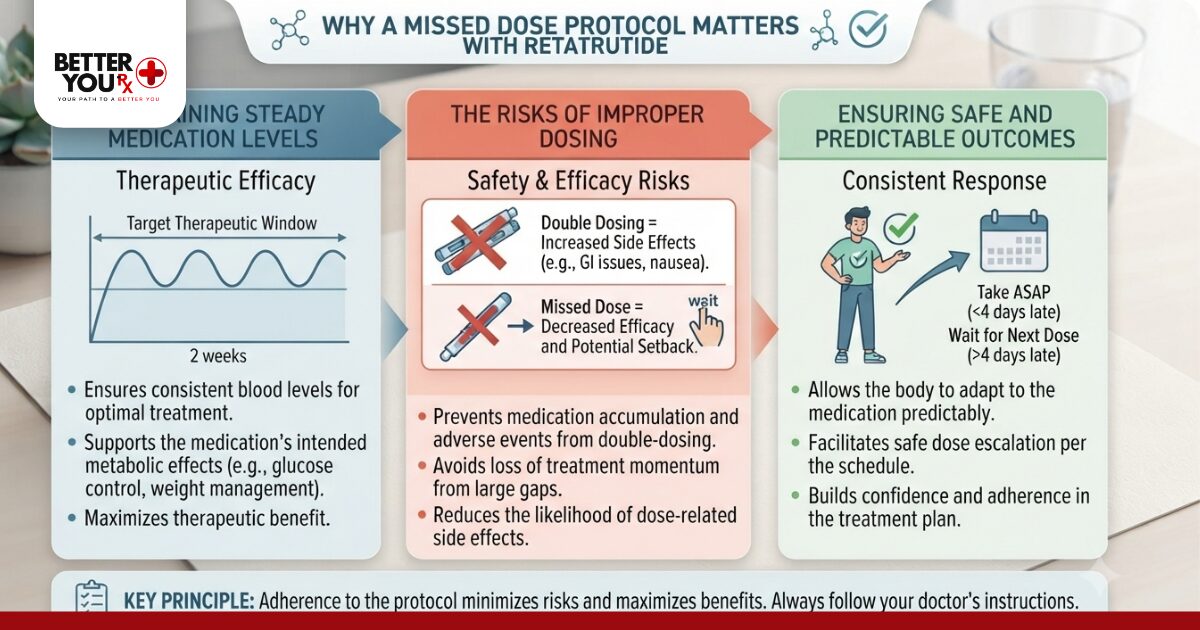
A Retatrutide missed dose protocol is not one-size-fits-all, since the appropriate next step depends heavily on how much time has passed since the missed dose was due and what stage of titration a patient is currently in. Providers generally advise patients to take the dose as soon as they remember if enough time remains before the next scheduled dose, or to skip it entirely and resume the regular schedule if too much time has passed. Because Retatrutide is still investigational, no missed dose should be handled without confirming the right approach with a licensed provider first.

Key Takeaways

  • A Retatrutide missed dose protocol generally depends on how many days have passed since the scheduled dose was due
  • Providers typically guide patients toward either taking the dose as soon as possible or waiting until the next scheduled dose, never doubling up
  • Because Retatrutide remains an investigational compound, missed dose guidance should always come directly from the prescribing provider rather than general assumptions
  • Consistency in timing supports steadier appetite and metabolic response, which is why missed doses are addressed promptly rather than ignored
  • Keeping a simple dosing log helps patients and providers identify patterns and adjust the schedule if missed doses become frequent

Why A Missed Dose Protocol Matters With Retatrutide

Consistency plays a meaningful role in how compounds like Retatrutide affect appetite regulation and metabolic signaling. Because Retatrutide acts on three separate receptor pathways, GLP-1, GIP, and glucagon, maintaining a steady schedule helps the body respond predictably from one dose to the next. A missed dose does not undo prior progress, but repeated inconsistency can make it harder for a provider to accurately gauge tolerability and effectiveness during titration.

This is one of the main reasons a clear missed dose protocol matters. Patients who know what to do the moment they realize a dose was missed tend to feel less anxious about the situation and are less likely to make an uninformed decision, such as taking a double amount to compensate. A calm, structured response supports both safety and the overall rhythm of treatment.

General Guidance Within A Typical Missed Dose Protocol

While every provider tailors guidance to the individual patient, most missed dose protocols for investigational compounds like Retatrutide follow a similar general structure based on how much time has elapsed.

Time Since Missed Dose General Guidance Reasoning
Within a few days Take the missed dose as soon as remembered Still within a reasonable window to maintain rhythm
Approaching the next scheduled dose Skip the missed dose entirely Reduces risk of overlapping effects from two doses too close together
Multiple weeks missed Contact the provider before resuming May require restarting at a lower amount to reassess tolerability
Uncertain about timing Contact the provider for individualized direction Ensures the decision reflects the patient’s specific titration stage

This table reflects general patterns rather than a fixed rule, since a provider’s actual recommendation will always account for a patient’s current dose, titration history, and how their body has responded to Retatrutide so far.

Things To Know

  • A Retatrutide missed dose protocol should always be confirmed with the prescribing provider rather than assumed from general information
  • Doubling a dose to make up for a missed one is not recommended under any circumstances
  • Patients further along in titration may need different guidance than those in early stages
  • Missing multiple doses in a row may prompt a provider to reassess the current stage before resuming
  • Keeping a simple record of dosing days makes it easier to answer a provider’s questions if a dose is ever missed

Retatrutide Missed Dose Protocol

Why Doubling Up Is Not Part Of Any Missed Dose Protocol

One of the most important elements of any Retatrutide missed dose protocol is what patients should not do, and doubling the next dose to compensate for a missed one falls squarely into that category. Taking two doses closer together than intended can intensify side effects such as nausea, fatigue, or digestive discomfort, particularly for a compound that already affects multiple metabolic pathways simultaneously.

Providers consistently emphasize this point because the temptation to “catch up” is understandable, especially for patients motivated to stay on track. In practice, providers tend to see better outcomes when patients follow the standard guidance for their specific situation rather than trying to correct for a missed dose on their own. Most healthcare providers follow established clinical protocols when advising patients on missed doses, prioritizing steady, predictable dosing over any attempt to compensate quickly.

How Titration Stage Affects Missed Dose Guidance

The right response within a Retatrutide missed dose protocol can shift depending on where a patient is in their titration schedule. A patient still in the early stages, working through lower amounts, may be advised differently than someone who has reached a higher, more established dose. Providers consider how long a patient has been at their current stage and how their body has responded so far when deciding whether a missed dose changes anything about the ongoing schedule.

For patients earlier in titration, a missed dose sometimes has little impact on the overall plan. For patients further along, a provider may want additional information, such as how many days were missed and whether any side effects were noticed beforehand, to determine whether it is appropriate to resume at the same amount or step back slightly before continuing.

Patients exploring related compounds such as Mounjaro or Zepbound may notice that missed dose considerations are also handled individually with these medications, since dosing schedules and receptor targets differ across GLP-1 and multi-receptor options.

What To Do Immediately After Realizing A Dose Was Missed

The first step in any Retatrutide missed dose protocol is simply pausing rather than reacting immediately. Patients are generally encouraged to check how many days have passed since the scheduled dose and review any notes they have kept about their current titration stage before deciding on a next step. Contacting the provider’s office promptly, rather than waiting until the next scheduled appointment, allows for timely guidance that reflects the patient’s specific circumstances.

In clinical practice, providers often note that patients who reach out promptly after a missed dose tend to have smoother experiences than those who wait and attempt to guess the right response on their own.

Common Patient Question Typical Provider Consideration
“Should I take it today?” Depends on days elapsed and proximity to next dose
“Should I skip it entirely?” Considered if the next dose is close
“Do I need to restart at a lower amount?” Considered after multiple missed doses
“Will this affect my results?” Addressed based on titration stage and consistency history

This table illustrates the kinds of questions providers typically address when guiding a patient through a missed dose, reinforcing why individualized communication matters more than applying a single blanket rule.

Preventing Missed Doses Going Forward

While an occasional missed dose is manageable within a well-communicated protocol, patients often find it helpful to build small habits that reduce the likelihood of it happening again. Setting a recurring reminder, pairing the dosing day with another regular weekly activity, or using a simple paper or digital log can all help maintain consistency. Patients frequently report that once they establish a routine tied to a specific day and time, missed doses become far less common.

For readers who want a deeper understanding of how Retatrutide compares to other options before or during treatment, Retatrutide versus Tirzepatide offers useful context, along with information on Retatrutide’s potential benefits and how to reconstitute Retatrutide properly as part of a broader understanding of the treatment process.

When To Contact A Provider Right Away

Certain situations within a Retatrutide missed dose protocol call for prompt provider contact rather than waiting to figure things out independently. This includes missing more than one dose in a row, feeling unsure about how much time has passed, or noticing new symptoms after resuming the schedule. Providers would rather field a quick question than have a patient guess incorrectly, particularly with an investigational compound where individual response can vary meaningfully between patients.

Better You Rx works within a prescription referral model, connecting patients with providers and a licensed contracted dispensing department, and does not set or recommend individual dosing decisions, since those determinations always rest with the prescribing provider.

How Titration Stage Affects Missed Dose Guidance

Bringing It All Together

There is no universal Retatrutide missed dose protocol that applies identically to every patient, only general guidance that a provider adapts based on timing, titration stage, and individual response. Patients who stay in close communication with their provider and avoid the temptation to compensate on their own tend to navigate missed doses with far less stress and disruption to their overall treatment plan.

Anyone exploring related metabolic health options can also review additional resources such as what Retatrutide does in the body or consider options like Saxenda while discussing the full range of provider-directed choices available.

Frequently Asked Questions

What Should I Do If I Miss A Retatrutide Dose?

Contact your provider before taking any action. The right response depends on how many days have passed and your current titration stage.

Should I Take A Double Dose To Catch Up?

No, doubling up is never recommended. This can increase side effects without providing any additional benefit.

Does A Missed Dose Undo My Progress?

No, a single missed dose typically does not undo progress. Repeated missed doses may require a provider to reassess your schedule.

How Do I Prevent Missing Future Doses?

Set a recurring reminder tied to a specific day. Many patients find pairing the dose with another weekly habit helps maintain consistency.

Is Retatrutide Approved For General Use?

No, Retatrutide remains an investigational compound. All dosing decisions, including a Retatrutide missed dose protocol, are made by a licensed provider on a case-by-case basis.

Sources

  1. New England Journal of Medicine — Clinical research on triple-receptor agonist compounds and their metabolic effects.
  2. The Lancet Diabetes & Endocrinology — Peer-reviewed data on GLP-1, GIP, and glucagon receptor co-agonism in metabolic treatment research.
  3. Mayo Clinic — Overview of investigational weight management medications and general dosing principles.
  4. Cleveland Clinic — Patient education resources on GLP-1 and multi-receptor agonist therapies.
  5. Journal of Clinical Endocrinology & Metabolism — Research on titration strategies and adherence in metabolic compound studies.

Medical Disclaimer: This content is provided for informational purposes only and is not intended as medical advice. It does not replace consultation with a licensed healthcare provider. Anyone considering Retatrutide or any other treatment should speak with a qualified medical professional to determine what is appropriate for their individual health needs before starting, adjusting, or discontinuing any medication.


 

What Is A Retatrutide Maintenance Dose And How Is It Determined?

Medically Reviewed by Dr. Amanda Reyes, MD | Last Updated: July 2026

A Retatrutide maintenance dose is the amount a provider identifies as the right long-term fit once the initial titration process is finished. Rather than continuing to increase, patients typically remain at this level for an extended period while their provider monitors response and tolerability. Because Retatrutide affects multiple metabolic pathways, the specific maintenance amount looks different from one patient to the next, shaped by how their body responded at each earlier stage.

Key Takeaways

  • A Retatrutide maintenance dose is the amount a provider settles on after titration is complete, meant to be sustained rather than increased further
  • This dose varies by individual and depends on tolerability, response, and the provider’s clinical judgment throughout earlier titration stages
  • Retatrutide remains an investigational compound, so maintenance planning is handled entirely through provider oversight rather than a fixed protocol
  • Some patients reach maintenance at a lower or moderate amount, while others require a higher tier to sustain their treatment goals
  • Ongoing check-ins with a provider help confirm that a maintenance level continues to work well over time

How Is A Retatrutide Maintenance Dose Chosen?

There is no single number that applies to every patient. Providers determine a maintenance level by looking at how a patient tolerated each prior titration stage, whether metabolic and appetite markers have stabilized, and whether the patient’s treatment goals are being met at the current amount. Some patients settle into maintenance at a lower tier because that level already produces the intended response, while others progress further before their provider identifies a suitable long-term fit.

Because Retatrutide engages GLP-1, GIP, and glucagon receptor pathways simultaneously, individual variability tends to be more pronounced than with single-mechanism compounds like Semaglutide. This is part of why maintenance planning is handled on a case-by-case basis rather than through a standardized formula. A provider will typically look at several months of accumulated response data before confirming that a patient has truly settled, rather than making that determination after just one or two titration steps.

It also helps to understand that reaching a stable level is not simply about finding the highest amount a patient can tolerate. Many providers describe the process as identifying the lowest effective amount that produces the desired outcome, since this approach tends to minimize unnecessary side effects while still supporting the patient’s broader metabolic health goals.

Some patients assume maintenance is reached the moment side effects fade, but providers usually look for more than just comfort. They want to see that appetite regulation, energy levels, and any relevant metabolic markers have stabilized over several consecutive check-ins before confirming a long-term amount. This distinction matters because comfort alone does not always indicate that the treatment goal has actually been achieved.

Typical Progression Toward A Maintenance Level

Most patients move through a general titration sequence before their provider settles on a stable long-term amount, though the specifics are always individualized.

Treatment Phase General Focus Typical Duration
Initial Titration Establishing baseline tolerability Early weeks of treatment
Gradual Increases Adjusting toward an effective amount Several months
Response Evaluation Confirming metabolic and appetite response Ongoing during titration
Maintenance Phase Sustaining a stable long-term amount Long-term, with periodic reassessment

This table reflects a general pattern rather than a fixed protocol, since providers adjust timing and amounts based on each patient’s individual response. Some patients move through these phases relatively quickly if they tolerate early increases well, while others spend additional time at each stage to confirm comfort before advancing.

It is also worth noting that the transition between phases is rarely abrupt. A provider may keep a patient at what looks like a titration amount for several extra weeks simply to gather more observation before officially calling it a maintenance level, particularly if early results are promising but not yet fully confirmed.

Things To Know

  • A Retatrutide maintenance dose is not necessarily the highest amount a patient could tolerate, but the amount that best balances effectiveness and comfort
  • Reaching maintenance does not mean treatment decisions are finished, since providers continue to monitor progress over time
  • Retatrutide is still considered investigational, so maintenance guidance may evolve as more clinical understanding develops
  • Adjustments to a maintenance level should only happen under a provider’s direction, never independently
  • Patients who reach a stable maintenance amount often report that consistency, rather than continued increases, made the biggest difference in how manageable treatment felt day to day
  • Lifestyle factors such as diet, hydration, and activity levels can influence how well a patient tolerates their maintenance amount, and providers may discuss these alongside dosing

How Is A Retatrutide Maintenance Dose Chosen

Why Maintenance Levels Differ Between Patients

The reasoning behind individualized maintenance planning comes down to how differently people respond to compounds that act on multiple metabolic pathways at once. One patient may reach their treatment goals comfortably at a moderate amount, while another may need a higher tier to achieve a similar response. Providers weigh tolerability just as heavily as effectiveness when identifying where a patient should remain long-term.

Body composition, metabolic history, and how gradually a patient moved through titration can all play a role in where maintenance ultimately settles. A patient who experienced persistent gastrointestinal discomfort at moderate amounts, for example, may end up remaining at that same level for maintenance rather than advancing further, even if their metabolic response has not fully plateaued.

Age, activity level, and any co-occurring health conditions can also shape where a provider ultimately lands. A patient managing another chronic condition alongside their metabolic health goals may need a more conservative long-term amount, while someone with fewer complicating factors might tolerate and benefit from a higher tier. None of these variables are considered in isolation, which is part of why two patients starting treatment around the same time can end up at noticeably different maintenance levels.

In clinical practice, providers often observe that patients who progressed slowly through titration, without significant gastrointestinal symptoms along the way, tend to settle into a stable maintenance level more comfortably than those who advanced quickly. Most healthcare providers follow established clinical protocols when guiding this process, prioritizing sustainable long-term outcomes over reaching the highest possible amount.

Patients exploring related options such as Mounjaro or Zepbound as part of a broader metabolic health conversation may find it useful to compare how maintenance planning differs across compounds, since not every option follows the same long-term dosing structure.

How Providers Monitor A Maintenance Dose Over Time

Settling into a maintenance level does not mean treatment becomes hands-off. Providers typically schedule periodic follow-ups to confirm that a patient’s Retatrutide maintenance dose continues to support their goals and remains well tolerated. If a patient’s response changes over time, whether due to weight loss plateaus, side effects, or shifting health needs, a provider may reassess whether the current amount still makes sense.

These follow-ups often include a review of any new symptoms, a discussion of how appetite and energy levels have trended since the last visit, and occasionally lab work to monitor broader metabolic markers. Patients are generally encouraged to keep track of how they feel between appointments, since detailed observations can help a provider make more informed decisions about whether the current amount remains appropriate.

Many providers also ask patients to note things like sleep quality, digestion patterns, and any changes in mood or energy, since these details can offer early clues about how well a maintenance amount is being tolerated even before more obvious symptoms appear. Bringing these observations to appointments tends to make follow-up visits more productive and helps providers spot small shifts before they become larger concerns.

This ongoing oversight is part of standard practice for investigational compounds, since long-term data continues to develop even as more patients reach stable maintenance phases. Regular monitoring also gives providers an opportunity to address any emerging tolerability concerns before they affect a patient’s ability to continue treatment consistently.

For readers comparing broader options, the difference between Retatrutide and Tirzepatide is worth reviewing, along with a closer look at Retatrutide’s potential benefits and documented Retatrutide side effects, both of which can help inform a more productive conversation with a provider about long-term planning.

How Is A Retatrutide Maintenance Dose Chosen

Comparing Maintenance Approaches Across Compounds

Maintenance planning looks somewhat different depending on which compound a provider has selected, since each one carries its own titration structure and tolerability profile.

Compound Maintenance Approach Primary Mechanism
Retatrutide Individualized long-term amount based on response GLP-1, GIP, and glucagon receptor activity
Tirzepatide Provider-determined maintenance range GLP-1 and GIP receptor activity
Semaglutide Provider-determined maintenance range GLP-1 receptor activity

This comparison highlights why maintenance planning is never a one-size-fits-all decision. The right long-term amount depends on the compound selected, how a patient responded throughout titration, and what their provider determines will support sustainable results. Patients switching between compounds, or considering a change in their treatment plan, should expect their provider to restart a similar evaluation process rather than carrying over an existing maintenance amount from a different medication.


What Happens If A Maintenance Dose Needs Adjusting

Occasionally, a provider may decide that a patient’s current maintenance amount needs to be revisited, whether because tolerability has changed or because treatment goals have shifted. This process mirrors the same careful, incremental approach used during initial titration rather than a sudden change. Patients should never adjust a maintenance level on their own, since even small changes to compounds that affect multiple metabolic pathways can influence tolerability meaningfully.

A provider might also revisit a maintenance amount if a patient reports that their appetite response has changed, if weight loss has plateaued longer than expected, or if new health conditions arise that could interact with continued treatment. In each case, any adjustment tends to happen gradually, mirroring the pace used during the original titration phase rather than jumping directly to a new amount.

Occasionally, external factors unrelated to the medication itself, such as changes in daily routine, travel, or shifts in overall stress levels, can also influence how a patient responds at a previously stable amount. Providers take these variables into account before assuming that a change in response necessarily calls for a dosing adjustment, since sometimes the underlying cause is temporary rather than a true shift in tolerability.

Better You Rx operates as a prescription referral service with a licensed contracted dispensing department, connecting patients with providers who oversee these ongoing dosing decisions. Maintenance planning, like all titration decisions, remains the responsibility of the prescribing provider rather than something determined independently by the patient.

Bringing It All Together

A Retatrutide maintenance dose reflects a personalized balance between effectiveness and comfort, arrived at gradually through provider-guided titration rather than a fixed endpoint. Patients who understand that maintenance is an ongoing, monitored phase, not a static finish line, tend to have more realistic expectations about what long-term treatment involves. Staying in consistent communication with a provider remains the most reliable way to ensure a maintenance level continues to serve a patient’s evolving health needs over the months and years that follow.

Anyone exploring related metabolic health topics can also review what Retatrutide does in the body or consider options like Saxenda while discussing the full range of provider-directed choices available.

Frequently Asked Questions

What Is A Retatrutide Maintenance Dose?

It is the stable amount a provider settles on after titration. This level is meant to be sustained long-term rather than increased further, based on individual tolerability and response.

How Long Does It Take To Reach Maintenance?

Typically several months of gradual titration. The exact timeline depends on how a patient tolerates each stage before their provider identifies a sustainable long-term amount.

Can A Maintenance Dose Change Over Time?

Yes, if a provider determines it is necessary. Changes are made gradually and only under medical supervision, never independently by the patient.

Is The Maintenance Amount The Same For Everyone?

No, it varies significantly between patients. Individual tolerability, response, and treatment goals all influence where a provider sets a long-term maintenance level.

Does Reaching Maintenance Mean Treatment Is Finished?

No, ongoing monitoring continues. Providers schedule periodic follow-ups to confirm the maintenance level remains effective and well tolerated over time.

Sources

  1. New England Journal of Medicine — Clinical research on triple-receptor agonist compounds and their metabolic effects.
  2. The Lancet Diabetes & Endocrinology — Peer-reviewed data on GLP-1, GIP, and glucagon receptor co-agonism in metabolic treatment research.
  3. Mayo Clinic — Overview of investigational weight management medications and general dosing principles.
  4. Cleveland Clinic — Patient education resources on GLP-1 and multi-receptor agonist therapies.
  5. Journal of Clinical Endocrinology & Metabolism — Research on titration strategies and tolerability in metabolic compound studies.

Medical Disclaimer: This content is provided for informational purposes only and is not intended as medical advice. It does not replace consultation with a licensed healthcare provider. Anyone considering Retatrutide or any other treatment should speak with a qualified medical professional to determine what is appropriate for their individual health needs before starting, adjusting, or discontinuing any medication.

 

Retatrutide Exercise Recommendations: What Actually Supports Results

Retatrutide exercise recommendations generally combine two to three weekly strength training sessions with light to moderate cardio, built around steady protein intake and enough rest between workouts. The goal is straightforward: protect lean muscle mass while thebody sheds fat, since rapid weight loss without resistance work tends to take muscle along with it.

Patients working with a prescribing provider often ask the same follow up question almost immediately after starting treatment: does exercise even matter if the medication is already reducing appetite and supporting weight loss on its own? The honest answer is yes, and the reasoning behind it explains a lot about how the body responds to fast, medication supported weight change.

Key Takeaways

  • Retatrutide exercise recommendations generally center on two to three weekly strength sessions paired with light to moderate cardio, not cardio alone.
  • Resistance training is the single most effective way to protect lean muscle while body weight drops.
  • Cardio supports heart health and daily calorie balance, but it works best as a supporting habit, not the main event.
  • Retatrutide is still an investigational compound, and any use of it should happen only under the direct guidance of a licensed medical provider.
  • Consistency, adequate protein, and rest matter more than intensity, particularly during the first several months.

What Retatrutide Exercise Recommendations Actually Look Like

A workable weekly structure usually includes two to three strength sessions, two to three shorter cardio sessions, and at least one full rest day. The strength sessions focus on major muscle groups: legs, back, chest, shoulders, and core, ideally on non-consecutive days so muscles have time to recover.

Cardio does not need to be intense to be useful. Walking, cycling, swimming, or a light jog for twenty to thirty minutes several times a week supports cardiovascular health and helps offset the reduced activity levels that sometimes come with lower appetite and lower energy in the early weeks of treatment.

Retatrutide remains an investigational compound studied primarily in a research setting, and self-directed dosing decisions are not something this article covers. Anyone considering it should work directly with a licensed medical provider who can determine whether it is appropriate and how it fits into an individualized care plan. For readers comparing how Retatrutide relates to other GLP-1 based compounds, Retatrutide vs Tirzepatide breaks down the mechanism differences in more detail.

Why Movement Matters More During Fast Weight Loss

When weight comes off quickly, whether through calorie reduction, medication, or both, the body does not automatically know to pull fat stores rather than muscle tissue. Without a reason to keep muscle, such as regular resistance training and enough dietary protein, a meaningful share of the weight lost can come from lean tissue instead of fat.

This matters beyond appearance. Muscle tissue drives resting metabolism, supports joint stability, and plays a role in long-term blood sugar regulation. Losing too much of it during treatment can make the number on the scale look good while actual body composition and long-term metabolic health quietly move in the wrong direction.

Most healthcare providers follow established clinical protocols when guiding patients through medication-supported weight loss, and resistance training is a near-universal recommendation across those protocols specifically because of this muscle preservation concern. It is not an optional add-on; it is treated as a core part of getting a sustainable result.

Cardio Versus Strength Training: Which Carries More Weight

Both forms of movement matter, but they are not interchangeable, and people often lean too heavily on one while neglecting the other.

Exercise Type Primary Benefit Recommended Frequency
Strength Training Preserves and builds lean muscle, supports metabolism 2 to 3 sessions weekly
Moderate Cardio Supports heart health, aids calorie balance, improves stamina 2 to 3 sessions weekly, 20 to 30 minutes
Walking Low-impact activity, easy recovery, supports daily movement goals Daily, as tolerated
Flexibility or Mobility Work Reduces injury risk, supports joint comfort 1 to 2 sessions weekly

For someone new to structured exercise, strength training generally deserves the priority slot because it is the harder habit to build and the one most directly tied to protecting muscle. Cardio can be layered in around it once a routine feels manageable.

Things To Know About Exercising While On Retatrutide

A few practical points come up consistently among patients and providers navigating early treatment:

  • Appetite reduction can sometimes mean lower energy intake than the body needs to fuel workouts, so protein and hydration deserve extra attention on training days.
  • Soreness and fatigue may feel more noticeable in the first few weeks, so starting with shorter, lower-intensity sessions and building up gradually is more sustainable than an aggressive start.
  • Skipping meals before a workout is common but often counterproductive; a small protein-forward snack beforehand tends to support better performance and recovery.
  • Sleep quality directly affects muscle retention, so treating rest as part of the exercise plan, not separate from it, tends to produce better outcomes.
  • Any new or worsening joint pain, dizziness, or unusual fatigue during exercise should be discussed with a provider rather than pushed through.

Patients frequently report that the biggest adjustment is not the exercise itself but the timing around it, since appetite and energy levels can shift week to week during early treatment. Providers commonly observe that patients who track how they feel during workouts, rather than just tracking weight, tend to stick with a routine longer.

Retatrutide Exercise Recommendations

How to Keep Muscle While Body Weight Drops

Protecting muscle comes down to a small set of repeatable habits rather than anything complicated. Progressive resistance training, meaning gradually increasing weight or repetitions over time, signals to the body that muscle tissue is still needed and worth keeping.

Protein intake spread across meals, rather than concentrated in one sitting, supports muscle repair more consistently throughout the day. Many providers suggest aiming for a protein source at each meal, particularly on training days, since appetite suppression can make it easy to under-eat protein without noticing.

Rest days are not wasted days. Muscle rebuilding happens during recovery, not during the workout itself, so at least one or two full rest days per week supports the same goal that training sessions are working toward.

For readers exploring how Retatrutide compares in terms of overall effect and reported outcomes, Retatrutide benefits covers what current research has shown so far, while Retatrutide side effects outlines what patients commonly report during treatment.

Which Approach Is Best for Your Goals

The right balance of cardio and strength depends heavily on what someone is trying to achieve, and there is no single universal answer.

Goal Best Approach Why It Works
Preserve muscle during weight loss Prioritize strength training, 3x weekly Directly signals the body to retain lean tissue
Improve cardiovascular health Moderate cardio, 3 to 4x weekly Builds heart and lung capacity over time
General activity and mood support Daily walking, light movement Low barrier to entry, easy to sustain long term
Faster visible body composition change Combined strength and cardio routine Supports fat loss while limiting muscle loss

For most people starting out, a combined approach works better than picking one extreme. Strength training alone without any cardio can leave cardiovascular health underserved, while cardio alone without resistance work tends to accelerate muscle loss during rapid weight change. The combined approach is generally considered the most balanced retatrutide exercise recommendation for people managing both body composition and long-term health.

Anyone interested in how other GLP-1 based options compare on this same front can review Mounjaro, Zepbound, or Saxenda, all of which are available through Better You Rx, a prescription referral service with a licensed contracted dispensing department connecting patients with prescribed treatment options.


Things To Know About Exercising While On RetatrutideThe Bottom Line on Retatrutide Exercise Recommendations

Retatrutide exercise recommendations are not about pushing harder than the body can handle; they are about giving the body a reason to hold onto muscle while fat comes off. Strength training carries most of that responsibility, cardio supports the rest, and rest days quietly do more work than most people give them credit for.

Patients who treat exercise as part of the treatment plan rather than an afterthought tend to report steadier progress and fewer surprises along the way. Anyone weighing Retatrutide against other options can also review Trulicity or explore how it stacks up in Ozempic vs Trulicity for a broader picture of currently available treatments.

Frequently Asked Questions About Retatrutide Exercise Recommendations

What exercise should I do on retatrutide?

A mix of strength training two to three times weekly and moderate cardio two to three times weekly works best. Walking daily and adding light mobility work rounds out a sustainable routine.

Do you need to do cardio on Retatrutide?

Cardio is not strictly required, but it is strongly recommended for heart health and stamina. Twenty to thirty minutes of moderate activity a few times a week is generally sufficient.

Does Retatrutide work without working out?

Yes, appetite and weight changes can occur without exercise, since the compound works through its own mechanism. However, skipping exercise raises the risk of losing muscle along with fat.

How to keep muscle on retatrutide?

Consistent resistance training paired with adequate protein intake is the most reliable way to protect muscle. Spreading protein across meals and avoiding long gaps without training also helps.

Should you take a break from retatrutide?

Any decision about pausing or adjusting treatment should be made with a licensed medical provider, not independently. Providers assess this based on individual response, goals, and overall health.

Sources

  1. Journal of Clinical Endocrinology and Metabolism — Research on GLP-1 and multi-agonist receptor compounds and their effects on body composition.
  2. Mayo Clinic — Overview of resistance training and its role in preserving lean muscle during weight loss.
  3. Obesity Reviews — Published research on exercise strategies during pharmacological weight management.
  4. American Council on Exercise — Guidance on structuring strength and cardiovascular training for weight management goals.
  5. Harvard T.H. Chan School of Public Health — Research summaries on protein intake and muscle preservation during weight loss.

Medical Disclaimer: This content is for informational purposes only and is not a substitute for professional medical advice, diagnosis, or treatment. Always consult a licensed healthcare provider before starting any exercise program or medication, including Retatrutide, and before making changes to an existing treatment plan.

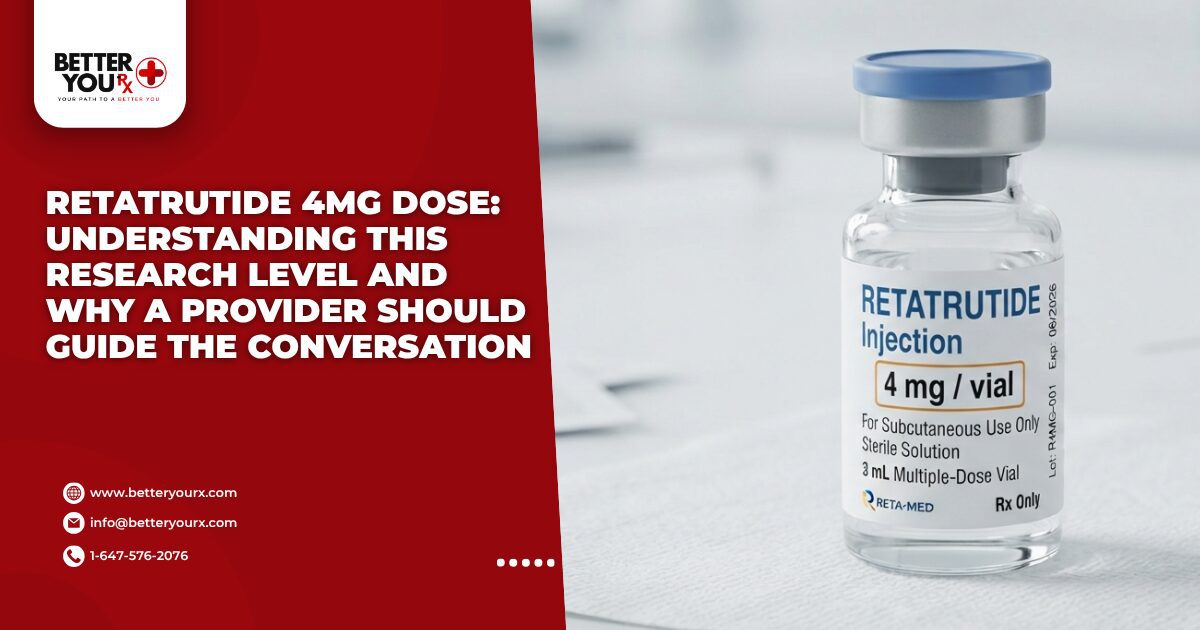
Retatrutide 4mg Dose: Understanding This Research Level and Why a Provider Should Guide the Conversation

Written by Maria Santos, BSc Health Communications | Medically Reviewed by Dr. Aleksandar Petrov, MD | Updated: July 2026

Last Updated: July 14, 2026

A Retatrutide 4mg dose refers to one of the higher amounts that has been examined in published research on this investigational compound, generally appearing later in a study’s range of tested levels. It is not a target number for self-directed use, and any discussion of this level should happen within a supervised relationship with a licensed provider.

Patients who come across this figure are often piecing together information from research summaries or informal online sources, trying to understand where it fits into the bigger picture. Knowing what a Retatrutide 4mg dose actually represents, and why that context does not carry over into personal use, helps make sense of a number that gets discussed frequently without much explanation.

Key Takeaways

  • A Retatrutide 4mg dose is one of the higher levels that has appeared in published research on this investigational compound, not a fixed number meant for independent use.
  • Because Retatrutide remains an investigational compound, any mention of a Retatrutide 4mg dose online reflects research reporting, not an approved prescribing standard.
  • Whether a Retatrutide 4mg dose is ever relevant to an individual depends entirely on a provider’s ongoing review of tolerance, health history, and treatment goals.
  • Moving toward a Retatrutide 4mg dose without provider oversight is not supported by standard clinical practice.
  • Patients curious about a Retatrutide 4mg dose should bring the topic directly to a licensed healthcare provider rather than acting on figures found online.

What Does a Retatrutide 4mg Dose Represent in Research?

Clinical trials examining Retatrutide have tested a range of amounts to observe how the compound performs at different levels, including its effects on appetite regulation, metabolic markers, and overall tolerability. A Retatrutide 4mg dose tends to sit toward the higher end of the levels studied in much of the published research, often reached only after earlier, lower levels were reviewed.

This distinction matters because research figures are not interchangeable with personal recommendations. A number appearing in a study reflects conditions specific to that research population, monitored under close supervision, and does not automatically apply to someone reading about it from outside that setting. Since Retatrutide has not completed the regulatory review required for standard prescribing in the United States, there is no approved consumer dosing standard tied to this figure or any other specific level at this stage.

Research teams generally report on how a compound performs across an entire tested range rather than focusing on one isolated figure, since higher levels are typically only meaningful when understood in relation to the lower levels that preceded them in the same study.

Why a Retatrutide 4mg Dose Is Not Something to Pursue Independently

A higher figure can feel like a milestone worth reaching, especially for patients who have read about it in research summaries. However, a Retatrutide 4mg dose in a clinical trial exists within a carefully monitored framework, and reaching that same figure outside of supervision removes the safety structure that made it appropriate for that research setting in the first place.

Providers who guide any phased treatment plan generally evaluate how a patient tolerated earlier stages, along with body weight, existing health conditions, and other medications, before considering whether a higher level like this would even be appropriate to discuss. Two people who start at the same point may never reach the same later stage, since the pace and ceiling of any plan depend on individual response rather than a shared target.

Patients sometimes assume that a higher number automatically means a stronger or more effective outcome, and that assumption can be misleading. Providers commonly explain that pushing toward a higher figure without confirmed tolerance at earlier stages increases the likelihood of side effects rather than improving results.

Things To Know

  • This higher research figure reflects a specific study population under supervision, not a general target.
  • Reaching a higher research figure typically depends on confirmed tolerance at earlier, lower levels first.
  • Retatrutide remains an investigational compound without an approved consumer dosing standard.
  • Assuming a higher number is automatically better can overlook the safety reasoning behind gradual, provider-guided pacing.
  • Most healthcare providers rely on established clinical protocols and close monitoring when evaluating whether any higher level is appropriate for a given patient.

Why a Retatrutide 4mg Dose Is Not Something to Pursue Independently

How a Retatrutide 4mg Dose Fits Into a Broader Research Range

Research involving Retatrutide has typically tested several levels as part of a phased design, moving from lower starting amounts toward higher figures only after earlier stages were reviewed. The table below outlines this general pattern without providing specific instructions for self-administration.

Research Range General Description Clinical Relevance
Lower Levels Amounts studied earliest in a trial design Establish initial tolerance patterns
Mid-Range Levels Levels reviewed after early tolerance is confirmed Balance effect and side effect monitoring
Higher Levels Amounts including a Retatrutide 4mg dose in several study designs Reached only after lower levels were reviewed
Extended Observation Levels studied over longer research periods Ongoing monitoring within a supervised setting

This table illustrates why this figure cannot be pulled out of its research context and applied elsewhere. It represents a later point in a structured sequence, not a starting reference for someone unfamiliar with the earlier stages.

What Determines Whether a Higher Level Is Ever Appropriate

Several factors influence whether a provider would ever consider a level this high relevant for a specific patient. None of these factors are something a patient can assess accurately without professional input.

Factor Why It Matters
Response at earlier stages Confirms whether moving toward a higher level is reasonable
Body weight and overall health Shapes how a provider interprets any studied figure
Kidney and liver function Chronic conditions can change the pace or ceiling of any plan
Other medications Must be reviewed for interactions before any change
Patient-reported symptoms Ongoing feedback directly shapes provider decisions

Patients often describe feeling reassured once they understand that a higher research figure is not a fixed goal to work toward, but rather a possibility that depends entirely on how the earlier parts of a plan unfolded. Providers routinely walk through this reasoning during consultations so patients understand why pacing matters more than reaching any particular number.

Why Higher Research Figures Require More, Not Less, Oversight

It is a common misconception that higher levels in a research study require less caution simply because they were tested and reported. In practice, the opposite is generally true. As a compound moves toward higher levels in any research design, monitoring tends to become more frequent, not less, since the goal is to catch any emerging safety signal as early as possible.

This is part of why a higher figure reported in a study should not be treated as evidence that it is broadly safe for unsupervised use. The reported outcome reflects what happened under continuous clinical observation, including regular lab work and structured follow-up, none of which exists for someone using the same figure independently.

Patients occasionally describe reading about a higher research level and feeling that it validates trying to reach that same point quickly on their own. Providers generally caution against this interpretation, since the research context and an individual’s unsupervised situation are simply not comparable.

What Does a Retatrutide 4mg Dose Represent in Research

Comparing a Retatrutide 4mg Dose to Other Levels in the Same Studies

Research summaries often present this level alongside lower and higher levels tested in the same trial to show how outcomes shifted across the full range. This kind of comparison is useful for understanding the general shape of the research, but it is not designed to help someone choose a level for themselves.

Patients exploring currently available, provider-prescribed options such as Mounjaro or Zepbound may recognize a similar philosophy, since these treatments are also adjusted gradually under supervision rather than started at a high level immediately. The same reasoning applies to any conversation involving this level.

Questions Worth Bringing to a Provider

Patients preparing to discuss this level, or any other researched figure, often benefit from thinking through a few specific questions beforehand. Asking what would need to be true before a provider considered a higher level appropriate, how often monitoring would occur, and what symptoms would prompt a pause gives the conversation useful structure.

It can also help to ask a provider how they evaluate research involving compounds that have not yet completed full regulatory review, since this shapes how cautiously they approach any specific figure. A provider who explains this reasoning clearly tends to leave patients with a more realistic sense of what a supervised plan actually involves.

Keeping a simple written record of any symptoms, energy changes, or concerns during earlier stages of a plan also gives a provider more useful information than a general recollection offered during an appointment. This kind of preparation supports a more productive conversation about whether any higher level, including this one, would ever be appropriate to discuss further.

Final Thoughts

A Retatrutide 4mg dose is best understood as a later point within a carefully monitored research sequence, not a target figure to reach independently. What matters most is not the number itself but the supervised process that determines whether any higher level is appropriate, including a provider’s ongoing review of tolerance, health history, and treatment goals. Patients who keep this in mind tend to have more grounded, productive conversations with their care team.

Anyone comparing options while Retatrutide continues through further research can review established treatments through resources like Wegovy or Ozempic, and explore broader context through guides such as Retatrutide side effects or Retatrutide benefits. A Retatrutide 4mg dose is a piece of research context worth raising with a provider, not a figure to pursue on one’s own.

Frequently Asked Questions

What is a Retatrutide 4mg dose used for?

A higher research reference point. A Retatrutide 4mg dose has appeared in published research as one of the higher levels studied, but it is not a figure intended for independent or self-directed use.

Is a Retatrutide 4mg dose considered a low, mid, or higher research level?

Generally a higher level. In much of the published research, this figure tends to appear later in a study’s tested range, reached only after lower levels were reviewed.

How does a Retatrutide 4mg dose compare to other studied levels?

It sits toward the upper range. Research typically tests several levels, and this figure is usually discussed as one of the higher points within that broader range.

What should someone know before considering a Retatrutide 4mg dose?

Short answer: It depends entirely on prior tolerance. A provider would need to confirm how earlier, lower levels were tolerated before any higher figure could reasonably be discussed.

Can a Retatrutide 4mg dose be self-administered without supervision?

No, this is strongly discouraged. A Retatrutide 4mg dose reported in research reflects continuous clinical monitoring, and using it independently removes that safety structure entirely.

Sources

  1. National Institutes of Health, National Library of Medicine, ClinicalTrials.gov – Registry entries and study protocols for triple agonist metabolic compounds under investigation.
  2. The New England Journal of Medicine – Peer reviewed clinical trial data on multi-receptor agonist compounds and metabolic outcomes.
  3. Mayo Clinic – General patient education on phased dosing approaches for metabolic and weight management treatments.
  4. Cleveland Clinic – Overview of how healthcare providers assess and monitor gradual treatment adjustments.
  5. American Diabetes Association – Clinical guidance on metabolic treatment monitoring and patient safety considerations.

Medical Disclaimer

This content is provided for general informational and educational purposes only and does not constitute medical advice. It is not a substitute for professional consultation, diagnosis, or treatment from a licensed healthcare provider. Retatrutide referenced in this article is discussed in its current investigational context. Readers should consult a licensed healthcare provider before starting, stopping, or adjusting any treatment plan.


Retatrutide 8mg Dose: What This High-End Research Level Means for Patients

Written by Maria Santos, BSc Health Communications | Medically Reviewed by Dr. Aleksandar Petrov, MD | Updated: July 2026

Last Updated: July 14, 2026

A Retatrutide 8mg dose refers to one of the higher amounts examined in published clinical research on this investigational compound, generally appearing well into a study’s tested range rather than at the start. It is not a number intended for self-directed use, and any discussion involving this level should take place within a supervised relationship with a licensed provider.

Patients encountering this figure are often trying to make sense of numbers pulled from research summaries or informal online discussions, without much surrounding context. Understanding what a Retatrutide 8mg dose actually represents in a research setting, and why that setting does not translate into personal use, helps clarify a topic that gets referenced frequently with little explanation.

Key Takeaways

  • A Retatrutide 8mg dose sits toward the upper end of the levels examined in published research on this investigational compound, not a fixed target for independent use.
  • Because Retatrutide remains an investigational compound, any mention of an 8mg figure online reflects research reporting rather than an approved prescribing standard.
  • Whether a level this high is ever relevant to an individual depends entirely on a provider’s ongoing review of tolerance, health history, and treatment goals.
  • Attempting to reach a Retatrutide 8mg dose without provider oversight falls outside standard, safety-focused clinical practice.
  • Patients curious about this figure should raise the topic directly with a licensed healthcare provider rather than acting on numbers found online.

Retatrutide 8mg Dose

What Does a Retatrutide 8mg Dose Represent in Research?

Clinical trials examining Retatrutide have tested a broad range of amounts to observe how the compound behaves at different levels, including effects on appetite regulation, metabolic markers, and tolerability. A Retatrutide 8mg dose tends to appear among the higher levels studied, generally reached only after a series of earlier, lower amounts were reviewed for tolerance.

This distinction is worth holding onto, since research figures are not interchangeable with personal recommendations. A number appearing in a published study reflects conditions specific to that research population, monitored continuously under clinical supervision. It does not automatically apply to someone reading about it outside of that setting. Because Retatrutide has not completed the regulatory review required for standard prescribing in the United States, no approved consumer dosing standard exists for this level or any other specific amount at this stage.

Research teams typically report on how a compound performs across a full tested range rather than isolating one figure, since higher amounts are usually only meaningful when understood alongside the lower levels that came before them in the same study design.

Why This Level Is Not Something to Pursue on One’s Own

A high figure can feel like an appealing benchmark, especially for patients who have come across it while reading research summaries. However, a Retatrutide 8mg dose within a clinical trial exists inside a carefully monitored framework, and reaching that same figure outside of supervision removes the safety structure that made it appropriate for that research setting.

Providers overseeing any phased treatment plan generally evaluate how a patient tolerated earlier stages, along with body weight, existing health conditions, and other medications, before even considering whether a higher level would be appropriate to discuss. Two patients who begin at the same starting point may follow very different paths afterward, since the pace and ceiling of any plan depend on individual response rather than a shared number.

Patients sometimes assume that a higher figure automatically means a better or faster outcome, but this assumption does not hold up clinically. Providers commonly explain that pushing toward a high number without confirmed tolerance at earlier stages tends to increase the likelihood of side effects rather than improve results.

Things To Know

  • A Retatrutide 8mg dose reported in research reflects a specific, closely monitored study population, not a general recommendation.
  • Reaching a high research figure typically depends on confirmed tolerance at multiple earlier, lower levels first.
  • Retatrutide remains an investigational compound without an approved consumer dosing standard.
  • Assuming a higher number is automatically better overlooks the safety reasoning behind gradual, provider-guided pacing.
  • Most healthcare providers rely on established clinical protocols and frequent monitoring when evaluating whether any high-end level is appropriate for a given patient.

How This Figure Fits Into a Broader Research Range

Research involving Retatrutide has generally tested several levels as part of a phased design, moving from lower starting amounts toward higher figures only after earlier stages were reviewed for safety and tolerance. The table below outlines this general pattern in broad terms, without providing specific instructions for self-administration.

Research Range General Description Clinical Relevance
Lower Levels Amounts studied earliest in a trial Establish initial tolerance patterns
Mid-Range Levels Levels reviewed after early tolerance is confirmed Balance observed effect against side effects
Upper Levels Amounts including a Retatrutide 8mg dose in several study designs Reached only after multiple earlier stages were reviewed
Extended Observation Levels studied over longer research periods Ongoing monitoring within a supervised clinical setting

This structure shows why a high figure cannot be pulled out of its research context and applied elsewhere. It represents a later point in a carefully sequenced process, not a starting reference for someone unfamiliar with the earlier stages that preceded it.

Factors That Shape Whether a High Level Is Ever Appropriate

Several factors influence whether a provider would ever consider a level this high relevant for a specific patient. None of these factors can be assessed accurately without professional input.

Factor Why It Matters
Response at earlier stages Confirms whether progressing toward a higher level is reasonable
Body weight and overall health Shapes how a provider interprets any studied figure
Kidney and liver function Ongoing conditions can change the pace or ceiling of any plan
Other medications Must be reviewed for interactions before any change
Patient-reported symptoms Ongoing feedback directly shapes provider decisions

Patients often describe feeling reassured once they understand that a high research figure is not a fixed goal to chase, but rather a possibility that depends entirely on how earlier parts of a plan unfolded. Providers routinely walk through this reasoning during consultations, since it directly affects why pacing matters more than reaching any specific number.

Why Higher Research Levels Call For More Oversight, Not Less

It is a common misconception that higher levels in a research study require less caution simply because they were tested and published. In practice, the opposite tends to be true. As a compound moves toward higher levels in any research design, monitoring generally becomes more frequent, since the goal is to catch any emerging safety signal as early as possible.

This is part of why a high figure like this reported in a study should not be treated as evidence that it is broadly safe for unsupervised use. The reported outcome reflects what happened under continuous clinical observation, including regular lab work and structured follow-up, none of which exists for someone applying the same number independently.

Patients occasionally describe reading about a high research level and feeling that it validates trying to reach that point quickly on their own. Providers generally caution against this interpretation, since a supervised research environment and an individual’s unsupervised situation are simply not comparable.

Why This Level Is Not Something to Pursue on One's OwnComparing This Level to Lower Studied Amounts

Research summaries often present a high figure like this alongside lower levels tested in the same trial, showing how outcomes shifted across the full studied range. This kind of comparison helps illustrate the general shape of the research, but it is not designed to help someone choose a level independently.

Patients exploring currently available, provider-prescribed options such as Mounjaro or Zepbound may recognize a similar philosophy, since these treatments are also adjusted gradually under supervision rather than started at a high level immediately. The same reasoning applies to any conversation involving a Retatrutide 8mg dose.

Preparing for a Conversation About High-End Research Levels

Patients preparing to raise this topic with a provider often benefit from thinking through a few specific questions in advance. Asking what would need to be true before a provider considered a higher level appropriate, how frequently monitoring would occur, and what symptoms would prompt a pause gives the conversation useful structure.

It also helps to ask a provider how they evaluate research involving compounds that have not yet completed full regulatory review, since this shapes how cautiously they approach any specific figure. A provider who explains this reasoning clearly tends to leave patients with a more realistic sense of what a supervised, phased plan actually involves.

Keeping a simple written record of symptoms, energy changes, or concerns during earlier stages of any plan gives a provider more useful information than a general recollection offered during an appointment. This kind of preparation supports a more productive conversation about whether a Retatrutide 8mg dose, or any other high-end figure, would ever be worth discussing further.

Frequently Asked Questions

What is a Retatrutide 8mg dose used for?

A high-end research reference point. This figure has appeared in published research as one of the higher levels studied, but it is not intended for independent or self-directed use.

Is a Retatrutide 8mg dose considered a high research level?

Yes, generally among the higher levels. In much of the published research, this figure tends to appear well into a study’s tested range, reached only after several lower levels were reviewed.

How does a Retatrutide 8mg dose compare to lower studied levels?

It sits near the upper range. Research typically tests a broad range of levels, and this figure is usually discussed as one of the higher points within that range.

What should someone know before considering a Retatrutide 8mg dose?

It depends entirely on prior tolerance. A provider would need to confirm how multiple earlier, lower levels were tolerated before a high figure like this could reasonably be discussed.

Can a Retatrutide 8mg dose be self-administered without supervision?

No, this is strongly discouraged. This figure, as reported in research, reflects continuous clinical monitoring, and using it independently removes that safety structure entirely.

Final Thoughts

A Retatrutide 8mg dose is best understood as a high-end point within a carefully monitored research sequence, not a target figure to reach independently. What matters most is not the number itself but the supervised process that determines whether any high-end level is appropriate, including a provider’s ongoing review of tolerance, health history, and treatment goals. Patients who keep this in mind tend to have more grounded, productive conversations with their care team.

Anyone comparing options while Retatrutide continues through further research can review established treatments through resources like Wegovy or Ozempic, and explore broader context through guides such as Retatrutide side effects or Retatrutide benefits. A Retatrutide 8mg dose is a piece of research context worth raising with a provider, not a figure to pursue alone.

Sources

  1. National Institutes of Health, National Library of Medicine, ClinicalTrials.gov – Registry entries and study protocols for triple agonist metabolic compounds under investigation.
  2. The New England Journal of Medicine – Peer reviewed clinical trial data on multi-receptor agonist compounds and metabolic outcomes.
  3. Mayo Clinic – General patient education on phased dosing approaches for metabolic and weight management treatments.
  4. Cleveland Clinic – Overview of how healthcare providers assess and monitor gradual treatment adjustments.
  5. American Diabetes Association – Clinical guidance on metabolic treatment monitoring and patient safety considerations.

Medical Disclaimer

This content is provided for general informational and educational purposes only and does not constitute medical advice. It is not a substitute for professional consultation, diagnosis, or treatment from a licensed healthcare provider. Retatrutide referenced in this article is discussed in its current investigational context. Readers should consult a licensed healthcare provider before starting, stopping, or adjusting any treatment plan.


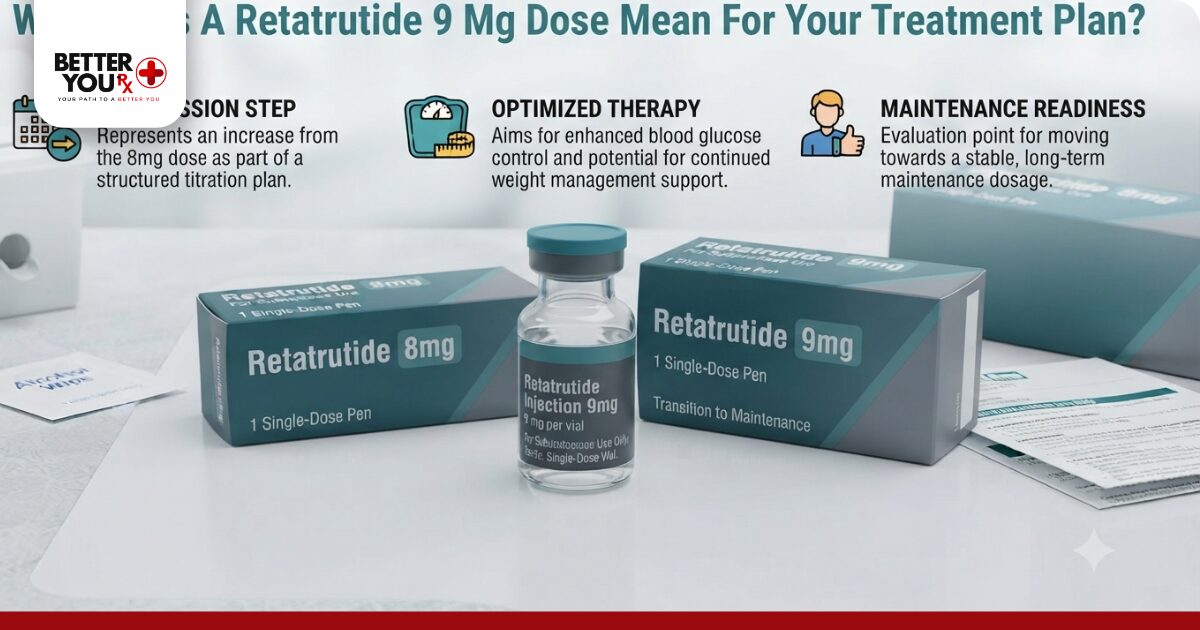
What Does A Retatrutide 9Mg Dose Mean For Your Treatment Plan?

Written by Sarah Collins, Clinical Content Writer | Medically Reviewed by Dr. Amanda Reyes, MD | Last Updated: July 2026

A Retatrutide 9mg dose represents one of the higher points on a typical investigational titration curve, reached only after a patient has moved through several lower stages under medical supervision. It is not a beginner amount, and no responsible provider prescribes it as an initial dose. Understanding where this level fits into a broader treatment timeline helps set realistic expectations for anyone exploring Retatrutide as part of a provider-directed weight management or metabolic health plan.

Key Takeaways

  • A Retatrutide 9mg dose is considered a higher tier within investigational titration schedules and is never a starting point for new patients
  • Reaching this level typically takes several months of gradual, provider-supervised increases from a much lower starting dose
  • Retatrutide remains an investigational compound, meaning dosing decisions are made entirely by a licensed provider based on individual response and tolerability
  • Patients who reach higher dose tiers are usually those who have shown consistent tolerability at lower amounts over multiple titration cycles
  • Working with a provider familiar with GLP-1, GIP, and glucagon receptor compounds helps ensure dose progression happens safely and appropriately

Is A Retatrutide 9Mg Dose Appropriate For Beginners?

No. This amount is not an appropriate starting point for anyone new to the compound. Providers who work with Retatrutide follow a structured titration approach, starting patients at a much lower dose and increasing gradually over a period of weeks to months. The goal of this slow progression is to allow the body to adjust to the compound’s effects on appetite regulation, gastric emptying, and metabolic signaling while minimizing gastrointestinal discomfort and other tolerability concerns.

Because Retatrutide targets three separate receptor pathways, GLP-1, GIP, and glucagon, individual responses can vary more than with single-mechanism compounds like Semaglutide. This is one of the primary reasons providers favor a cautious, incremental approach rather than jumping to a higher tier early in treatment.

Retatrutide 9mg Dose

How A Typical Titration Schedule Progresses

Most provider-directed titration schedules for investigational compounds like Retatrutide follow a similar general pattern, though exact timing and increments are always determined on an individual basis by the prescribing provider.

Titration Stage General Dose Range Clinical Focus
Initial Phase Lowest starting tier Assessing baseline tolerability
Early Titration Low to moderate Monitoring gastrointestinal response
Mid-Range Adjustment Moderate Evaluating appetite and metabolic response
Approaching Higher Tiers Approaching a Retatrutide 9mg dose Confirming sustained tolerability before advancing
Higher Investigational Tiers Upper range, including this level and above Reserved for patients with demonstrated consistency at lower amounts

This table reflects the general shape of a titration curve rather than a fixed protocol, since every patient’s schedule is individualized by their provider based on how they respond at each stage.

Things To Know

  • Reaching this amount is generally the result of multiple prior titration steps, not something achieved within the first few weeks of treatment
  • Tolerability at each lower stage is a key factor providers evaluate before approving any increase
  • Retatrutide is still considered investigational, so dosing frameworks may be refined as more clinical understanding develops
  • Self-directed dose increases are strongly discouraged and dosing should always be managed by a licensed provider
  • Patients working toward higher tiers often report that gradual titration made the adjustment period far more manageable than jumping doses quickly

Why Providers Advance Toward Higher Dose Tiers Gradually

The reasoning behind a slow climb toward the upper end of the titration curve comes down to how the body adapts to compounds that influence multiple metabolic pathways at once. Advancing too quickly can increase the likelihood of nausea, fatigue, or digestive discomfort, which may lead patients to discontinue treatment altogether. A measured pace allows the digestive and metabolic systems to acclimate at each stage, which tends to support better long-term adherence.

Providers also use each titration step as a checkpoint. If a patient experiences ongoing side effects at a lower amount, the provider may extend that stage before considering any further increase. This individualized pacing is part of why no two patients follow an identical timeline toward the higher tiers.

How Providers Decide When A Patient Is Ready

Reaching a Retatrutide 9mg dose is not based on a set calendar. Instead, providers typically consider a combination of factors before recommending an increase, including how well a patient tolerated the previous stage, whether appetite and metabolic markers are trending in the expected direction, and whether any side effects reported at the current stage have resolved.

In clinical practice, providers often observe that patients who progress steadily through lower stages without significant gastrointestinal symptoms tend to tolerate increases toward higher tiers more comfortably than those who experienced ongoing discomfort earlier in treatment. This pattern is one reason providers place such emphasis on patience during the early titration phases rather than rushing toward a higher amount. Most healthcare providers follow established clinical protocols when managing dose progression for investigational compounds, prioritizing patient safety and gradual adaptation over speed.

Patients exploring options such as Mounjaro or Zepbound as part of a broader metabolic health conversation with their provider may find it helpful to compare how titration philosophies differ across compounds, since not every option follows the same dosing structure.

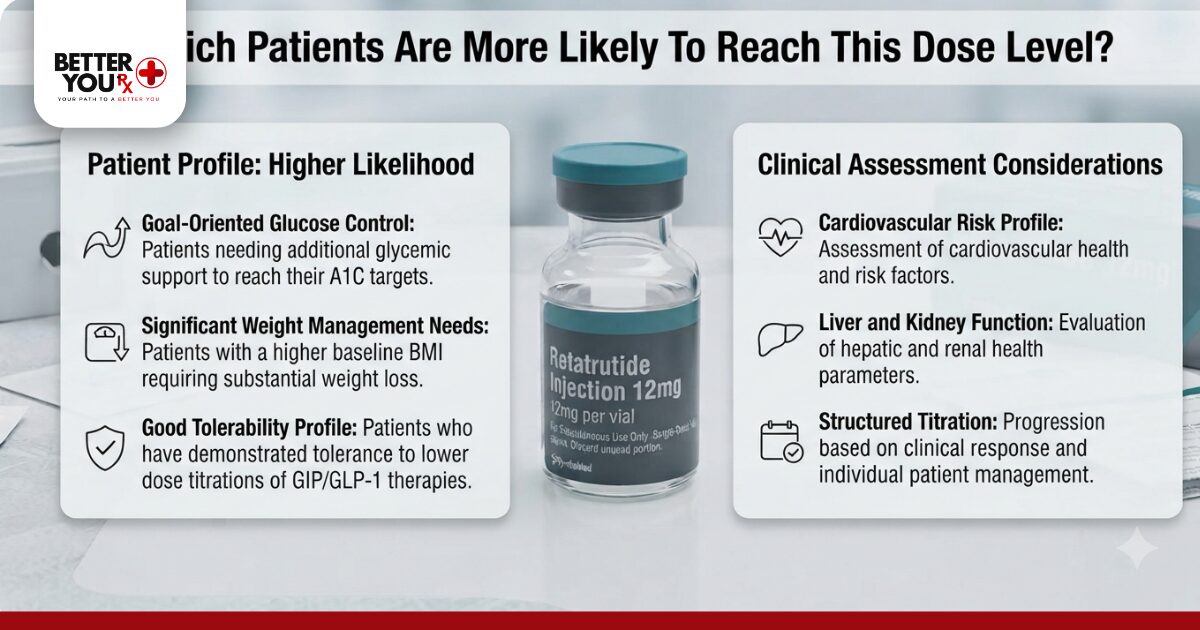
Which Patients Are More Likely To Reach This Dose Level

Not every patient progresses to the higher end of the titration range, and that is by design. Providers reserve these tiers for patients who have demonstrated consistent tolerability and who may benefit from additional metabolic effect based on their individual treatment goals. Patients who experience adequate response at a lower or moderate amount may remain there indefinitely rather than advancing further.

Compound Typical Maintenance Range Primary Mechanism
Retatrutide Varies, with higher investigational tiers reserved for select patients GLP-1, GIP, and glucagon receptor activity
Tirzepatide Provider-determined maintenance range GLP-1 and GIP receptor activity
Semaglutide Provider-determined maintenance range GLP-1 receptor activity

This comparison illustrates why the appropriate amount, and whether a patient should aim toward the upper titration tiers at all, depends heavily on which compound a provider has selected and how that patient’s body responds throughout treatment. There is no universally “best” dose tier, only the one that a provider determines fits a specific patient’s response pattern and health profile.

For readers comparing options more broadly, the difference between Retatrutide and Tirzepatide is worth reviewing, along with a closer look at Retatrutide’s potential benefits and documented Retatrutide side effects, all of which can inform a more productive conversation with a provider.

Common Questions About Dose Progression

Patients often ask whether reaching a higher tier means treatment is “working better,” but that assumption does not always hold true. Some patients achieve strong results at moderate amounts and never need to progress further at all. Others may need the additional tier to see the metabolic response their provider is targeting. Because Retatrutide remains investigational, providers continue to rely on individualized clinical judgment rather than a fixed formula when making these determinations.

Better You Rx works within a prescription referral model, connecting patients with providers and a licensed contracted dispensing department, and does not set or recommend individual dosing decisions, since those determinations always rest with the prescribing provider.

How A Typical Titration Schedule Progresses

Moving Toward The Right Dose For You

Reaching the upper tiers of Retatrutide titration is not a milestone every patient needs to work toward, nor is it a starting point for anyone new to treatment. It represents one stage within a broader, individualized titration process that providers manage carefully based on tolerability, response, and clinical judgment. Patients considering Retatrutide as part of their metabolic health plan benefit most from open, ongoing communication with their provider about how their body is responding at each stage, rather than focusing on a specific number as the end goal.

Anyone exploring related metabolic health options can also review additional resources such as what Retatrutide does in the body or consider options like Saxenda while discussing the full range of provider-directed choices available.

Frequently Asked Questions

Is A Retatrutide 9Mg Dose Considered High?

Yes, it sits in the upper range of typical titration schedules. It is generally reached only after several lower stages and is managed entirely by a provider based on individual tolerability.

How Long Does It Take To Reach This Higher Tier?

Typically several months of gradual titration. The exact timeline depends on how a patient tolerates each preceding stage, and providers adjust pacing individually.

Can Patients Skip Lower Doses To Start Higher?

No, providers do not recommend skipping titration stages. Starting at a higher tier increases the risk of gastrointestinal discomfort and other tolerability issues.

Does Everyone Eventually Reach This Dose Level?

No, many patients remain at lower or moderate doses. Providers only advance patients who show consistent tolerability and a clinical reason to increase further.

Is Retatrutide Approved For General Use?

No, Retatrutide remains an investigational compound. All dosing decisions, including how close a patient may get to a Retatrutide 9mg dose, are made by a licensed provider on a case-by-case basis.

Sources

  1. New England Journal of Medicine — Clinical research on triple-receptor agonist compounds and their metabolic effects.
  2. The Lancet Diabetes & Endocrinology — Peer-reviewed data on GLP-1, GIP, and glucagon receptor co-agonism in metabolic treatment research.
  3. Mayo Clinic — Overview of investigational weight management medications and general dosing principles.
  4. Cleveland Clinic — Patient education resources on GLP-1 and multi-receptor agonist therapies.
  5. Journal of Clinical Endocrinology & Metabolism — Research on titration strategies and tolerability in metabolic compound studies.

Medical Disclaimer: This content is provided for informational purposes only and is not intended as medical advice. It does not replace consultation with a licensed healthcare provider. Anyone considering Retatrutide or any other treatment should speak with a qualified medical professional to determine what is appropriate for their individual health needs before starting, adjusting, or discontinuing any medication.

What Does A Retatrutide 12Mg Dose Mean For Your Treatment Plan?

Written by Sarah Collins, Clinical Content Writer | Medically Reviewed by Dr. Amanda Reyes, MD | Last Updated: July 2026

A Retatrutide 12mg dose represents one of the highest points on a typical investigational titration curve, reached only after a patient has moved through several lower stages under ongoing medical supervision. It is not a beginner amount, and no responsible provider prescribes it as an initial dose. Understanding where this level fits into a broader treatment timeline helps set realistic expectations for anyone exploring Retatrutide as part of a provider-directed weight management or metabolic health plan.

Key Takeaways

  • A Retatrutide 12mg dose sits near the top of investigational titration schedules and is never a starting point for new patients
  • Reaching this level typically takes many months of gradual, provider-supervised increases from a much lower starting amount
  • Retatrutide remains an investigational compound, meaning dosing decisions rest entirely with a licensed provider based on individual response and tolerability
  • Patients who reach the highest dose tiers are usually those who have shown consistent tolerability across multiple earlier titration stages
  • Working with a provider experienced in GLP-1, GIP, and glucagon receptor compounds helps ensure any dose progression happens safely and appropriately

Is A Retatrutide 12Mg Dose Appropriate For Beginners?

No. This amount is not an appropriate starting point for anyone new to the compound. Providers who work with Retatrutide follow a structured titration approach, starting patients at a much lower dose and increasing gradually over a period of months. The goal of this slow progression is to allow the body to adjust to the compound’s effects on appetite regulation, gastric emptying, and metabolic signaling while minimizing gastrointestinal discomfort and other tolerability concerns.

Because Retatrutide targets three separate receptor pathways, GLP-1, GIP, and glucagon, individual responses can vary more than with single-mechanism compounds like Semaglutide. This is one of the primary reasons providers favor a cautious, incremental approach rather than jumping toward the higher end of the titration range early in treatment.

How A Typical Titration Schedule Progresses

Most provider-directed titration schedules for investigational compounds like Retatrutide follow a similar general pattern, though exact timing and increments are always determined on an individual basis by the prescribing provider.

Titration Stage General Dose Range Clinical Focus
Initial Phase Lowest starting tier Assessing baseline tolerability
Early Titration Low to moderate Monitoring gastrointestinal response
Mid-Range Adjustment Moderate Evaluating appetite and metabolic response
Advanced Titration Approaching the upper range Confirming sustained tolerability before advancing
Highest Investigational Tier A Retatrutide 12mg dose and nearby amounts Reserved for patients with demonstrated consistency over time

This table reflects the general shape of a titration curve rather than a fixed protocol, since every patient’s schedule is individualized by their provider based on how they respond at each stage.

Things To Know

  • Reaching this amount is generally the result of many prior titration steps, not something achieved within the first few months of treatment
  • Tolerability at each lower stage is a key factor providers evaluate before approving any further increase
  • Retatrutide is still considered investigational, so dosing frameworks may be refined as more clinical understanding develops
  • Self-directed dose increases are strongly discouraged and dosing should always be managed by a licensed provider
  • Patients working toward the highest tiers often report that gradual titration made the adjustment period far more manageable than jumping doses quickly

Why Providers Advance Toward Higher Dose Tiers Gradually

The reasoning behind a slow climb toward the top of the titration curve comes down to how the body adapts to compounds that influence multiple metabolic pathways at once. Advancing too quickly can increase the likelihood of nausea, fatigue, or digestive discomfort, which may lead patients to discontinue treatment altogether. A measured pace allows the digestive and metabolic systems to acclimate at each stage, which tends to support better long-term adherence.

Providers also use each titration step as a checkpoint. If a patient experiences ongoing side effects at a lower amount, the provider may extend that stage before considering any further increase toward a Retatrutide 12mg dose. This individualized pacing is part of why no two patients follow an identical timeline toward the highest tiers.

How Providers Decide When A Patient Is Ready

Reaching the top of the titration range is not based on a set calendar. Instead, providers typically consider a combination of factors before recommending any further increase, including how well a patient tolerated the previous stage, whether appetite and metabolic markers are trending in the expected direction, and whether any side effects reported at the current stage have resolved.

In clinical practice, providers often observe that patients who progress steadily through lower stages without significant gastrointestinal symptoms tend to tolerate increases toward the higher tiers more comfortably than those who experienced ongoing discomfort earlier in treatment. This pattern is one reason providers place such emphasis on patience during the early titration phases rather than rushing toward a Retatrutide 12mg dose. Most healthcare providers follow established clinical protocols when managing dose progression for investigational compounds, prioritizing patient safety and gradual adaptation over speed.

Patients exploring options such as Mounjaro or Zepbound as part of a broader metabolic health conversation with their provider may find it helpful to compare how titration philosophies differ across compounds, since not every option follows the same dosing structure.

Which Patients Are More Likely To Reach This Dose Level

Not every patient progresses to the highest tier, and that is by design. Providers reserve this level for patients who have demonstrated consistent tolerability across multiple stages and who may benefit from additional metabolic effect based on their individual treatment goals. Patients who experience adequate response at a lower or moderate amount may remain there indefinitely rather than advancing further.

Compound Typical Maintenance Range Primary Mechanism
Retatrutide Varies, with a Retatrutide 12mg dose among the highest investigational tiers GLP-1, GIP, and glucagon receptor activity
Tirzepatide Provider-determined maintenance range GLP-1 and GIP receptor activity
Semaglutide Provider-determined maintenance range GLP-1 receptor activity

This comparison illustrates why the appropriate amount, and whether a patient should aim toward the highest titration tier at all, depends heavily on which compound a provider has selected and how that patient’s body responds throughout treatment. There is no universally “best” dose tier, only the one that a provider determines fits a specific patient’s response pattern and health profile.

For readers comparing options more broadly, the difference between Retatrutide and Tirzepatide is worth reviewing, along with a closer look at Retatrutide’s potential benefits and documented Retatrutide side effects, all of which can inform a more productive conversation with a provider.

Common Questions About Dose Progression

Patients often ask whether reaching the highest tier means treatment is “working better,” but that assumption does not always hold true. Some patients achieve strong results at moderate amounts and never need to progress further at all. Others may need the additional tier to see the metabolic response their provider is targeting. Because Retatrutide remains investigational, providers continue to rely on individualized clinical judgment rather than a fixed formula when making these determinations.

Better You Rx works within a prescription referral model, connecting patients with providers and a licensed contracted dispensing department, and does not set or recommend individual dosing decisions, since those determinations always rest with the prescribing provider.

Retatrutide 12Mg Dose

Moving Toward The Right Dose For You

Reaching a Retatrutide 12mg dose is not a milestone every patient needs to work toward, nor is it a starting point for anyone new to treatment. It represents one stage within a broader, individualized titration process that providers manage carefully based on tolerability, response, and clinical judgment. Patients considering Retatrutide as part of their metabolic health plan benefit most from open, ongoing communication with their provider about how their body is responding at each stage, rather than focusing on a specific number as the end goal.

Anyone exploring related metabolic health options can also review additional resources such as what Retatrutide does in the body or consider options like Saxenda while discussing the full range of provider-directed choices available.

Frequently Asked Questions

Is A Retatrutide 12Mg Dose Considered High?

Yes, it is near the top of typical titration schedules. It is generally reached only after many lower stages and is managed entirely by a provider based on individual tolerability.

How Long Does It Take To Reach This Dose Level?

Typically many months of gradual titration. The exact timeline depends on how a patient tolerates each preceding stage, and providers adjust pacing individually.

Can Patients Skip Lower Stages To Start Higher?

No, providers do not recommend skipping titration stages. Starting near the higher end increases the risk of gastrointestinal discomfort and other tolerability issues.

Does Everyone Eventually Reach This Level?

No, many patients remain at lower or moderate doses. Providers only advance patients who show consistent tolerability and a clinical reason to increase further.

Is Retatrutide Approved For General Use?

No, Retatrutide remains an investigational compound. All dosing decisions, including whether a patient advances toward a Retatrutide 12mg dose, are made by a licensed provider on a case-by-case basis.

Sources

  1. New England Journal of Medicine — Clinical research on triple-receptor agonist compounds and their metabolic effects.
  2. The Lancet Diabetes & Endocrinology — Peer-reviewed data on GLP-1, GIP, and glucagon receptor co-agonism in metabolic treatment research.
  3. Mayo Clinic — Overview of investigational weight management medications and general dosing principles.
  4. Cleveland Clinic — Patient education resources on GLP-1 and multi-receptor agonist therapies.
  5. Journal of Clinical Endocrinology & Metabolism — Research on titration strategies and tolerability in metabolic compound studies.

Medical Disclaimer: This content is provided for informational purposes only and is not intended as medical advice. It does not replace consultation with a licensed healthcare provider. Anyone considering Retatrutide or any other treatment should speak with a qualified medical professional to determine what is appropriate for their individual health needs before starting, adjusting, or discontinuing any medication.

 

Retatrutide Alcohol Interaction: What Happens When You Mix the Two

Medically Reviewed by Dr. Michael Reyes, MD  |  Updated: July 2026

Last Updated: July 27, 2026

A retatrutide alcohol interaction typically shows up as worse nausea, slower digestion, and less predictable blood sugar, rather than a sudden or dangerous reaction. Most people who drink while using Retatrutide notice that side effects they already had, like stomach upset or fatigue, become more noticeable instead of something entirely new appearing.

Retatrutide slows how quickly food and liquid move through the stomach, so alcohol lingers longer than it normally would and its effects can feel stronger and last longer than usual. Blood sugar becomes harder to predict too, since alcohol can push glucose levels in either direction depending on how much is consumed and what else has been eaten. None of this makes an occasional drink automatically off limits, but it does mean the timing, amount, and context matter more than most people assume, especially for anyone still adjusting to treatment.

Key Takeaways

  • A retatrutide alcohol interaction is not a dangerous drug interaction in the traditional sense, but drinking can intensify nausea, slow digestion, and make blood sugar swing more than usual.
  • Retatrutide is still an investigational compound, so any dosing figures discussed in research settings are reference points requiring provider oversight, not a basis for self-directed use.
  • Alcohol and Retatrutide share overlapping side effects, particularly on the stomach and blood sugar, which is why the combination often feels worse than either does alone.
  • Dehydration from alcohol can add to the fatigue and lightheadedness some people already notice while their body adjusts to treatment.
  • Limiting or timing alcohol carefully, in coordination with a prescribing provider, is generally considered more practical than assuming occasional drinking carries no effect at all.

What Happens Physically During a Retatrutide Alcohol Interaction

Retatrutide is a triple agonist being studied for its effects on weight and metabolic health, and like other GLP-1 and GIP related compounds, it slows gastric emptying. That single mechanism explains most of what people notice when alcohol enters the picture. Food and liquid sit in the stomach longer, so alcohol is absorbed more slowly but also stays in the system longer once it is absorbed.

This delayed processing can intensify nausea, which is already one of the more common effects reported during Retatrutide research. A stomach that is already slower than usual does not handle carbonation, sugar, or the irritation alcohol causes to the stomach lining particularly well. Some people describe feeling fuller faster after only a drink or two, along with a heavier, more uncomfortable fullness than they experienced before starting treatment.

Alcohol also affects the liver’s ability to regulate blood sugar, which becomes more relevant when a person is also using a compound that influences insulin and glucagon activity. That overlap is part of why a retatrutide alcohol interaction deserves more attention than people typically give it, even though it is not classified as a dangerous mixing of medications the way certain drug combinations are.

Retatrutide Alcohol Interaction

How Alcohol Can Worsen Common Retatrutide Side Effects

Common Side Effect Why It Happens With Retatrutide How Alcohol Can Make It Worse
Nausea Slower gastric emptying Alcohol irritates the stomach lining and adds to fullness
Fatigue Body adjusting to reduced appetite and intake Alcohol is dehydrating and disrupts sleep quality
Dizziness or lightheadedness Lower food intake and shifting blood sugar Can lower blood sugar further, especially on an empty stomach
Constipation or bloating Slower digestive transit Worsens dehydration, which affects digestion
Heartburn or reflux Delayed stomach emptying Relaxes the muscle that normally keeps stomach acid down

In clinical research settings, participants using Retatrutide are generally advised to moderate alcohol intake rather than eliminate it entirely, since the concern is cumulative discomfort rather than acute danger. Most healthcare providers who work with GLP-1 and GIP related compounds follow established clinical reasoning here: side effects that overlap tend to compound each other, so reducing one variable, in this case alcohol, often makes the other easier to manage.

Things to Know About Retatrutide, Alcohol, and Blood Sugar

  • Retatrutide research dosing figures are reference points used under provider supervision, not a guide for self-directed use, since the compound remains investigational.
  • Alcohol on an empty stomach affects blood sugar more unpredictably than alcohol consumed with food, regardless of what medication someone is taking.
  • People who drink heavily before starting Retatrutide often notice digestive side effects more intensely once treatment begins, since their tolerance baseline shifts.
  • Sugary cocktails or mixers combined with alcohol can create a sharper blood sugar swing than alcohol on its own.
  • Hydration before and after drinking noticeably reduces the next day fatigue that many people already report during treatment.

The Retatrutide Alcohol Interaction and Blood Sugar Risk

Blood sugar is where a retatrutide alcohol interaction becomes most worth paying attention to, particularly for anyone with existing insulin sensitivity or a history of blood sugar swings. Alcohol can initially raise blood sugar, especially sugary drinks, and then cause a drop several hours later as the liver prioritizes processing the alcohol over releasing stored glucose. That delayed drop is what catches people off guard, sometimes hours after the last drink and sometimes overnight.

Risk Factor Why It Increases Blood Sugar Risk
Drinking on an empty stomach Removes the buffering effect food provides against blood sugar swings
Combining alcohol with reduced appetite Less overall food intake means less glucose buffer available
Drinking later in the evening A delayed glucose drop can occur overnight while asleep, when symptoms go unnoticed
History of hypoglycemia or insulin sensitivity Baseline risk is already elevated before alcohol is introduced
Frequent or heavier drinking patterns Cumulative liver strain reduces its glucose regulating efficiency over time

This is one of the clearer reasons providers ask patients to be specific about drinking habits before starting any GLP-1 or GIP related treatment. It is not about restriction for its own sake, it is about giving a provider the full picture needed to flag risk early. Anyone comparing how Retatrutide behaves against a related compound may find Retatrutide vs Tirzepatide useful, since both affect blood sugar regulation through overlapping but distinct pathways.

Hydration, Sleep, and Timing Matter More Than People Expect

Patients navigating both alcohol and Retatrutide side effects often report that hydration status, more than the alcohol itself, determines how rough the next day feels. Alcohol is a diuretic, and Retatrutide already reduces the drive to eat and drink as much throughout the day, so the two together can leave someone more dehydrated than either would alone. That dehydration shows up as headaches, fatigue, and a kind of grogginess that can be mistaken for a medication side effect when it is really a hydration issue compounding an existing one.

According to the Mayo Clinic, alcohol can disrupt the later stages of sleep even when it initially makes someone feel drowsy, which compounds the fatigue some people already experience while adjusting to a new metabolic treatment. Timing alcohol earlier in the evening, drinking water alongside it, and eating something substantial beforehand are simple habits that meaningfully reduce next day symptoms for most people managing both.

For anyone weighing where Retatrutide fits against other GLP-1 options with a longer track record, Ozempic, Wegovy, and Saxenda are among the treatments available through Better You Rx for patients exploring metabolic and weight management support with a licensed contracted dispensing department.

How Alcohol Can Worsen Common Retatrutide Side Effects

Which Option Is Best: Avoiding, Limiting, or Timing Alcohol Around Retatrutide

Three approaches come up repeatedly in patient conversations about alcohol and Retatrutide: avoiding it completely, limiting how much and how often, or timing it more carefully around meals and sleep. Each has a different trade off, and the right one depends heavily on individual health history and how someone’s body has responded to treatment so far.

Why avoiding alcohol works best for some people: Complete avoidance removes the variable entirely, which is especially relevant for anyone with a history of blood sugar instability, significant nausea, or someone still in the early weeks of adjusting to treatment when side effects tend to be strongest. It is the most reliable way to isolate whether symptoms are coming from the medication alone.

How limiting alcohol works for others: For people with a stable response to treatment and no history of blood sugar issues, limiting intake to one drink, consumed with food and spaced apart from other drinks, tends to keep the retatrutide alcohol interaction manageable without eliminating alcohol from someone’s life entirely. This middle ground works best when paired with consistent hydration and never drinking on an empty stomach.

Which option applies best comes down to personal risk factors: timing alcohol earlier in the day, avoiding it close to bedtime, and pairing it with a full meal is the least restrictive option, but it is also the least reliable for people with existing blood sugar concerns, since it manages symptoms without addressing the underlying overlap in how alcohol and Retatrutide affect the liver and stomach. For most people navigating early treatment, a combination of limiting intake and timing it carefully, discussed openly with a prescribing provider, tends to be the most sustainable approach.

Anyone curious about the fuller side effect profile beyond alcohol specifically can review Retatrutide side effects for a more complete picture, and those weighing whether the compound is worth exploring at all may find Retatrutide benefits helpful context.

The Bottom Line on Retatrutide and Alcohol

A retatrutide alcohol interaction is less about acute danger and more about compounding discomfort, particularly around digestion and blood sugar stability. The safest path for most people is treating alcohol as a variable worth discussing openly with a prescribing provider rather than something to navigate alone, especially during the early weeks of treatment when the body is still adjusting.

Betteryourx.com connects patients with a licensed contracted dispensing department as part of a prescription referral service, helping people access GLP-1 and GIP related treatment options alongside clear guidance on how everyday factors like alcohol fit into the bigger picture.

Frequently Asked Questions

Can I drink alcohol while using Retatrutide?

Short answer: Occasional, moderate drinking is generally considered lower risk than frequent or heavy drinking, but it should be discussed with a provider first.

Alcohol can intensify nausea, dehydration, and blood sugar swings that already occur with Retatrutide, so most providers recommend caution rather than a complete prohibition for occasional, moderate use.

Does alcohol make Retatrutide side effects worse?

Short answer: Yes, alcohol commonly intensifies nausea, fatigue, and digestive discomfort already associated with Retatrutide.

Both alcohol and Retatrutide slow digestion and affect the stomach lining, so combining them tends to amplify symptoms that are already present rather than introducing new ones.

How long should I wait to drink after a Retatrutide dose?

Short answer: There is no universally set waiting window, since this depends on individual tolerance and provider guidance.

Most providers suggest waiting until digestive side effects from a given dose have settled and prioritizing food and hydration before introducing alcohol.

Can alcohol cause low blood sugar with Retatrutide?

Short answer: Yes, especially when alcohol is consumed on an empty stomach or later in the evening.

The liver prioritizes processing alcohol over releasing stored glucose, which can cause a delayed blood sugar drop hours after drinking, sometimes overnight.

Is it safe to drink alcohol during the early weeks of starting Retatrutide?

Short answer: Many providers recommend added caution during the early adjustment period, when side effects tend to be strongest.

Waiting until the body has adjusted to initial digestive changes before reintroducing regular alcohol intake tends to make the transition more comfortable.

Medical Disclaimer: This article is for informational purposes only and is not a substitute for professional medical advice, diagnosis, or treatment. Retatrutide remains an investigational compound at the time of writing. Always consult a licensed healthcare provider before starting, stopping, or combining any medication or treatment, including questions about alcohol consumption.

Sources

  • Mayo Clinic: Overview of how alcohol affects sleep quality and overall health.
  • The New England Journal of Medicine: Clinical research on triple agonist compounds and metabolic outcomes.
  • Journal of Clinical Endocrinology and Metabolism: Research on GLP-1 and GIP receptor agonists and glucose regulation.
  • Diabetes Care: Clinical guidance on alcohol consumption and blood sugar management.
  • Obesity Reviews: Research overview on investigational metabolic compounds, including multi-receptor agonists.

Retatrutide Mixing Instructions: What Determines Your Provider’s Protocol

Medically Reviewed by Dr. Priya Nair, MD | Updated: July 2026

Last Updated: July 24, 2026

Retatrutide mixing instructions are not something patients should follow from a blog post or a social media video. Because Retatrutide is still an investigational compound, the exact reconstitution ratio, dosing volume, and preparation steps a provider selects depend on the specific vial concentration, the patient’s titration stage, and clinical judgment, which means there is no single universal protocol to publish.

Key Takeaways

  • Retatrutide mixing instructions vary by vial strength, prescribed dose, and the provider’s titration plan, so no fixed ratio applies to every patient
  • Reconstitution is a clinical step that should be performed or directly supervised by a licensed provider, not self-taught from online sources
  • Vial concentration, diluent volume, and storage handling all influence how a compound is prepared before use
  • Retatrutide remains investigational, and dosing figures referenced online are research points requiring provider oversight, not do-it-yourself targets
  • Providers typically walk patients through preparation during an in-office visit or a supervised telehealth consultation before any at-home use begins

What Retatrutide Mixing Instructions Actually Depend On

Patients searching for Retatrutide mixing instructions are usually hoping for a single, universal answer: a fixed amount of diluent, a fixed number of units to draw. That answer does not exist, and any source offering one identical protocol for every patient should be treated with caution.

Reconstitution protocols are built around several variables that differ from one prescription to the next. The vial’s powder concentration is the starting point, since manufacturers can package the same compound at different strengths. The prescribed dose, which shifts as a patient moves through a titration schedule, changes how much diluted solution is needed per injection. Storage conditions, syringe type, and the interval between reconstitution and first use also factor into what a provider recommends.

This is exactly why generic mixing charts circulating online create more confusion than clarity. A ratio that applies to one vial strength can produce an entirely different concentration in another, and a patient following the wrong chart risks a dosing error that has nothing to do with the medication itself and everything to do with mismatched preparation.

Retatrutide Mixing Instructions

Why Reconstitution Requires Provider Oversight

Reconstitution is the process of converting a lyophilized, or freeze-dried, powder into a liquid solution ready for injection. It sounds mechanical, and in a clinical setting it is a routine step performed daily. The reason it stays in provider hands rather than becoming a home guide is accuracy.

A small miscalculation in diluent volume changes the final concentration of every subsequent dose drawn from that vial. Because Retatrutide is still being studied and does not yet carry standardized consumer labeling the way long-approved medications do, providers rely on current research protocols and manufacturer-specific vial data rather than a fixed public standard. That is a meaningful difference from medications that have years of consistent, standardized home-use instructions behind them.

Providers who prescribe Retatrutide typically walk a patient through the entire preparation process in person or through a supervised telehealth session before the patient ever handles a vial independently. This mirrors how most healthcare providers introduce any new injectable therapy: demonstration first, supervised practice second, independent use only once competency is confirmed.

Factor Why It Changes the Protocol
Vial concentration Different manufacturers or batches may package the compound at different strengths
Titration stage Early low-dose phases require smaller draw volumes than later maintenance phases
Diluent type The specific diluent used affects stability and final solution concentration
Storage timeline How long a reconstituted vial remains stable affects how it should be handled after mixing
Syringe increments Providers select syringe sizes that allow accurate measurement of small volume differences

Things To Know

Patients often assume that because a compound arrives as a powder requiring reconstitution, the process must be identical to other injectable medications they have used before. That assumption is where most confusion starts. Every compound has its own stability profile, its own recommended diluent, and its own handling window once mixed. A protocol that worked for a different medication should never be applied to Retatrutide without direct provider confirmation.

It also helps to know that reconstitution is only one part of a broader preparation and administration plan. Providers typically pair mixing guidance with instructions on storage temperature, injection site rotation, and what to do if a dose looks visibly different than expected, such as cloudiness or discoloration. None of these details are meant to be pieced together from separate sources. A single conversation with a prescribing provider covers all of it at once, which is part of why that conversation is not optional.

Retatrutide Mixing Instructions and the Broader Titration Picture

Retatrutide dosing research generally references figures in the 2 milligram to 12 milligram range across a gradual titration schedule, with providers increasing the dose incrementally over weeks or months. Each step in that schedule can correspond to a different reconstituted concentration, which is another reason mixing instructions are not static.

A patient beginning at a lower research reference point may be working with a more diluted solution than a patient several months into treatment at a higher maintenance dose. Providers recalculate preparation guidance at each titration step rather than expecting one mixing instruction to carry a patient through the entire course of treatment.

Titration Phase General Purpose Who Determines the Protocol
Initial phase Allows the body to adjust with minimal side effects Prescribing provider, based on baseline health and tolerance
Escalation phase Gradually increases dose toward a target level Provider, reassessed at scheduled follow-up visits
Maintenance phase Sustains the dose associated with ongoing research outcomes Provider, adjusted only if clinically indicated

Patients working with a licensed provider through a structured program often report that the biggest source of early anxiety is not the injection itself but uncertainty about preparation. That uncertainty tends to resolve quickly once a provider demonstrates the process directly and answers questions specific to the patient’s own vial and dose, rather than the patient trying to reverse-engineer instructions from unrelated sources.

Why, How, and Which Approach Applies to You

Why does a single set of Retatrutide mixing instructions not exist online. Because vial strength, dose, and titration stage all shift the math, and because the compound’s investigational status means there is no long-standing, standardized consumer protocol the way there is for older, fully approved medications.

How do providers determine the right protocol for an individual patient. They start with the vial’s labeled concentration, confirm the patient’s current titration stage, calculate the diluent volume needed to reach the prescribed dose, and then walk the patient through the physical steps during a supervised session, adjusting as the treatment plan progresses.

Which approach is best for a patient trying to understand their own preparation needs. The only reliable approach is direct, ongoing communication with the prescribing provider rather than relying on general online guidance, since even well-intentioned public information cannot account for the specific vial and dose a particular patient has been prescribed.

Patients interested in how Retatrutide compares to other GLP-1 based options may find it useful to review Retatrutide vs Tirzepatide or explore the broader Retatrutide benefits that research has associated with the compound so far. Understanding Retatrutide side effects alongside preparation questions gives patients a fuller picture before starting any treatment plan.

For patients further along in a GLP-1 treatment journey, or comparing options with a provider, medications such as Mounjaro, Zepbound, and Saxenda are among the approved alternatives providers may discuss depending on individual treatment goals.

Better You Rx operates as a prescription referral service with a licensed contracted dispensing department, connecting patients with providers who can walk through preparation and dosing questions directly rather than leaving patients to interpret mixing instructions on their own.

Why Reconstitution Requires Provider Oversight

Bringing It All Together

Retatrutide mixing instructions cannot be reduced to a single chart because the compound’s investigational status, varying vial concentrations, and individualized titration schedules all shape what a correct protocol looks like for any given patient. The safest and most accurate path forward is a direct conversation with a licensed provider who can confirm the specific numbers that apply to a particular prescription, rather than piecing together guidance from general sources.

What is the correct ratio for Retatrutide mixing instructions?

There is no single correct ratio, since it depends on vial concentration and prescribed dose. A provider calculates this individually for each patient rather than applying a universal number.

Can I follow Retatrutide mixing instructions I found online?

No, general online instructions should not replace provider guidance. Vial strengths and dosing schedules vary, so a mismatched protocol can lead to an inaccurate dose.

Who should perform Retatrutide reconstitution?

A licensed provider should perform or directly supervise the process. This ensures the correct diluent volume and concentration for the specific vial being used.

Does the mixing protocol change during treatment?

Yes, it typically changes as a patient moves through titration phases. Higher maintenance doses often require different preparation than the initial low-dose phase.

Why does Retatrutide not have standardized public mixing instructions?

Because it remains investigational and lacks long-term standardized consumer labeling. Providers rely on current research protocols and vial-specific data instead of a fixed public standard.

Medical Disclaimer: This content is provided for informational purposes only and is not a substitute for professional medical advice, diagnosis, or treatment. Retatrutide is an investigational compound, and any dosing or preparation information referenced here reflects general research context, not individualized medical guidance. Always consult a licensed healthcare provider before starting, adjusting, or preparing any medication.

Sources:

  1. New England Journal of Medicine — Clinical trial data on triple agonist GLP-1/GIP/glucagon receptor compounds, including Retatrutide, and associated metabolic outcomes.
  2. The Lancet — Peer-reviewed research on investigational incretin-based therapies and phased dose-escalation study designs.
  3. Mayo Clinic — Patient education overview of injectable medication preparation, reconstitution principles, and provider-supervised administration.
  4. Journal of Clinical Endocrinology and Metabolism — Research on titration protocols and safety monitoring for GLP-1 receptor agonist therapies.
  5. American Diabetes Association Clinical Guidelines — Established clinical framework for provider-directed injectable therapy initiation and dose adjustment.


What Determines Retatrutide Syringe Type In A Treatment Plan?

Medically Reviewed by Dr. Amanda Reyes, MD | Last Updated: July 2026

Retatrutide syringe type is determined by the prescribing provider and the licensed contracted dispensing department handling a patient’s treatment, based on the prescribed dose and formulation rather than patient preference. Since Retatrutide remains an investigational compound, every detail of how it is dispensed and administered is handled within a structured, provider-directed process. Understanding who makes these decisions, and why, helps set realistic expectations for anyone moving through a Retatrutide-based treatment plan.

Key Takeaways

  • Retatrutide syringe type is selected by a prescribing provider and licensed contracted dispensing department, not chosen independently by patients
  • Syringe selection depends on factors like prescribed dose, formulation, and delivery method determined during the prescribing process
  • Patients never handle reconstitution or draw-up steps themselves; all administration specifics are managed within the referral and dispensing process
  • General medical syringe types vary by volume and gauge, though the specific syringe type used in any treatment is a clinical decision, not a patient choice
  • Questions about administration supplies should always go to the prescribing provider or dispensing team, not general product research

Why Syringe Selection Is Not A Patient Decision

Syringe type, much like dose and titration schedule, falls under the clinical decisions a provider and dispensing team make together rather than something a patient selects independently. Because Retatrutide is investigational, the entire administration process, including anything related to syringe type or delivery format, is coordinated through the prescribing provider and the licensed contracted dispensing department fulfilling that prescription.

This structure exists to reduce error and ensure consistency. A provider considers the prescribed dose, the formulation dispensed, and general delivery requirements before any administration supply decision is finalized. Patients are not expected to research or select this information on their own, and are always encouraged to direct supply or administration questions to their care team rather than general sources.

Retatrutide Syringe TypeGeneral Syringe Types Used In Medical Settings

Outside the context of any specific medication, syringes generally fall into a few broad categories based on their construction and typical use. This is general medical background information and is not intended as guidance for self-administering Retatrudide or any other specific medication.

Syringe Type Common Volume Range Typical General Use
Insulin Syringe Small volume, fine gradations Precise small-volume dosing in diabetes management
Standard Hypodermic Syringe Small to moderate volume General injectable medication administration
Oral/Dosing Syringe Variable volume, no needle Measuring liquid oral medications

The specific syringe type used for any patient’s Retatrutide treatment is determined separately by the prescribing provider and dispensing department, and is not something this general breakdown is meant to apply to directly.

Things To Know

  • Retatrutide syringe type is one of several administration details coordinated entirely between the prescriber and dispensing department
  • Patients are not expected to select or source their own administration supplies independently
  • Because Retatrutide is investigational, protocols around dispensing and delivery may be refined as clinical understanding develops
  • Questions about syringe type or supplies should always be directed to the prescribing provider or dispensing team, not general online research
  • Providers commonly report that patients feel more confident in their treatment plan once they understand which decisions are handled clinically versus which are part of general patient education

How Providers And Dispensing Teams Coordinate This Process

In clinical practice, the prescribing provider communicates the prescribed dose and formulation to the licensed contracted dispensing department, which then prepares the prescription according to that order. Any detail related to Retatrutide syringe type is part of this internal coordination rather than something communicated to patients as a decision point they need to make.

Most healthcare providers follow established clinical protocols when coordinating with dispensing teams, prioritizing consistency and patient safety over individual preference in these administration-related decisions. Patients typically report feeling reassured once they understand this coordination happens behind the scenes, rather than being something they need to manage or research independently.

Patients exploring Retatrutide as part of a broader metabolic health conversation may also want to review how it compares with other options like Mounjaro or Zepbound, since delivery formats and provider protocols can differ meaningfully between compounds.

Why This Structure Matters For Investigational Compounds

Because Retatrutide has not completed the same regulatory pathway as long-established medications, providers and dispensing departments take a more structured approach to every detail of a patient’s treatment, including anything connected to Retatrutide syringe type. This is part of a broader pattern seen across newer GLP-1, GIP, and glucagon receptor compounds, where dispensing protocols are still being refined as clinical experience grows.

This structured approach is one reason patients are not given independent instructions on administration supplies. Instead, the prescribing provider and dispensing department manage these details as part of the overall treatment plan, updating their internal protocols as needed based on evolving clinical guidance.

For a broader understanding of how Retatrutide compares to other established options, Retatrutide vs Tirzepatide and what Retatrutide does in the body offer useful context, alongside a closer look at Retatrutide side effects for patients building a fuller picture before starting treatment.

Working With Better You Rx’s Referral Process

Better You Rx operates as a prescription referral service connecting patients with providers and a licensed contracted dispensing department. Within this process, any decision tied to Retatrutide syringe type, dose, or delivery format is handled entirely by the prescriber and dispensing team, not by the patient or by general product research. Patients are encouraged to bring any supply-related questions directly to their care team during the referral process.

Patients interested in related treatment options can also review Saxenda as part of a broader conversation with their provider about which metabolic health path fits their individual needs.

General Syringe Types Used In Medical Settings

Bringing It All Together

Retatrutide syringe type is a clinical detail managed entirely by the prescribing provider and licensed contracted dispensing department, not a decision patients need to research or make independently. Understanding this distinction helps patients focus their attention on the parts of treatment that matter most to them, like communicating openly with their provider about tolerability and response, while trusting that administration logistics are being handled with appropriate clinical oversight.

Frequently Asked Questions

What Are The Three Types Of Syringes?

Insulin, standard hypodermic, and oral dosing syringes are the three general categories. Each differs by volume range and typical use, though specific medication syringe types are always determined by a prescriber.

Who Determines The Syringe Type Used For Retatrutide?

The prescribing provider and dispensing department make this decision together. It is based on the prescribed dose and formulation, not patient preference.

Does Syringe Type Affect How Retatrutide Is Stored?

Storage requirements are determined separately by the dispensing department. Patients receive specific storage guidance directly from their care team rather than general sources.

Is Syringe Type The Same For Every Retatrutide Dose?

Not necessarily, since dose and formulation can vary by patient. The dispensing department adjusts administration details according to each individual prescription.

Can Patients Request A Specific Syringe Type?

Any such request should go through the prescribing provider. Final decisions depend on clinical appropriateness rather than patient preference alone.

Sources

  1. New England Journal of Medicine — Clinical research on triple-receptor agonist compounds and their metabolic effects.
  2. The Lancet Diabetes & Endocrinology — Peer-reviewed data on GLP-1, GIP, and glucagon receptor co-agonism in metabolic treatment research.
  3. Mayo Clinic — Overview of investigational weight management medications and general dosing principles.
  4. Cleveland Clinic — Patient education resources on GLP-1 and multi-receptor agonist therapies.
  5. Journal of Clinical Endocrinology & Metabolism — Research on titration strategies and administration protocols in metabolic compound studies.

Medical Disclaimer: This content is provided for informational purposes only and is not intended as medical advice. It does not replace consultation with a licensed healthcare provider. Anyone considering Retatrutide or any other treatment should speak with a qualified medical professional regarding dosing, administration, and supplies before starting, adjusting, or discontinuing any medication.


Sign Up For Newsletter

Please enable JavaScript in your browser to complete this form.

Join 60.000+ Subscribers and get a new discount coupon on every Saturday.

Address

PO Box 29631, Mississauga RPO Central Parkway, ON L5A 4H2

Phone Number

1-647-576-2076

better you rx big letter logo

Discover convenience with Better You Rx, your trusted pharmacy-affiliated partner. We work with leading pharmacies to deliver prescriptions and over-the-counter medications right to your doorstep. Enjoy cost-effective solutions on a platform that’s easy to use. We focus on safety and efficacy in all products. Our dedicated team ensures a smooth experience. From ordering to delivery, we simplify your healthcare needs. Choose Better You Rx for reliable service and expert support. Trust us for all your medication requirements. Experience the ease of modern pharmacy care.

Categories

Operating Hours: 
10:00AM – 6:00PM CST
Monday – Friday

Our Payment Partners :

Copyright © 2026 BetteryouRX. All Rights Reserved.
Join The Waitlist Be among the first to know when becomes available.
Add to cart