
What Does A Retatrutide Weekly Injection Schedule Look Like?

Written by Sarah Collins, Clinical Content Writer | Medically Reviewed by Dr. Amanda Reyes, MD | Last Updated: July 2026
A Retatrutide weekly injection schedule means administering one injection every week, on a day that stays fairly consistent from week to week, with the specific amount set and adjusted by a provider based on tolerability and progress. This once-weekly rhythm is common across several investigational and approved metabolic compounds, and it exists to keep blood levels steady rather than causing the peaks and dips that more frequent dosing can create. Understanding how this weekly pattern works, and why consistency matters more than the exact day chosen, helps patients build a routine that supports their broader treatment plan and reduces unnecessary guesswork week to week.
Key Takeaways
- A Retatrutide weekly injection schedule involves one injection per week, with the amount determined and adjusted by a provider over time
- Consistency in timing each week matters more than the exact day or hour chosen, since a stable weekly rhythm supports steadier results
- Retatrutide remains an investigational compound, so injection amounts follow an individualized titration path rather than a fixed public standard
- Missing an occasional dose does not automatically undo progress, but any changes to the schedule should be discussed with a provider
- Working with a provider familiar with GLP-1, GIP, and glucagon receptor compounds helps ensure the weekly routine stays safe and appropriate

Why Retatrutide Follows A Weekly Rather Than Daily Pattern
The once-weekly design behind a Retatrutide weekly injection schedule comes down to how the compound is metabolized in the body. Compounds built for weekly administration are formulated to release gradually, maintaining a steady level of activity across receptor pathways for several days at a time. This is different from medications that need to be taken daily to maintain consistent effects, and it is part of why weekly dosing has become a common format across several newer metabolic treatments.
Because Retatrutide acts on three separate receptor pathways, GLP-1, GIP, and glucagon, a steady weekly rhythm helps avoid the kind of fluctuation that could otherwise affect tolerability. Providers generally recommend picking a day of the week that fits naturally into a patient’s routine, since a predictable pattern makes it easier to remember and reduces the chance of accidentally skipping a dose. Choosing a day tied to an existing weekly habit, such as meal prep on Sundays or a weekly grocery run, often works better than picking a day arbitrarily.
There is also a practical benefit to the weekly format beyond convenience. Because each dose is designed to remain active over several days, small variations in exact timing, injecting a few hours earlier or later than usual, tend to have far less impact than they would with a medication that needs to be taken at precise daily intervals. This built-in flexibility is one of the reasons providers describe the weekly structure as more forgiving for patients juggling busy schedules.
A Sample Weekly Structure
While the exact amount and timing of any Retatrutide weekly injection schedule is always determined individually by a provider, the general weekly structure tends to follow a consistent shape.
| Weekly Element | General Guidance | Why It Matters |
| Injection Frequency | Once every seven days | Maintains steady receptor activity between doses |
| Day Selection | Same day each week | Reduces the chance of missed or delayed doses |
| Time of Day | Consistent, but flexible | Supports habit formation rather than strict timing |
| Amount | Set and adjusted by provider | Based on tolerability and titration stage |
| Site Rotation | Rotating injection sites weekly | Supports skin comfort and consistent absorption |
This structure reflects general practice rather than a fixed protocol, since the specific amount and any adjustments to timing are always guided by the prescribing provider based on individual response. Some patients settle into this rhythm within the first few weeks, while others take a bit longer to find a day and time that consistently works with their schedule, and that adjustment period is entirely normal.
Things To Know
- A Retatrutide weekly injection schedule works best when the same general day is used consistently, even if the exact hour shifts slightly
- Rotating injection sites each week, such as alternating between the abdomen, thigh, and upper arm, can support comfort and more consistent absorption over time
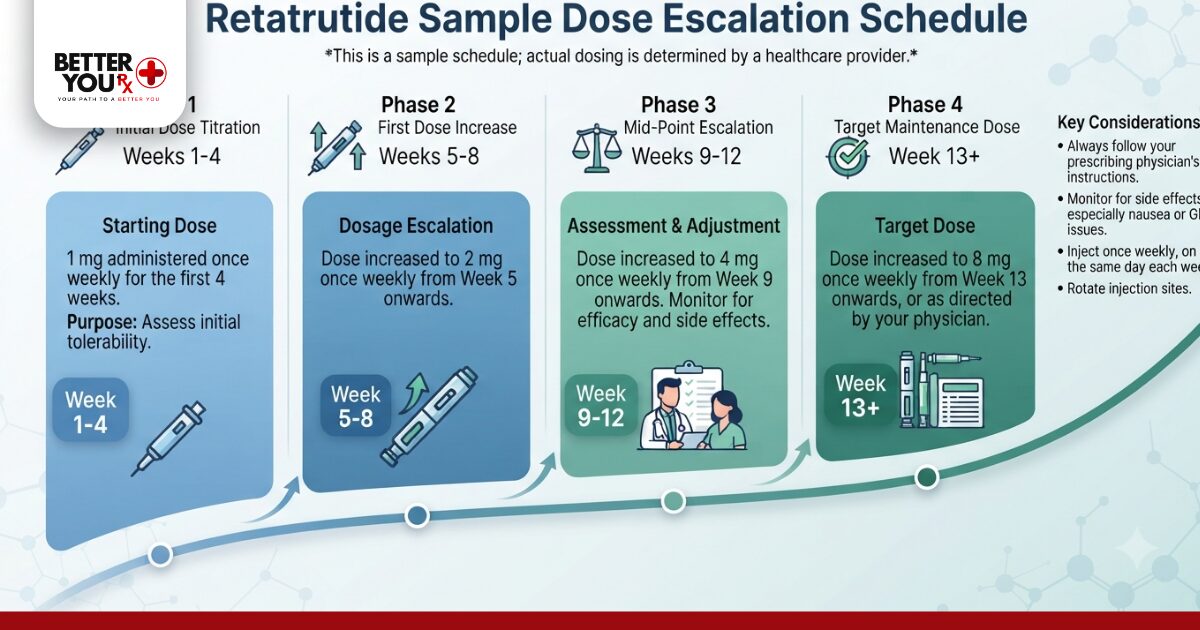
- The amount injected each week is set by a provider and typically increases gradually during titration, not on a fixed weekly basis
- Occasional questions about timing, storage, or technique are common and worth bringing directly to a provider rather than guessing
- Patients who keep a simple weekly log of injection day and any side effects often find it easier to have productive conversations with their provider at follow-up visits
- Storing supplies in a consistent, visible location can reduce the chance of a missed dose simply due to forgetfulness
How Providers Approach Timing And Consistency
Providers generally emphasize that the specific day chosen for a Retatrutide weekly injection schedule matters less than sticking with that day consistently. A patient who injects every Sunday morning, for example, is building a routine that is easy to remember and track, which in turn makes it easier to notice if a dose has been missed or delayed.
In clinical practice, providers often observe that patients who anchor their injection to an existing weekly habit, such as a specific morning routine or a recurring day off work, tend to maintain their schedule more reliably than those who try to inject at a different time each week. This small structural choice can meaningfully reduce the number of missed or delayed doses over the course of a longer titration period. Most healthcare providers follow established clinical protocols when guiding patients on injection timing, prioritizing steady adherence over strict precision to the hour.
Patients exploring related options such as Mounjaro or Ozempic may notice that weekly dosing patterns are common across several metabolic compounds, though each has its own specific guidance that a provider will tailor to the individual. Some patients transitioning between compounds ask whether the weekly day needs to change, and this is another detail best confirmed directly with a provider rather than assumed.
What Happens If A Dose Is Delayed Or Missed
Life occasionally interferes with even the most consistent weekly routines, and providers generally have specific guidance for what to do if a dose within a Retatrutide weekly injection schedule is delayed by a day or two versus missed entirely. In many cases, a brief delay can be managed by administering the dose as soon as it is remembered, then resuming the regular weekly day going forward. A longer gap may call for a different approach, depending on how much time has passed and where the patient is in their titration process.
Because these situations depend heavily on individual circumstances, providers strongly discourage guessing or making adjustments independently. A quick conversation with a provider or their care team is generally the safest way to handle a missed or delayed dose, rather than assuming the same guidance that applies to another medication or another patient’s situation applies universally. Travel, illness, and simple forgetfulness are among the most common reasons patients report a missed or delayed dose, and providers are generally well prepared to help patients get back on a steady schedule without unnecessary worry.
-
-
Buy Wegovy from Canada
Original price was: $609.99.$596.99Current price is: $596.99.



Comparing Weekly Dosing Across Compounds
Several metabolic compounds share a similar weekly injection structure, though the specific amounts, titration pace, and individual guidance differ across each option.
| Compound | Injection Frequency | Primary Mechanism |
| Retatrutide | Once weekly, provider-determined amount | GLP-1, GIP, and glucagon receptor activity |
| Tirzepatide | Once weekly, provider-determined amount | GLP-1 and GIP receptor activity |
| Semaglutide | Once weekly, provider-determined amount | GLP-1 receptor activity |
This comparison shows that while the weekly rhythm itself is fairly consistent across these compounds, the appropriate amount and the pace of any increases depend entirely on which compound a provider has selected and how an individual patient responds. There is no universal weekly amount that applies across compounds or patients, only the specific plan a provider builds around one person’s needs.
For readers researching related topics, comparing Retatrutide and Tirzepatide or reviewing documented Retatrutide side effects can add helpful context before a provider conversation, along with a closer look at Retatrutide’s potential benefits for patients weighing their overall options.

Building A Routine That Supports The Full Treatment Plan
A Retatrutide weekly injection schedule works best when it fits naturally into a patient’s broader week rather than feeling like an extra task to remember. Many patients find it helpful to pair the injection with an existing habit, keep supplies stored in a visible and consistent location, and note the injection date somewhere easy to reference, whether that is a phone reminder or a simple paper calendar.
Beyond the injection itself, a supportive weekly routine often includes checking supply levels ahead of time, confirming the next injection site rotation, and briefly noting how the previous week felt in terms of appetite, energy, or any mild digestive symptoms. This kind of light, ongoing tracking gives both the patient and provider useful information without requiring extensive daily effort.
Better You Rx works within a prescription referral model, connecting patients with providers and a licensed contracted dispensing department, and does not set or recommend individual dosing schedules, since those decisions always rest with the prescribing provider based on each patient’s specific circumstances.
Practical Tips For Staying Consistent Week To Week
Small habits tend to make the biggest difference in maintaining a reliable Retatrutide weekly injection schedule over the long term. Setting a recurring phone reminder for the chosen injection day, rather than relying on memory alone, is one of the simplest ways patients avoid accidental delays. Keeping an extra alcohol swab and a sharps container within easy reach of the storage location also removes small friction points that can otherwise turn a quick weekly task into something patients put off.
Some patients find it useful to link their injection to a specific weekly event they already track, such as a recurring calendar appointment, a weekly grocery trip, or a regular check-in with a workout partner. Anchoring the injection to something already happening on a predictable day tends to work better than trying to remember an isolated task in the middle of a busy week. Providers often ask about these small logistical details during early follow-up visits, since patients who have a workable system in place from the start tend to have fewer questions about missed or delayed doses later in treatment.
Travel and schedule changes are among the most common disruptions to a weekly routine. Patients who plan ahead before a trip, confirming storage requirements and packing supplies with enough buffer time, generally avoid the scramble of trying to figure out logistics at the last minute. A provider can offer specific guidance on how to handle travel across time zones or extended trips where the usual weekly day might shift slightly.
Keeping The Weekly Routine On Track
A consistent Retatrutide weekly injection schedule is one of the simpler parts of an overall treatment plan to manage once a routine is established, but it still benefits from attention to timing, site rotation, and open communication with a provider about any missed doses or side effects. Patients who treat their weekly injection as a fixed part of their routine, rather than an afterthought, tend to report a smoother overall experience with fewer surprises along the way.
Anyone exploring related metabolic health resources can also review what Retatrutide does in the body or consider other provider-directed options such as Saxenda while discussing the full range of choices available for a personalized plan.
Frequently Asked Questions
How Many Times Should I Inject Retatrutide A Week?
Once per week is the standard pattern. The specific amount and day are set by a provider as part of an individualized titration plan.
How Many Units A Week Of Reta?
This varies entirely by individual titration stage. A provider determines the exact amount based on tolerability and treatment goals, so there is no single standard unit count.
How Much Weight Can I Lose In 4 Weeks On Retatrutide?
Results vary significantly between individuals. Early titration stages are focused on tolerability rather than maximum effect, and a provider can offer more specific guidance based on an individual’s plan.
Can I Skip A Week Of Retatrutide?
This should be discussed with a provider rather than decided independently. Guidance on delayed or missed doses depends on individual titration stage and timing.
Is 2Mg Of Retatrutide Enough?
This depends entirely on the individual patient and provider’s plan. What is considered adequate varies based on tolerability, response, and treatment goals.
Sources
- New England Journal of Medicine — Clinical research on triple-receptor agonist compounds and their metabolic effects.
- The Lancet Diabetes & Endocrinology — Peer-reviewed data on GLP-1, GIP, and glucagon receptor co-agonism in metabolic treatment research.
- Mayo Clinic — Overview of investigational weight management medications and general dosing principles.
- Cleveland Clinic — Patient education resources on GLP-1 and multi-receptor agonist therapies.
- Journal of Clinical Endocrinology & Metabolism — Research on titration strategies and injection administration in metabolic compound studies.
Medical Disclaimer: This content is provided for informational purposes only and is not intended as medical advice. It does not replace consultation with a licensed healthcare provider. Anyone considering Retatrutide or any other treatment should speak with a qualified medical professional to determine what is appropriate for their individual health needs before starting, adjusting, or discontinuing any medication.






 The Bottom Line on Retatrutide Exercise Recommendations
 How Patients Can Prepare for a Conversation About Escalation




 Comparing This Level to Lower Studied Amounts